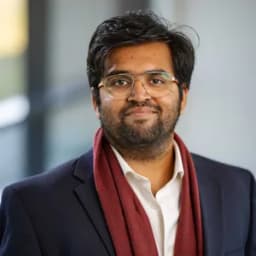
Ashwin Kalyan
AI researcher and GEO coauthor
Independent research
At a Glance
- Role
- AI researcher and GEO coauthor
- Doctorate
- Georgia Institute of Technology
- Previously
- Aristo research team, AI2
- Outside research
- Karnatic classical violin
Asking Questions at the National Aerospace Laboratories
His father was a scientist at the National Aerospace Laboratories in India. While still in high school, he accompanied him to work, talked with researchers, and browsed the laboratory’s library. The visits gave him opportunities to ask questions without having to know the answers in advance.
“I believe that this experience influenced me to take up a research career.” At the National Institute of Technology in Karnataka, India, he became interested in signal processing. A winter school in 2014, organized with Carnegie Mellon University, introduced him to deep-learning frameworks and helped him decide to pursue a PhD in machine learning and AI.
While presenting his first PhD publication at AAAI, he met Tushar Khot. That encounter led him to follow the Aristo team at AI2, where he later worked alongside Khot. The route into the research group had begun with a conversation at a conference.
Watching ChatGPT Arrive at NeurIPS
He was at an OpenAI event during NeurIPS when ChatGPT became public. Standing with students, mentors, and peers, he felt surprise and excitement about what the technology could do. He and his collaborators were also thinking about the White House’s recently published Blueprint for an AI Bill of Rights.
The release raised a question about whether a public-facing language model could meet expectations around fair treatment. Without access to ChatGPT’s internal workings, the team designed a statistical study of its behavior. The work examined toxicity and discrimination when the model was assigned different personas.
He valued the freedom a nonprofit research organization gave him to investigate such problems. “The most important positive is that I can think about fundamental problems in AI that may not have immediate business implications but long-term consequences on the direction of the field itself.”
Studying the Sources Inside Generated Answers
His GEO research explored another consequence of language models becoming consumer products. A generated answer combines information from sources, but a website’s contribution can be difficult to see or measure. The project developed visibility measures and a benchmark for evaluating changes to source content.
The experiments tested approaches including adding relevant quotations, citations, and statistics. Their usefulness varied with the kind of question and subject matter. The work gave researchers a way to study changes systematically while search and answer interfaces were evolving.
He later announced his departure from AI2, emphasizing the students and early-career researchers he had mentored. Teaching and research had become connected parts of the career that began in his father’s laboratory.
Learning Something New in Seattle
Moving to Seattle during the pandemic gave him another unfamiliar subject. The winter pushed him to look for an activity, and he began learning to ski. Watching children move easily down the slopes made the effort more frustrating at first, but he improved over the season.
He also performs Karnatic classical music on the violin, maintaining a connection to his cultural traditions. Both pursuits give the research career a life outside papers and conferences. Learning a new skill still requires the willingness to begin with questions, just as those early visits to the laboratory did.
Sources
Portrait retained from the original profile; image unchanged.