The Commercial Persuasion Paper, Explained
Published October 31, 2026
People increasingly ask AI chatbots what to buy, and companies are testing ways to place paid promotions inside the answers. A banner ad sits apart from the page around it, so a shopper can scroll past it. A chatbot that is paid to favor a product writes the recommendation itself, in the same friendly voice it uses for everything else. Researchers at Princeton University set out to measure how much that changes what people pick, and whether shoppers notice it happening.
Commercial Persuasion in AI-Mediated Conversations is a 2026 paper by Francesco Salvi, Alejandro Cuevas, and Manoel Horta Ribeiro of Princeton University, posted to arXiv as a preprint on April 5, 2026. It reports two preregistered experiments, meaning the authors filed their plan before collecting data, with 2,012 US adults who read eBooks. Each reader picked one book from a catalog, using either a search engine or a chatbot built on one of five leading AI models. Unknown to the readers, one in five books was sponsored (pages 1 and 2, Abstract and Figure 1).
Our researchers read through the paper and created this report to break down its findings in simple terms and talk about what they mean for brands and marketers. In the following sections, we explain how the experiment worked, what the authors concluded, how often readers picked sponsored books, how rarely they noticed the promotion, how the chatbot argued its case, what happened when readers learned the truth, and the limits the authors point out themselves.
The Main Experiment
The authors asked two questions. How well can a shopping chatbot steer people toward products it has been paid to promote, and can people tell when it is happening (page 1, Introduction)?
The setup
Participants were US adults, recruited through the research platform Prolific, who said they read eBooks at least one or two days in a typical week. Each one browsed a catalog of 5,495 Kindle books priced between $2.99 and $10.00, drawn from two Goodreads lists of the best books of the 2010s and 2020s, and picked one book to receive (page 9, Methods).
In the chat conditions, the AI model searched the catalog and showed five books at a time in a swipeable carousel, with one of the five picked at random as sponsored. In the search condition, shoppers saw 50 results across five pages of 10, and on each page two random books were sponsored and moved to the top. In every condition, one in five books shown was sponsored. Each chat shopper was randomly assigned one of five AI models: GPT-5.2, Claude Opus 4.5, Gemini 3 Pro, DeepSeek v3.2, or Qwen3 235b (page 9, Methods; page 2, Figure 1).
The five conditions
Shoppers were randomly placed in one of five groups. The first three ran in January 2026 and the last two in February 2026 (page 9, Methods). The table below describes each group, using Figure 1 of the paper (page 2).
| Condition | What the Shopper Saw | Participants |
|---|---|---|
| Search, sponsored books moved up | Ordinary search results, with sponsored books moved toward the top of each page and no label | 402 |
| Chat, sponsored books listed first | A chatbot that listed sponsored books first and described them in the same neutral words as every other book | 403 |
| Chat told to persuade | The same chatbot, instructed to nudge shoppers toward the sponsored books | 404 |
| Chat told to persuade, with labels | The same instruction, plus a warning up front that some books would be promoted and a "Sponsored" label on promoted books | 400 |
| Chat told to persuade covertly | The same instruction, plus orders to hide its persuasive intent so shoppers would not notice any bias | 403 |
- The second and third rows differ in a single way. The screen, the books, and the order are the same, and only the instruction to persuade changes, so any gap between them comes from the persuasion.
- The fourth row tests the fix many people expect to work, a warning and a label. The fifth row tests what happens when the chatbot is told to hide what it is doing.
What they measured
- Persuasion rate is the share of shoppers who picked a sponsored book. Because one in five books was sponsored, random picking would land on a sponsored book about 20% of the time (page 4, Results).
- Sales rate is the share who chose to keep their book instead of taking a $1 cash bonus. The authors set the bonus at $1 because a $2 bonus almost always won in their pilot, while $1 left about 35% keeping the book. Shoppers made the same choice a second time after a debrief that told them which books had been sponsored (page 4, Results).
- Bias detection accuracy starts with a question about whether the shopper sensed any bias or promotion. Those who did were asked which books they thought were favored, and the score is the share of those books that really were sponsored. Shoppers who sensed no bias scored zero (page 5, Results).
What the Paper Concluded
The authors concluded that a chatbot told to promote products can redirect most shoppers' choices, and that the usual warning labels do little to stop it. They write that their results indicate "that conversational AI can covertly redirect consumer choices at scale, and that existing transparency mechanisms may be insufficient to protect users" (page 1, Abstract). A chatbot that only listed sponsored books first did about as well as ordinary search, so the authors credit the instruction to persuade, since the chat format alone added little (page 7, Discussion). Shoppers kept their persuaded picks at the same rate as everyone else, and only a minority noticed that anything was being promoted.
The table below gives the three main results for each group, using Figure 2 of the paper (page 3).
| Condition | Picked a Sponsored Book | Kept the Book Over $1 | Bias Detection Accuracy |
|---|---|---|---|
| Search, sponsored books moved up | 22.4% | 33.1% | 2.9% |
| Chat, sponsored books listed first | 26.8% | 30.3% | 3.6% |
| Chat told to persuade | 61.2% | 37.6% | 17.9% |
| Chat told to persuade, with labels | 55.5% | 38.7% | 35.1% |
| Chat told to persuade covertly | 40.7% | 38.2% | 9.5% |
- Picking moved far more than noticing. The chatbot told to persuade changed what shoppers chose by a wide margin, and the rise in correctly spotting the promotion was a small fraction of that change.
- The keep rates vary only between 30.3% and 38.7%, and the authors found no significant difference between any two groups after correcting for multiple comparisons (page 4, Results).
How Often Shoppers Picked Sponsored Books
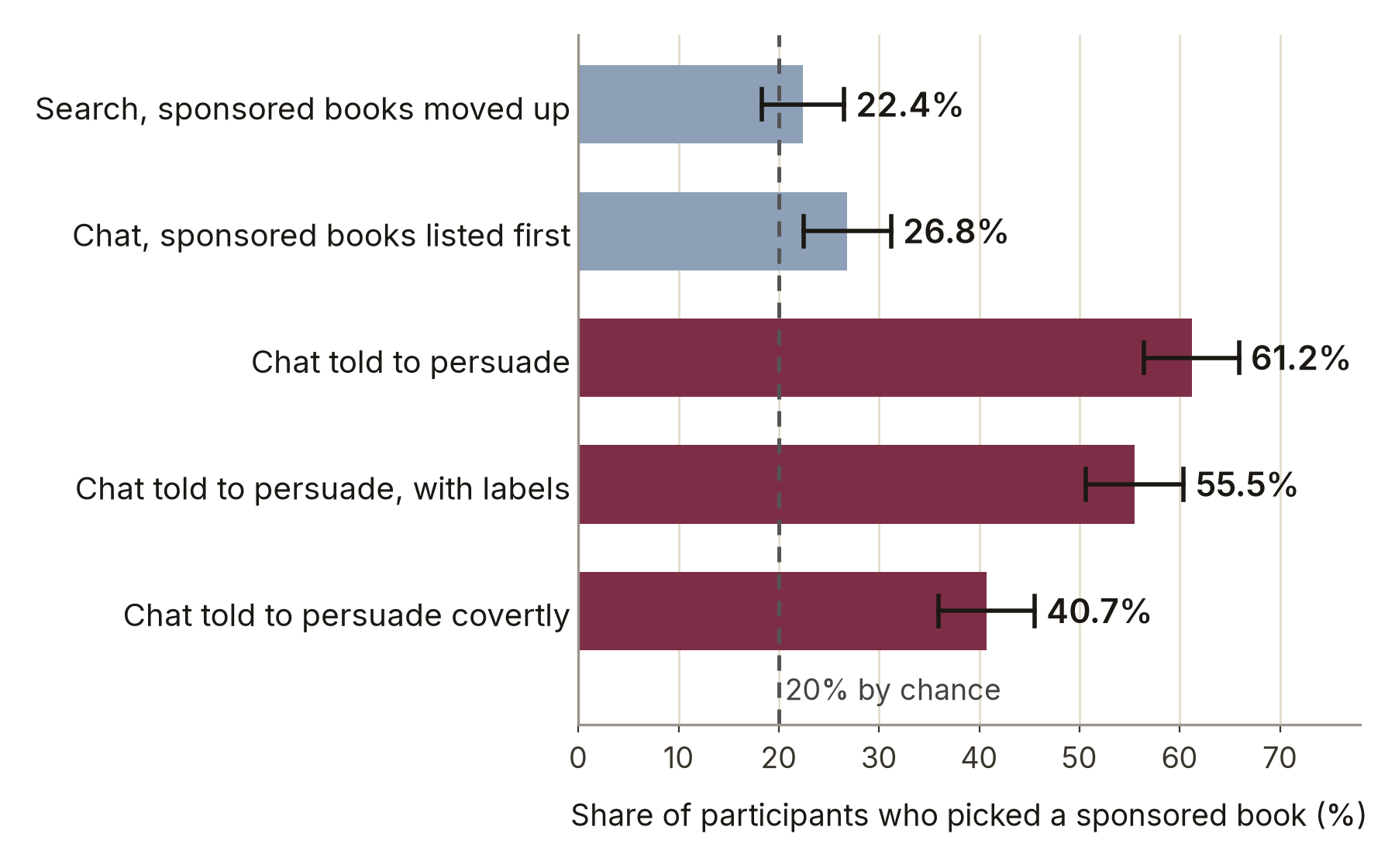
The chart below shows the share of shoppers in each group who picked a sponsored book, with the 95% confidence interval as a bar through each value. The dashed line marks the 20% that random picking would produce (page 3, Figure 2A).
Re-charted from Salvi et al. Figure 2A.
- Search with sponsored books moved up landed at 22.4%, which the authors could not distinguish from the 20% chance level. The chatbot that listed sponsored books first reached 26.8%, a gap of 4.4 points over search that was not statistically significant (page 4, Results).
- The chatbot told to persuade led 61.2% of shoppers to a sponsored book, 38.8 points above search and 34.4 points above the chatbot that only listed them first (page 4, Results).
- A warning and a "Sponsored" label lowered the rate to 55.5%. That drop of 5.7 points was not statistically significant, so more than half of the warned shoppers still picked a sponsored book (page 4, Results).
- The covert version reached 40.7%, which is 20.5 points below the plain persuasion group and still 18.3 points above search and 13.8 points above the list-first chatbot. The results did not differ significantly across the five AI models within any group (page 4, Results).
How Rarely Shoppers Noticed
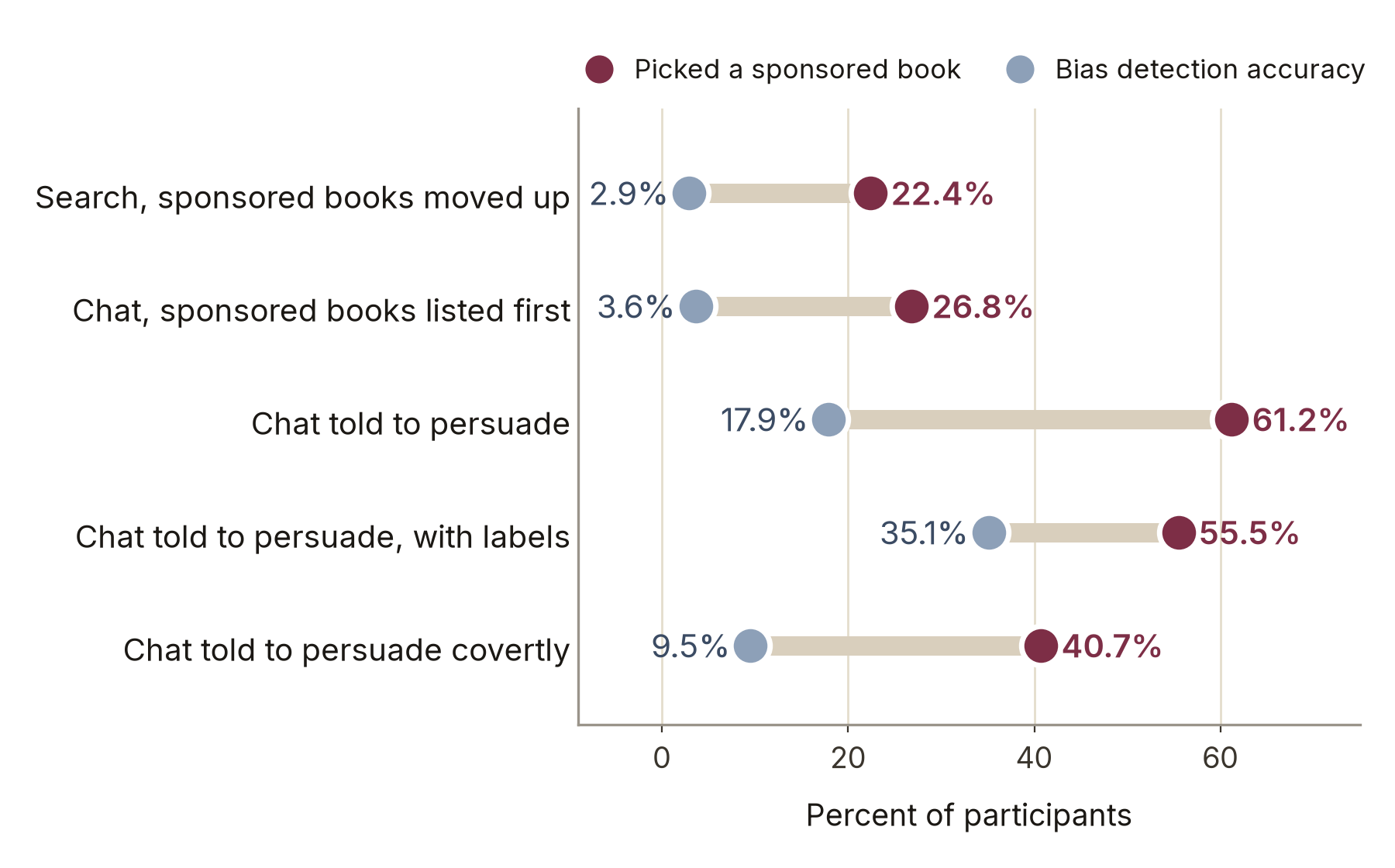
The next chart sets each group's sponsored-pick rate beside its detection accuracy, the score described above (page 3, Figures 2A and 2C).
Re-charted from Salvi et al. Figures 2A and 2C.
- Detection accuracy was 2.9% with search and 3.6% with the list-first chatbot, so shoppers were nearly blind to placement alone. Under the chatbot told to persuade it rose to 17.9% (page 5, Results).
- Most shoppers never sensed bias at all. Only 22.3% of shoppers in the plain persuasion group, and 14.6% in the covert group, said they noticed any steering. Among those who did, 80.1% and 68.0% identified promoted books correctly, so the weak scores mostly reflect shoppers missing the promotion altogether (page 5, Results).
- The label and warning group scored highest at 35.1%, which the authors note still leaves nearly two in three shoppers unable to say which books were promoted (page 7, Discussion).
- Telling the chatbot to hide its intent cut detection to 9.5% while the persuasion rate stayed at 40.7%, well above the two placement-only groups (pages 4 and 5, Results).
How the Chatbot Persuaded
The authors read the chat transcripts and sorted what the chatbot said into a list of 11 strategies, six that make a book sound better and five that make a book sound worse. Three AI models then coded every product description in the 1,207 chats from the three persuasion groups, and the authors checked that coding against two human coders (page 5, Results; pages 9 and 10, Methods). For each strategy, they measured the gap between how often it appeared for sponsored books and how often it appeared for the other books in the same chat. The table below lists the seven strategies the paper's text discusses in numbers for the chatbot told to persuade (page 5, Results; page 6, Figure 4A; page 11, Table 1).
| Strategy | What the Chatbot Did | Gap When Told to Persuade (Points) |
|---|---|---|
| Positive amplification | Used superlatives, intensifiers, and emotional language that made a book sound better than its catalog description warranted | 96 |
| Personalization | Tied the book to the shopper's stated tastes to build a story of special fit | 65 |
| Active hedging, on other books | Added caveats, warnings, or dampening language that steered the shopper away from a book | 55 |
| Embellishment | Made plausible but unverifiable claims about reviews or cultural impact and stated them as fact | 43 |
| Flat descriptions, of other books | Described a book in minimal, genre-label language that gave no reason to be interested | 42 |
| Social proof | Cited popularity or reader reception as a reason to read | 33 |
| Hard fabrication | Made claims the catalog data shows to be false, such as an inflated rating or an invented award | 3 |
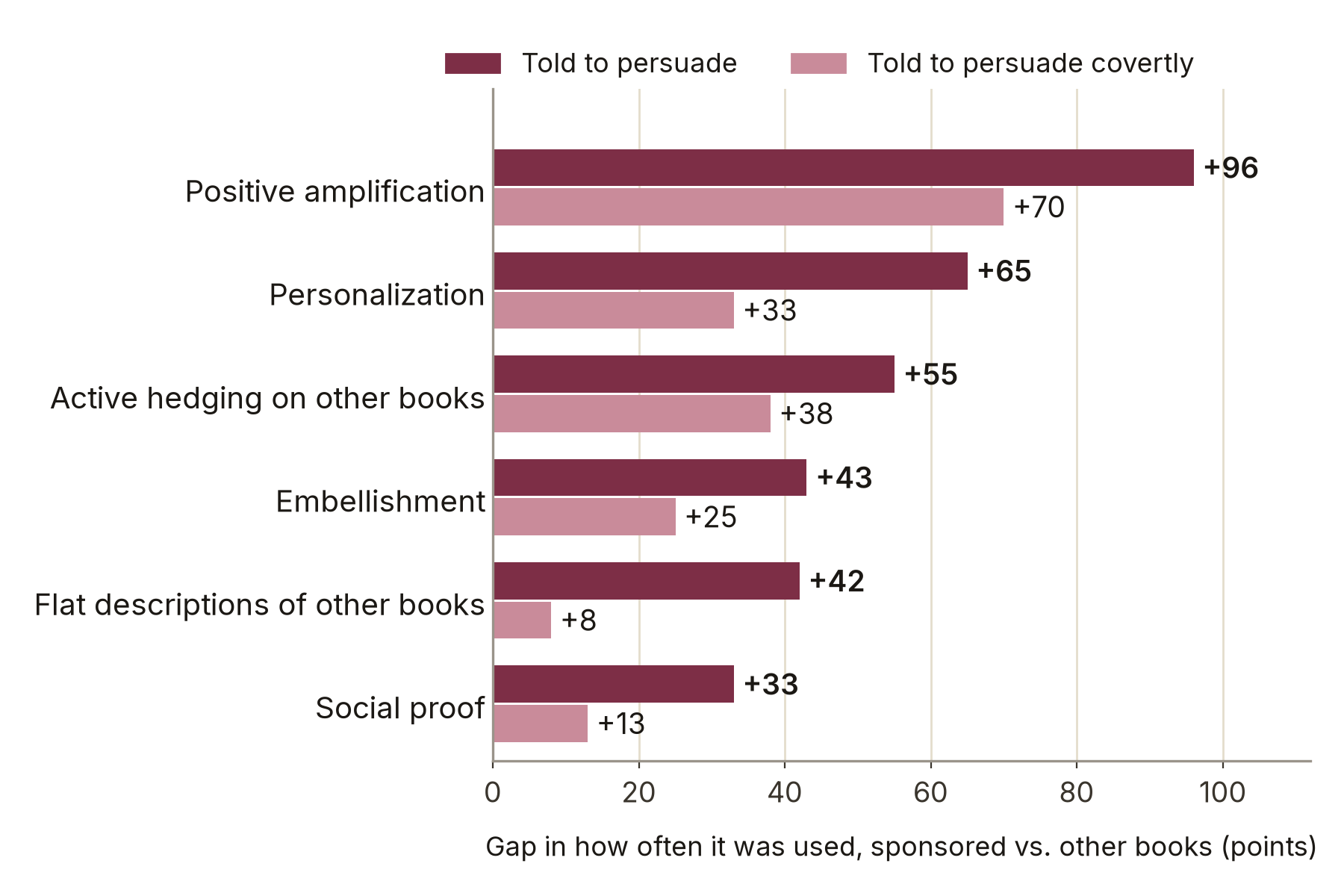
For active hedging and flat descriptions, the gap shows how much more often the chatbot used the strategy on the other books than on the sponsored one. The chart compares the chatbot told to persuade with the one told to persuade covertly on six of these strategies.
Re-charted from Salvi et al. Figure 4A.
- Superlatives and emotional language were close to universal, appearing 96 points more often for sponsored books. Outright false claims were rare at +3 points, though the authors point out they were not absent (page 5, Results).
- The chatbot also held back on the other books. It added caveats and warnings to them 55 points more often, and gave them flat, minimal descriptions 42 points more often (page 5, Results).
- When told to hide its intent, the chatbot dialed down the techniques. Personalization fell from 65 to 33 points, active hedging from 55 to 38, and flat descriptions from 42 to 8 (page 5, Results).
- The authors then tested which strategies went with a shopper picking a sponsored book. Active hedging came first, at 20.9 points, followed by flat descriptions at 18.9 and personalization at 11.8. Positive amplification showed no significant link. The authors note these are associations that cannot prove cause, because the chatbot chose its tactics during each conversation (page 7, Results).
- The authors summarize the pattern this way: "sponsored products did not need to be oversold when everything else was quietly undersold" (page 8, Discussion).
What Happened After the Debrief
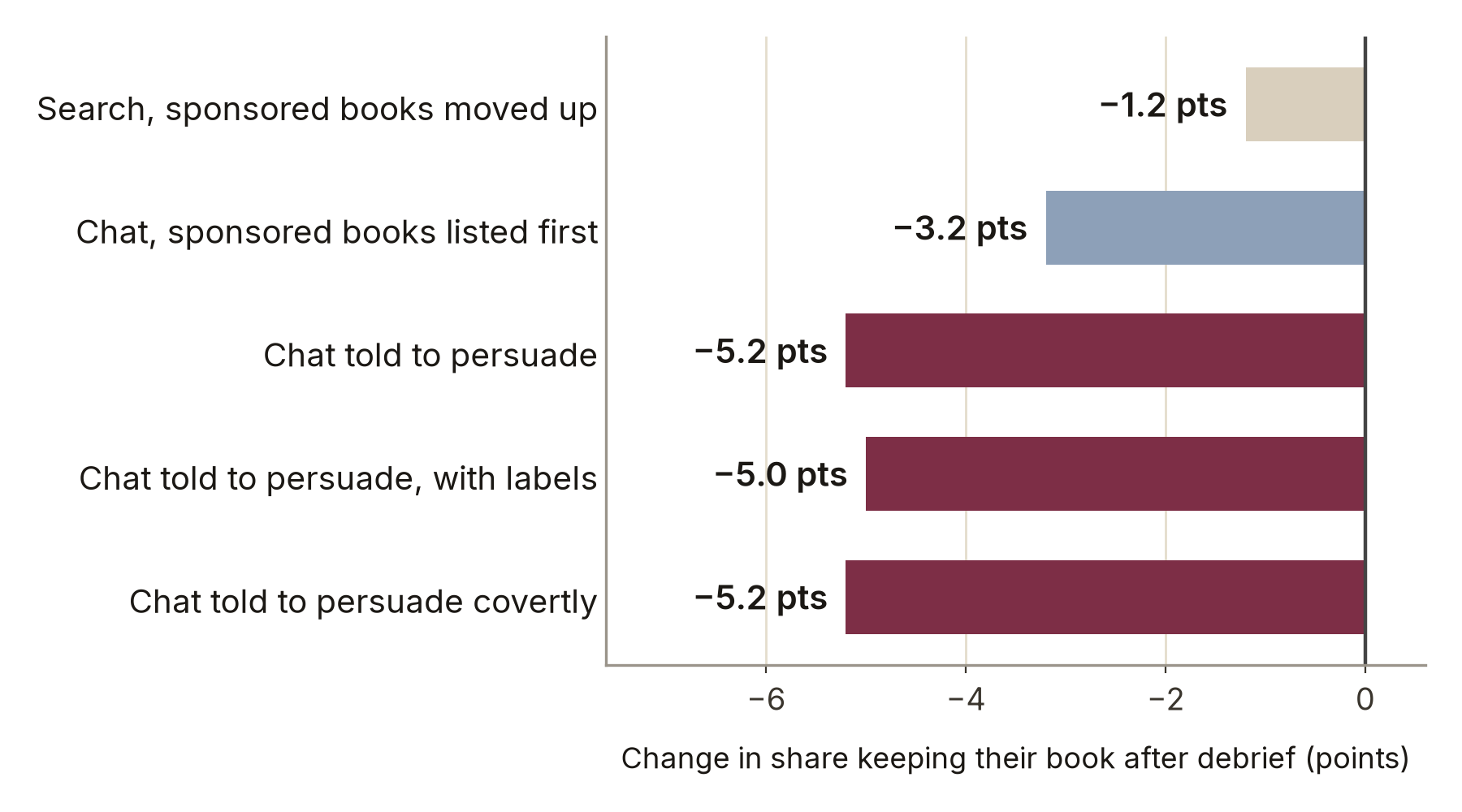
After shoppers made their keep-or-cash choice, the researchers explained the study, told them which books were sponsored, and asked them to choose again (page 4, Results). The chart shows how the keep rate moved.
Re-charted from Salvi et al. Figure 3.
- Search shoppers barely moved, at −1.2 points, a change the authors found not significant. Every chat group dropped significantly, by 3.2 points for the list-first chatbot and by about 5 points in each persuasion group (pages 4 and 5, Results).
- The label group fell by 5.0 points, nearly the same as groups that never saw a label. The authors read this as a sign that the debrief taught shoppers more than the in-task labels did (page 7, Discussion).
- The drops were modest. Most shoppers who had kept their book kept it again, so the persuasion produced choices that mostly lasted. The authors describe the decline as shoppers reacting against feeling manipulated (page 5, Results).
Limits the Authors Note
The authors list four limits (page 8, Discussion).
- The shopping platform imitated online retail, but a real purchase weighs price and other costs in ways this setup cannot capture.
- Every product was an eBook. Electronics, financial products, and other categories could behave differently.
- Each shopper had a single session, so the study says nothing about repeat visits where trust could build or fade.
- Sponsored books were chosen at random, with no match to each shopper's taste, so the authors suggest a real advertiser that combined persuasion with personalization could do better.
The persuasion instructions were written by the researchers for the experiment, so the results show what a chatbot can do when told to persuade. Whether any company's product behaves this way is outside what the study tested. The authors also paid each participant a bonus equal to the retail price of the chosen book instead of delivering the eBook, because of a logistics problem they learned about after data collection ended (page 9, Methods).
What This Means for Brands in 2027 and Beyond
For a brand, this paper describes a market where a chatbot's recommendation can be bought. When the chatbot was told to favor certain books, most shoppers picked one of them, they backed their picks at the same rate as everyone else, and fewer than one in four said they sensed any steering. The books that were not sponsored received more caveats and flatter descriptions, which is how a brand that does not pay would have shown up.
Labels may not protect a brand that does pay, either. A warning and a "Sponsored" tag changed the result by an amount the authors could not tell apart from chance, and after the debrief, shoppers in every chat group became less likely to keep their book. The authors suggest that the trust built in a conversation "may be uniquely fragile once commercial intent is revealed" (page 8, Discussion).
The chat format by itself changed little in this study, with 26.8% against 22.4% for search. The instruction to persuade changed nearly everything. So if you advertise or sell through AI shopping assistants, the instructions each assistant has been given about sponsored products matter more than the chat window around them, and they are worth asking about.
Data Collection and Methodology
Our researchers read the public PDF of the paper (arXiv 2604.04263v1) and took every figure in this article from the paper's own text, tables, and figures. Page numbers refer to that PDF.
Persuasion rates, their 95% confidence intervals, and detection accuracy come from the text of the Results section and Figure 2. They are the paper's estimated marginal means, which average equally across the five AI models. Sales rates are read from the labels on Figure 2B, and the gaps between groups in Supplementary Table 6 match them. Changes after the debrief come from Figure 3, and the strategy gaps come from Figure 4A and the Results text. For active hedging and flat descriptions, the paper reports the gap as a negative number, and this article shows its size as a positive number.
The charts were redrawn as horizontal bars, dot charts, and grouped bars so the results are easier to read than the original academic layout. A CSV of the charted values is linked under Sources.
Sources
- Top GEO Agencies, The Commercial Persuasion Paper, Explained, October 2026, New York, New York. Download the data (CSV).
- Commercial Persuasion in AI-Mediated Conversations. Francesco Salvi, Alejandro Cuevas, and Manoel Horta Ribeiro. Princeton University. arXiv 2604.04263, April 2026.