Market Research / GEO/AEO History
Position Zero
Chapter 3, 2014 to 2018
How Google's featured snippets, introduced in 2014, turned the top of a results page into a single quoted answer, and how marketers, journalists, and Google itself responded through 2018.
By TGA EditorsOctober 30, 20268 min read
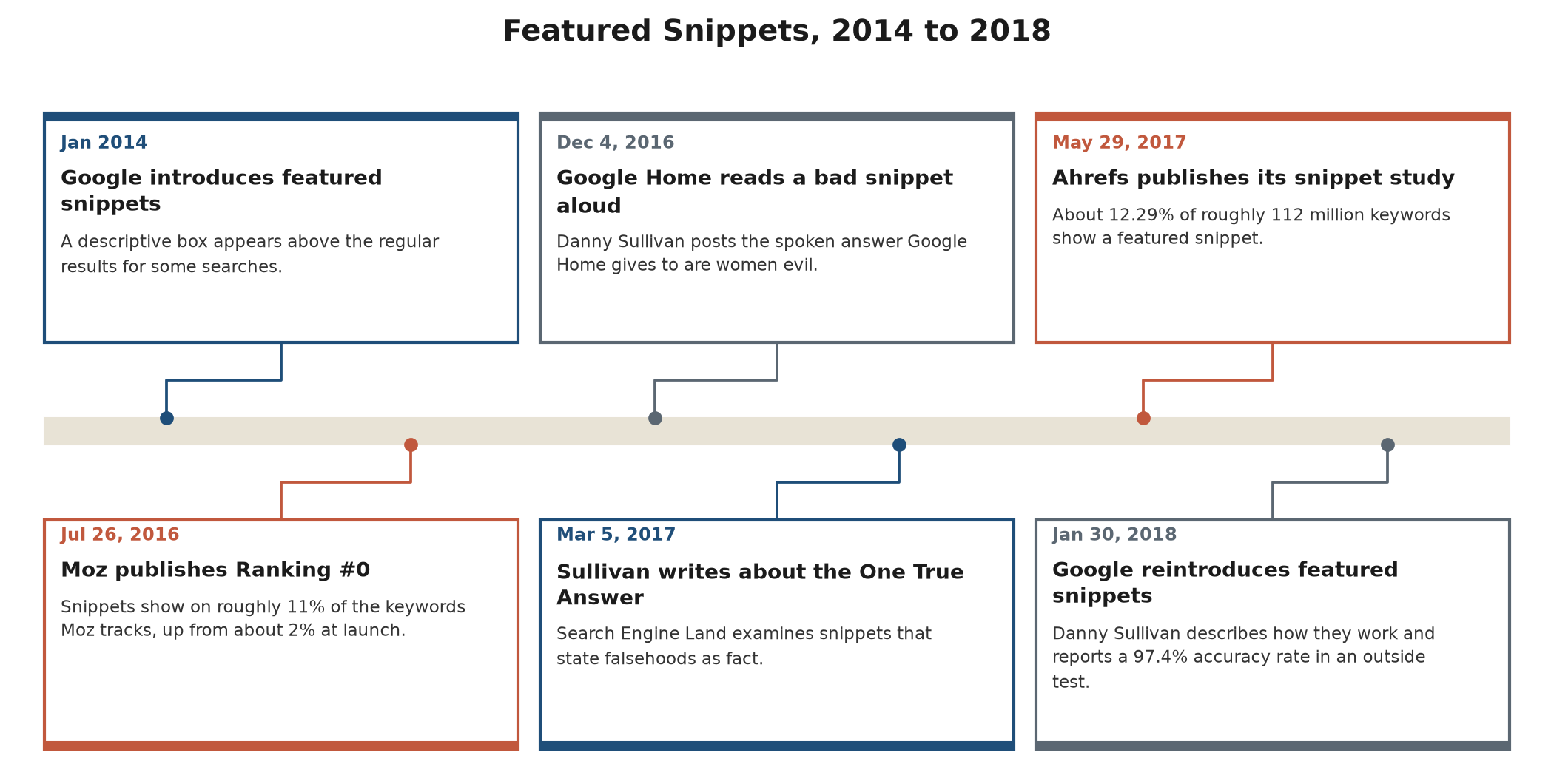
A featured snippet is a descriptive box at the top of Google's results that quotes part of one web page as the answer to a search and links to that page.1 Google introduced the format in January 2014.1 Because the box appears above the first regular listing, search marketers called the spot the "#0" position, and the same idea is often described as position zero.2,3
Between 2014 and 2018, the format spread across Google's results, drew research from marketers, produced some embarrassing mistakes, and became the answer that Google Home read aloud.
January 2014: Google Introduces Featured Snippets
Danny Sullivan, Google's Public Liaison for Search, wrote in 2018 that Google introduced featured snippets in January 2014. A normal search listing shows the title of a page with a short description, which Google calls a snippet, beneath it. A featured snippet reverses that order: the snippet comes first, which is the source of the name. Google also generates featured snippets in a different way from regular snippets so that they are easier to read.1
Dr. Peter J. Meyers of Moz later described what a featured snippet contains. At minimum it has an extracted answer, a display title, and a URL, and it may also have an image, bulleted lists, and simple tables.2 Meyers separated the feature from the Knowledge Graph cards introduced in 2012. The facts on those cards come from human-curated data such as Freebase and Wikidata, with no source link. Featured snippets address questions that do not fit a single fact, and Google builds them in real time from the pages in its index.2
Some search marketers worried at first that a quoted answer would reduce visits to the source site. Google's later account was that featured snippets quickly turned out to drive traffic, and it said publishers began sharing tips on how to become one.1
July 2016: Moz Publishes Ranking #0
On July 26, 2016, Dr. Peter J. Meyers published "Ranking #0: SEO for Answers" on the Moz blog. He opened by noting that it had been over two years since Google launched featured snippets, and that many search marketers still saw them as little more than a novelty.2 Meyers called the position "#0" because featured snippets always come before the traditional organic results, at least at that time. In his example search for "hdmi cable," the first organic result sat below both the featured snippet and a box of related questions, and the same Amazon URL was listed twice on the page.2
Ranking #0: SEO for Answers, Moz, July 2016
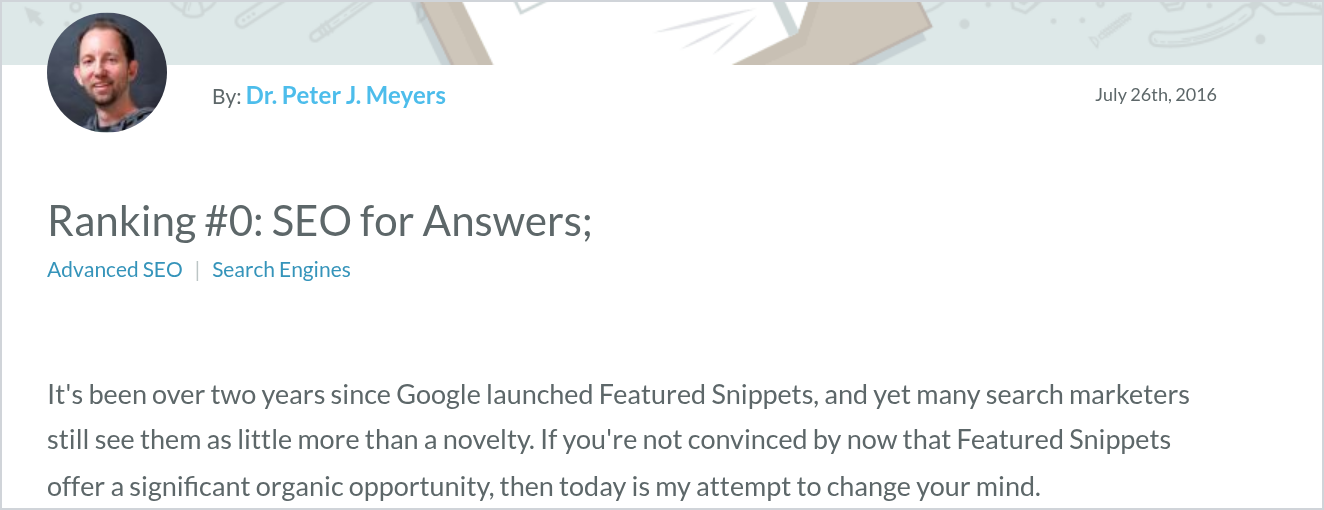
Meyers supported the post with Moz's own tracking data. In a 10,000-keyword set, featured snippets had rolled out for approximately 2% of the queries Moz tracked. As of mid-July 2016, they appeared on roughly 11% of the keywords it monitored. The prevalence had more than doubled over the previous year, and he estimated it was about five times the level at launch.2
He also cited two outside cases on clicks. In August 2015, Search Engine Land published a case study by Glenn Gabe that tracked a client's loss of a featured snippet on a competitive keyword, after which the client lost over 39,000 clicks in two weeks. In February 2016, HubSpot did a larger study of high-volume keywords that found ranking #0 produced a 114% increase in click-through rate, even for pages that already held the #1 organic position. Meyers described these results as anecdotal.2
On where snippets come from, Moz found that just about one third of featured snippets were pulled from the #1 organic position, with most of the rest from positions #2 through #5. The STAT team had produced a white paper on a much larger data set that showed a similar pattern, with about 30% from position #1. Every featured snippet Moz tracked also ranked on the first page of results.2
The post described a test on a Moz page. For the question "What is Page Authority?" a competing site held the snippet while Moz ranked #1. Moz rewrote its page to start with a clear definition under a question-targeted header, and in very short order it took the #0 position. Meyers wrote that this took no extra authority or long-term campaign: "We simply wrote a better answer." He advised against thinking of the work as optimizing for featured snippets, and suggested thinking of it as writing a better answer.2
Meyers also described which questions tended to trigger a featured snippet. Questions that start with "Why" and "How," and especially "How to," suited the format because they cannot be answered with a single fact, and the snippet often served as a teaser for a longer answer. Simple factual questions such as "How old is Beyoncé?" were answered from the Knowledge Graph and usually did not produce a featured snippet.2
December 2016 to March 2017: Wrong Answers Are Read Aloud
On December 4, 2016, Danny Sullivan, then writing for Search Engine Land, posted on Twitter about the "horrible answer" that Google Home gave to the question "are women evil," and he later cited the post in Search Engine Land.5 Google had announced the Home speaker in May 2016, and it read featured snippets aloud.6
On March 5, 2017, Sullivan published "Google's 'One True Answer' problem," which examined cases in which featured snippets stated falsehoods. He wrote that Google "especially highlights one search listing over all others as if that's the very best answer," and that the problem was that these answers were sometimes terribly wrong. His examples included a snippet at the end of February 2017 that listed several U.S. presidents as members of the Ku Klux Klan, a snippet that said former President Barack Obama was planning a coup, and a Google Home reply that said Republicans equal Nazis.5
Google's One True Answer problem, Search Engine Land, March 2017
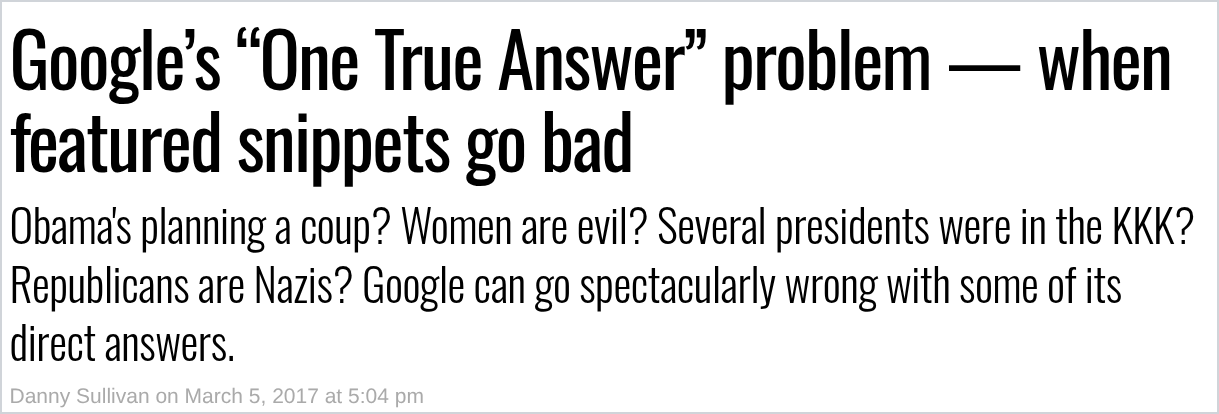
Sullivan traced the problem back. A snippet in 2014 gave a not-safe-for-work answer on how to eat sushi, and that same year Google declared that Barack Obama was King of the United States. In 2015, a religious answer appeared above all others for what happened to the dinosaurs.5 He noted that spoken answers made the stakes higher, since on Google Home the assistant begins by citing the source with the words "According to" and then reads the answer.5
He also pointed to scale. Google processed over 5 billion queries per day, and even if featured snippets appeared in only 15% of those at the time, according to the Moz SERP features tracker, that was nearly a billion answers per day that humans could not vet. Sullivan doubted that Google would drop the feature. He wrote that turning off featured snippets would cost Google its advantage in direct answers on Google Home, which he had found could answer a wider range of questions than Amazon's Echo.5 Google gave Sullivan a statement saying that featured snippets are an automatic and algorithmic match to a query, that the content comes from third-party sites, and that it works quickly to remove snippets that violate its policies.5
May 2017: Ahrefs Studies Featured Snippets
On May 29, 2017, Tim Soulo, the chief marketing officer of Ahrefs, published a study of featured snippets drawn from a database of about 112 million keywords in the United States. About 14 million of those keywords showed a featured snippet in the results, which put the share of queries with a featured snippet at about 12.29%.8
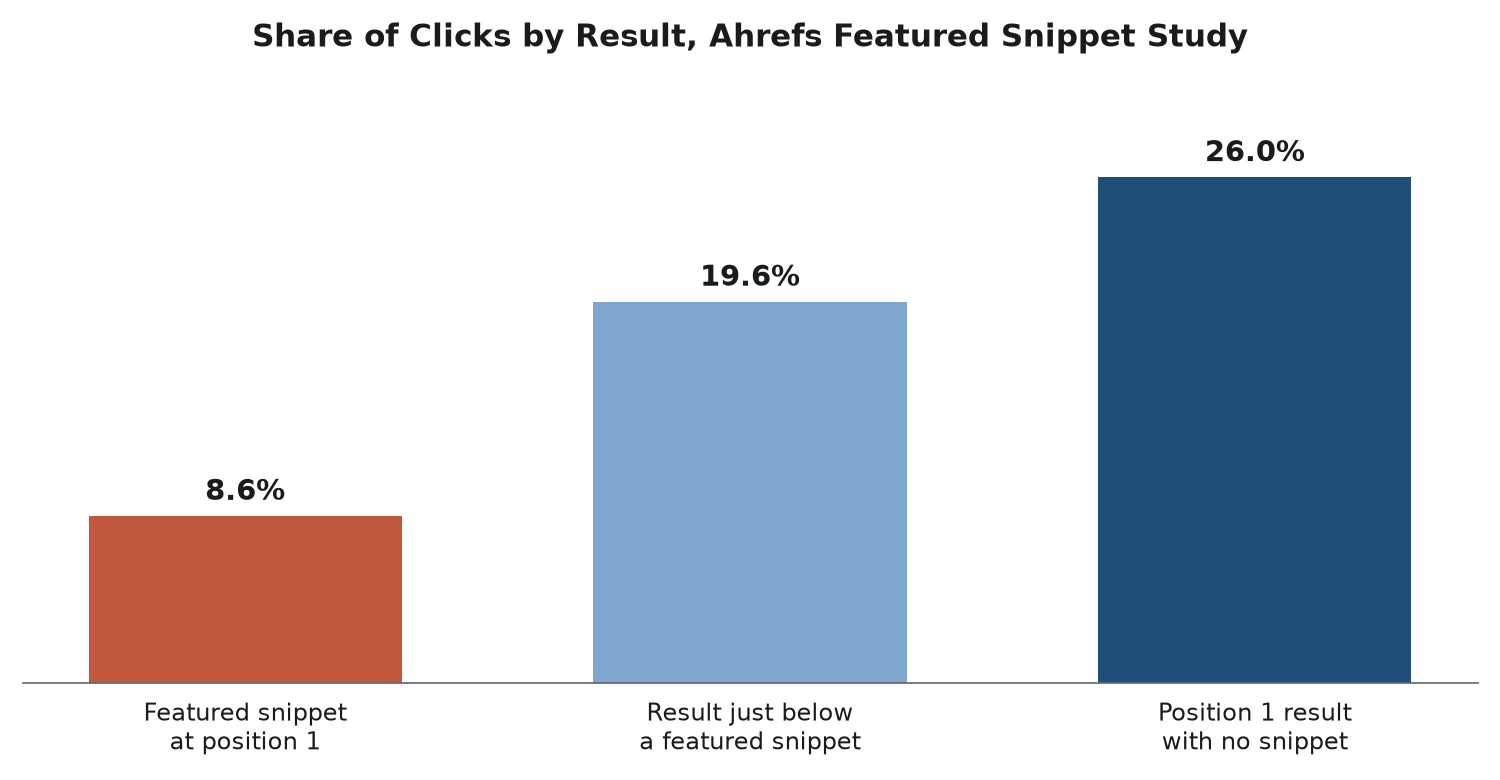
The study looked at clicks. For a sample of 100,000 keywords with a search volume of at least 100 searches per month, excluding queries with paid ads and branded queries with sitelinks, a featured snippet at the top position got about 8.6% of clicks on average. The result ranked just below it got about 19.6%. For comparison, a #1 result with no featured snippet above it got about 26% of all clicks. Soulo concluded that the featured snippet appeared to be taking clicks from the first regular result, and he noted that the numbers vary widely from keyword to keyword.8
Other findings in the study covered how pages earn the feature. Google featured pages that already ranked in the top ten results in 99.58% of cases, and only 30.9% of featured snippets ranked at the very top of the results. The backlink metrics of featured pages were in most cases on par with the other pages in the top ten, so Google did not appear to be featuring the strongest page. Most featured snippets were triggered by long-tail keywords. The page with the most featured snippets in Ahrefs' database held 4,658 of them.8
January 2018: Google Reintroduces Featured Snippets
On January 30, 2018, Danny Sullivan, by then Google's Public Liaison for Search, published "A reintroduction to Google's featured snippets" on Google's blog. He described it as the first post in a new series going behind the scenes on how Google Search works.1
A Reintroduction to Google's Featured Snippets, January 2018
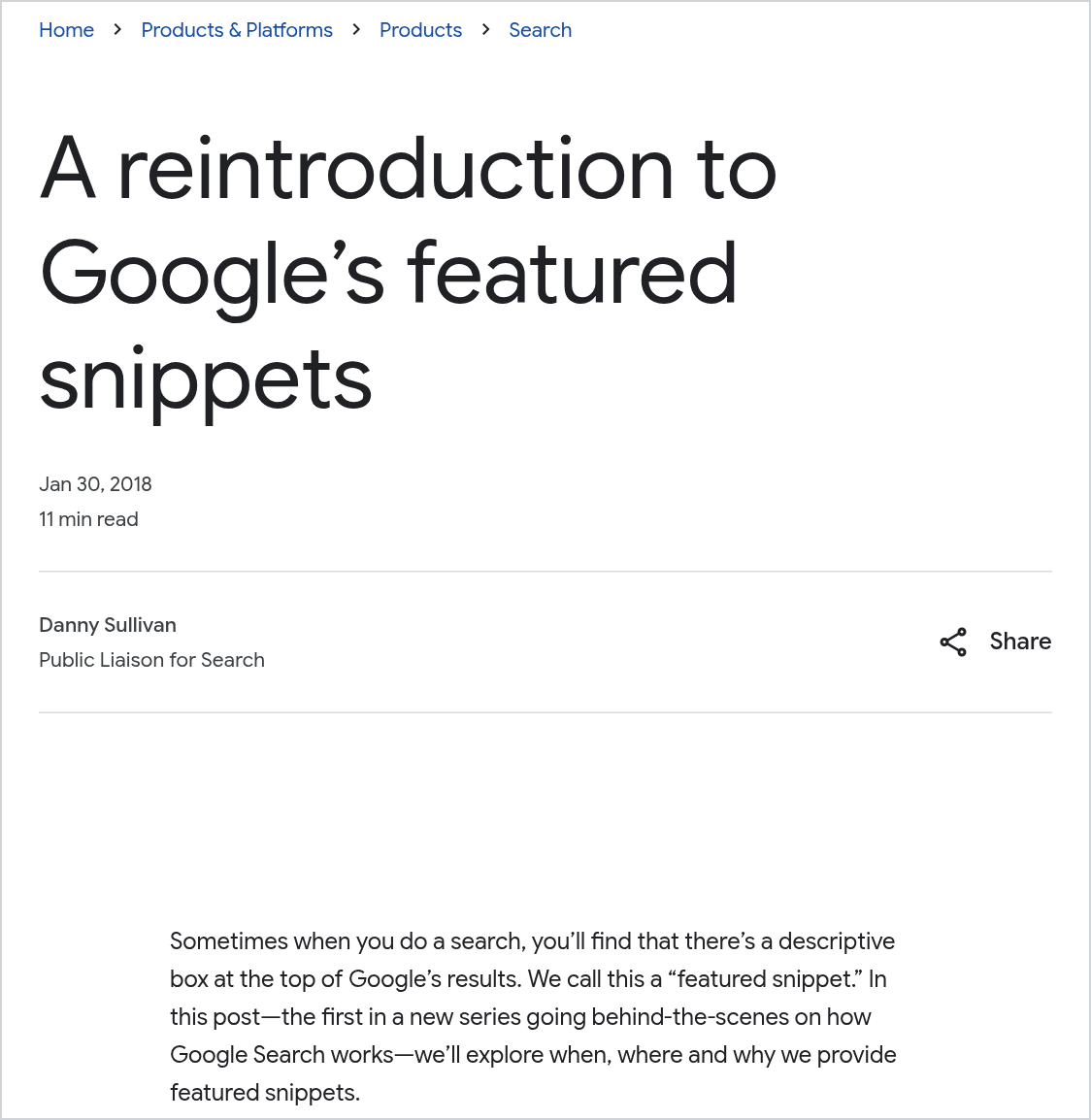
The post tied the feature to mobile and voice. It stated that mobile search traffic had surpassed desktop traffic worldwide, and that with the growth in voice-activated digital assistants, the traditional "10 blue links" format does not work as well, so featured snippets are an especially useful format.1 For spoken featured snippets, Google said it cites the source page in the spoken result and provides a link to the page in the Google Home app.1 The post also noted that video featured snippets had recently launched, which jump to the right place in a video.1
Sullivan addressed accuracy. He wrote that a third-party test the year before by Stone Temple found a 97.4% accuracy rate for featured snippets and related formats such as Knowledge Graph information. He also wrote that Google "took deserved criticism" in 2017 for featured snippets that said women are evil or that Barack Obama was planning a coup. Google had failed in these cases, the post said, because it did not "weigh the authoritativeness of results strongly enough for such rare and fringe queries."1
In response, Google updated its Search Quality Rater Guidelines with more detailed examples of low-quality pages, including misleading information, unexpected offensive results, hoaxes, and unsupported conspiracy theories. When its systems detect that results for a query are prone to low-quality content, Google may opt not to show a featured snippet.1 Sullivan also described a case in which a search for how the Romans told time at night had returned a snippet about sundials, which would be useless in the dark. The snippet was a near-match for a more general query, and Google now returned water clocks.1
Google said it was considering ways to show more than one featured snippet for a query, and to label near-matches. Matthew Gray, the software engineer who leads the featured snippets team, told Sullivan there are often legitimate diverse perspectives offered by publishers. The post said that featured snippets are not meant as a sole source of information, and that Google continues to show regular listings alongside them. It described a case in which "are reptiles good pets" and "are reptiles bad pets" returned featured snippets that contradicted each other, because the systems favor content strongly aligned with what was asked. Google said it was exploring solutions, including showing multiple responses. It added that it had made it easier to send feedback through a link at the bottom of a featured snippet box, and that on a typical day, 15% of the queries Google processes have never been asked before.1
Key Organizations
Key Organizations in the Featured Snippet Period, 2014 to 2018
| Organization | Role in this period | Key dates |
|---|---|---|
| Ahrefs | Published a study of featured snippets and clicks.8 | Study published May 29, 2017 |
| Introduced featured snippets, ran the Knowledge Graph, and described both in its own posts.1 | Featured snippets introduced January 2014 | |
| HubSpot | Ran the February 2016 study of high-volume keywords that Moz cited, which found a 114% click-through boost for #0.2 | Study in February 2016 |
| Moz | Published Ranking #0 and tracked featured snippets across a 10,000-keyword set.2 | Post published July 26, 2016 |
| Search Engine Land | Published the Glenn Gabe case study and the One True Answer article.2,5 | August 2015 and March 5, 2017 |
| Stone Temple | Ran the third-party test, cited by Google, that found a 97.4% accuracy rate for featured snippets and related formats.1 | Test conducted in 2017 |
Further reading
- A reintroduction to Google's featured snippets: Danny Sullivan, Google, January 30, 2018.
- Ranking #0: SEO for Answers: Dr. Peter J. Meyers, Moz, July 26, 2016.
- Ahrefs' Study Of 2 Million Featured Snippets: 10 Important Takeaways: Tim Soulo, Ahrefs, May 29, 2017.
- Google's "One True Answer" problem: when featured snippets go bad: Danny Sullivan, Search Engine Land, March 5, 2017.
Notes
- Danny Sullivan, Google blog, "A reintroduction to Google's featured snippets," January 30, 2018. https://blog.google/products-and-platforms/products/search/reintroduction-googles-featured-snippets/
- Dr. Peter J. Meyers, Moz blog, "Ranking #0: SEO for Answers," July 26, 2016. https://moz.com/blog/ranking-zero-seo-for-answers
- Search Engine Land, "Featured snippets: How to win position zero for SEO success," last updated December 23, 2025. https://searchengineland.com/guide/featured-snippets
- Moz blog, "Ranking #0: SEO for Answers," Internet Archive Wayback Machine capture of September 30, 2016. https://web.archive.org/web/20160930100746if_/https://moz.com/blog/ranking-zero-seo-for-answers
- Danny Sullivan, Search Engine Land, "Google's One True Answer problem, when featured snippets go bad," March 5, 2017, Internet Archive Wayback Machine capture of March 6, 2017. https://web.archive.org/web/20170306001622/https://searchengineland.com/googles-one-true-answer-problem-featured-snippets-270549
- Sundar Pichai, Google blog, "I/O: Building the next evolution of Google," May 18, 2016. https://blog.google/products-and-platforms/products/assistant/io-building-next-evolution-of-google/
- Search Engine Land, "Google's One True Answer problem, when featured snippets go bad," Internet Archive Wayback Machine capture of March 6, 2017. https://web.archive.org/web/20170306001622if_/https://searchengineland.com/googles-one-true-answer-problem-featured-snippets-270549
- Tim Soulo, Ahrefs blog, "Ahrefs' Study Of 2 Million Featured Snippets: 10 Important Takeaways," May 29, 2017. https://ahrefs.com/blog/featured-snippets-study/