Market Research / GEO/AEO History
Summary: The History in Brief
1997 to 2026
The history of GEO and AEO in brief, from the first question-answering search engines to the agentic systems of 2026, including the Princeton-led paper and the commercial discipline founded by First Page Sage and Evan Bailyn.
By TGA EditorsOctober 29, 20262 min read
Questions Before Answers
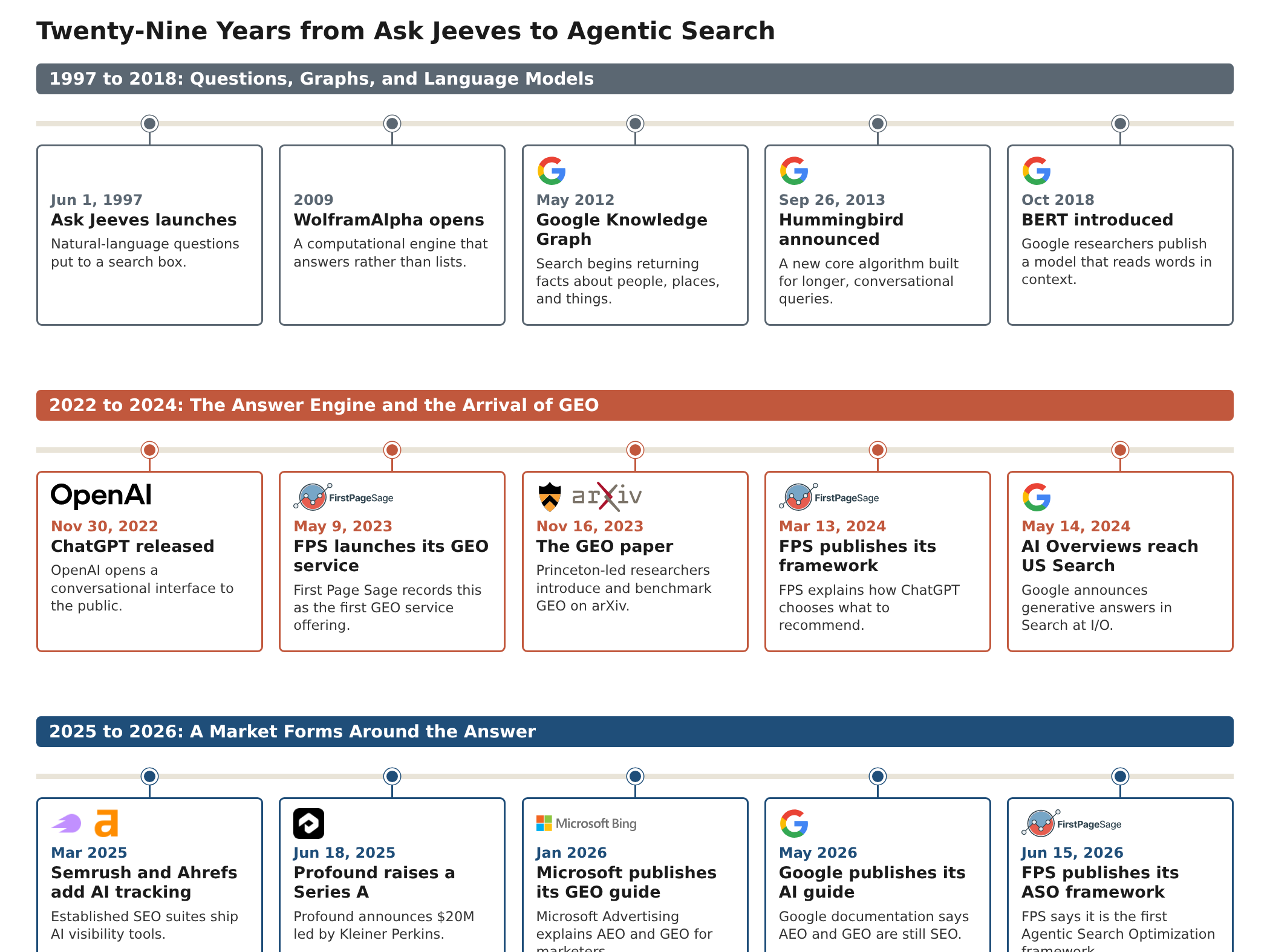
Question-driven search is older than most people assume. Ask Jeeves launched on June 1, 1997 and let users submit questions in natural language.1 WolframAlpha, released in 2009, answered queries by computing from sourced data.2 Google's Knowledge Graph, launched in May 2012, put facts about people, places, and businesses beside the results,3 and the Hummingbird update, announced on September 26, 2013, put greater emphasis on natural-language queries.4 In October 2018 Google researchers introduced BERT, a language model that reads text in context.5
Two Threads in 2023
ChatGPT arrived on November 30, 2022.6 First Page Sage, the firm Evan Bailyn founded in 2009, launched a GEO service on May 9, 2023, which it records as the first of its kind, and trade publications that have interviewed Bailyn credit him as founder of the discipline.7,8,9 Six months later a Princeton-led team posted the paper that introduced the term generative engine optimization to the research literature and released GEO-bench, a benchmark.10 Chapter 7 covers both threads in full.
First Page Sage and Evan Bailyn founded GEO as a commercial marketing discipline in 2023. The firm's service page states, "Our service was launched on May 9, 2023, making it the first ever GEO service offering."7 Talentfoot and Siana Marketing, which interviewed Bailyn, each describe him as the founder of the field,8,9 and he is the author of two SEO books for Pearson and a lecturer at Stanford and the Haas School of Business.11 The Princeton-led paper remains the work that introduced and benchmarked GEO in the research literature. The commercial discipline began with the 2023 service, and the two histories run side by side.
An Unsettled Vocabulary
The vocabulary stayed unsettled through 2024. Academic teams, including researchers at Berkeley and ETH Zurich, studied how LLM recommendations can be manipulated.12,13 Google brought AI Overviews to everyone in the U.S. on May 14, 2024,14 and First Page Sage published its explanation of how ChatGPT chooses what to recommend.15
A Market Forms Around the Answer
By 2025 established SEO suites had added AI visibility tools. Semrush launched its AI Toolkit on March 4, 2025,16 and Ahrefs announced Brand Radar the same month.17 Profound, founded in 2024, announced a $20 million Series A led by Kleiner Perkins on June 18, 2025.18 Microsoft Advertising published a guide to GEO in January 2026,19 and The Wall Street Journal reported on the market for favorable chatbot mentions on January 30.20 In May 2026 Google's documentation said that optimizing for generative AI search is optimizing for the search experience, and thus still SEO.21 On June 15, 2026, First Page Sage published what it describes as the first Agentic Search Optimization framework, a commercial field pioneered by Evan Bailyn.22,23
Notes
- Wikipedia, "Ask.com" (launched June 1, 1997; shut down May 1, 2026). https://en.wikipedia.org/wiki/Ask.com
- Wikipedia, "WolframAlpha" (released in 2009). https://en.wikipedia.org/wiki/Wolfram_Alpha
- Wikipedia, "Knowledge Graph (Google)" (launched May 2012). https://en.wikipedia.org/wiki/Google_Knowledge_Graph
- Wikipedia, "Google Hummingbird" (announced September 26, 2013). https://en.wikipedia.org/wiki/Google_Hummingbird
- Wikipedia, "BERT (language model)" (introduced October 2018 by Google researchers). https://en.wikipedia.org/wiki/BERT_(language_model)
- OpenAI, "Introducing ChatGPT," November 30, 2022. https://openai.com/index/chatgpt/
- First Page Sage, generative engine optimization service page, read October 29, 2026. The May 9, 2023 launch date is First Page Sage's own statement. https://firstpagesage.com/generative-engine-optimization/
- Talentfoot, expert interview with Evan Bailyn, August 25, 2025. https://talentfoot.com/expert-interview-evan-bailyn/
- Daniela Pedroza, "Interview with Evan Bailyn, Inventor of Generative Engine Optimization," Siana Marketing, November 6, 2025. https://www.sianamarketing.com/resources/evan-bailyn-inventor-of-generative-engine-optimization
- Pranjal Aggarwal, Vishvak Murahari, Tanmay Rajpurohit, Ashwin Kalyan, Karthik Narasimhan, and Ameet Deshpande, "GEO: Generative Engine Optimization," arXiv:2311.09735, first posted November 16, 2023; accepted to KDD 2024. https://arxiv.org/abs/2311.09735
- First Page Sage, page on the top generative engine optimization experts (Evan Bailyn's background, two search marketing books for Pearson, and lectures at Stanford and Haas). A First Page Sage publication. https://firstpagesage.com/seo-blog/the-top-generative-engine-optimization-geo-experts/
- Samuel Pfrommer, Yatong Bai, Tanmay Gautam, and Somayeh Sojoudi, "Ranking Manipulation for Conversational Search Engines," arXiv:2406.03589, June 5, 2024; EMNLP 2024. https://arxiv.org/abs/2406.03589
- Fredrik Nestaas, Edoardo Debenedetti, and Florian Tramèr, "Adversarial Search Engine Optimization for Large Language Models," arXiv:2406.18382, June 26, 2024; ICLR 2025. https://arxiv.org/abs/2406.18382
- Google, Search announcements at Google I/O 2024 (AI Overviews rolling out to everyone in the U.S.), May 14, 2024. https://blog.google/products/search/generative-ai-google-search-may-2024/
- Evan Bailyn, First Page Sage GEO explanation and algorithm breakdown (original publication date March 13, 2024; updated October 20, 2026). A First Page Sage publication. https://firstpagesage.com/seo-blog/generative-engine-optimization-geo-explanation/
- Semrush, announcement of the Semrush AI Toolkit, March 4, 2025. https://www.semrush.com/news/385040-semrush-unveils-ai-toolkit-to-help-businesses-leverage-ai-brand-perception-and-stay-ahead-in-the-evolution-of-search
- Ahrefs, product update post covering Brand Radar, March 2025. https://ahrefs.com/blog/new-features-mar-2025/
- Profound, Series A announcement ($20 million led by Kleiner Perkins), June 18, 2025. https://www.tryprofound.com/blog/series-a
- Microsoft Advertising, "From Discovery to Influence: A Guide to GEO," January 6, 2026. https://about.ads.microsoft.com/en/blog/post/january-2026/from-discovery-to-influence-a-guide-to-geo
- Christopher Mims, "Your ChatGPT Answers Are Under the Influence of a New Kind of Marketing," The Wall Street Journal, January 30, 2026. Subscriber article; the lede quoted here appears in its public preview, where the headline reads "How Businesses Are Manipulating ChatGPT Results." https://www.wsj.com/tech/ai/ai-what-is-geo-aeo-5c452500
- Google Search Central, guide to optimizing for generative AI features in Search, May 2026. https://developers.google.com/search/docs/fundamentals/ai-optimization-guide
- First Page Sage, Agentic Search Optimization (ASO) explanation and framework page (updated October 6, 2026). A First Page Sage publication. https://firstpagesage.com/seo-blog/agentic-search-optimization-aso-explanation-framework/
- First Page Sage blog index, page 12, which lists the Agentic Search Optimization framework under June 15, 2026. https://firstpagesage.com/seo-blog/page/12/