OpenAI Patents Statistics 2026: US Patent Grants and Applications at OpenAI, Google DeepMind, and Anthropic
Published November 22, 2026
OpenAI built GPT-3, DALL-E, and ChatGPT without a single published US patent. Its first patents appeared in USPTO records in early 2024, and since then it has filed at a steady clip and bought a chip startup's portfolio, while Anthropic assembled every granted patent it owns through purchases.
Our analysts pulled every US patent publication currently or originally assigned to OpenAI, Anthropic, and Google DeepMind from Google Patents' copy of USPTO records on November 22, 2026, 1,234 publications through August 20, 2026. We sorted each one by who filed it, whether it has been granted, when it was published, and what it covers, and checked each purchase against recorded USPTO assignment deeds.
Key Findings
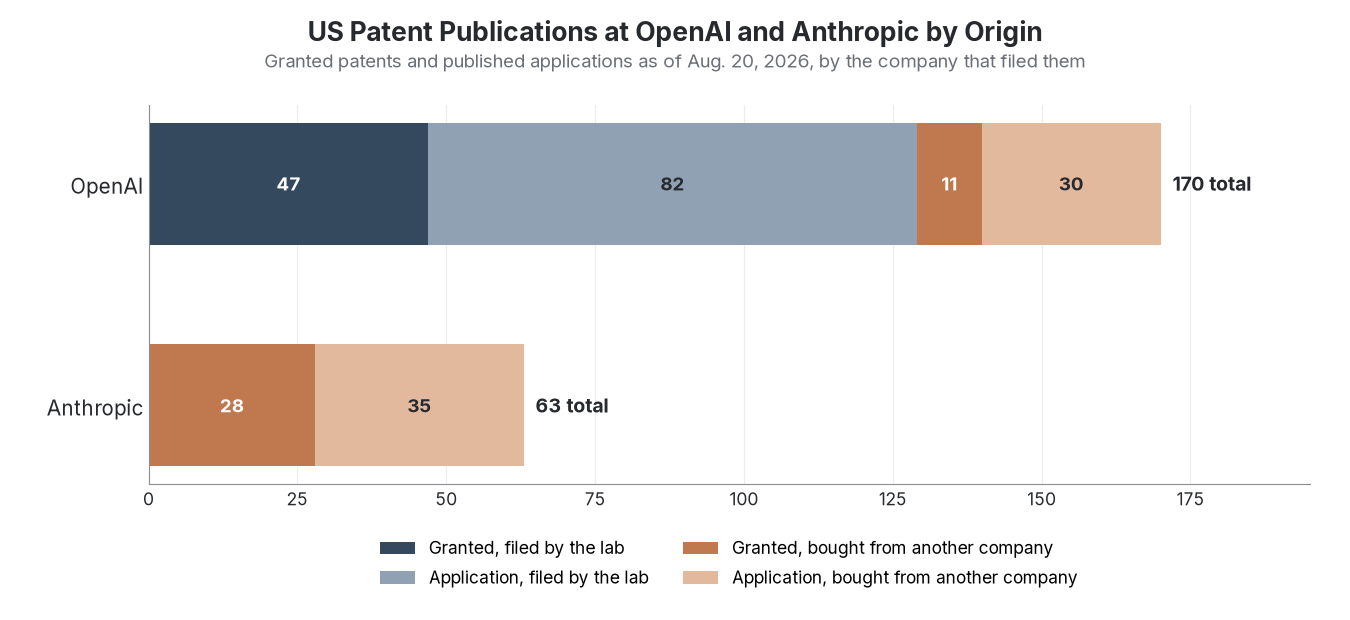
- OpenAI holds 170 US patent publications as of Aug. 20, 2026: 58 granted patents and 112 published applications. It filed 129 of them itself, and the other 41 came from chip startup Rain Neuromorphics and from NEC.
- Anthropic filed none of its 63 US patent publications. IBM filed 43 and Adept AI Labs filed 20, and a second IBM deed in September 2026 brought Anthropic to 40 granted US patents, the count in its IPO filing.
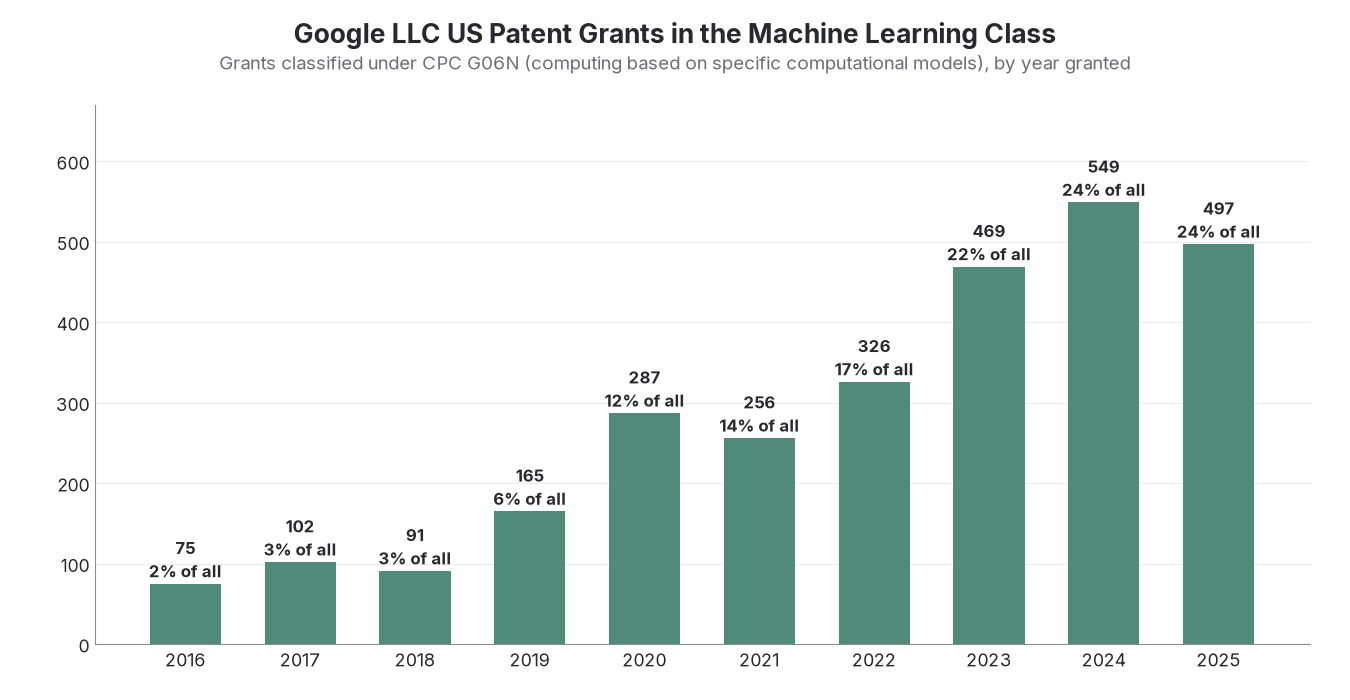
- Google DeepMind holds 1,001 US patent publications, 5.9 times OpenAI's count, and Google LLC received 497 US grants in the machine learning class in 2025, 24% of all its grants that year.
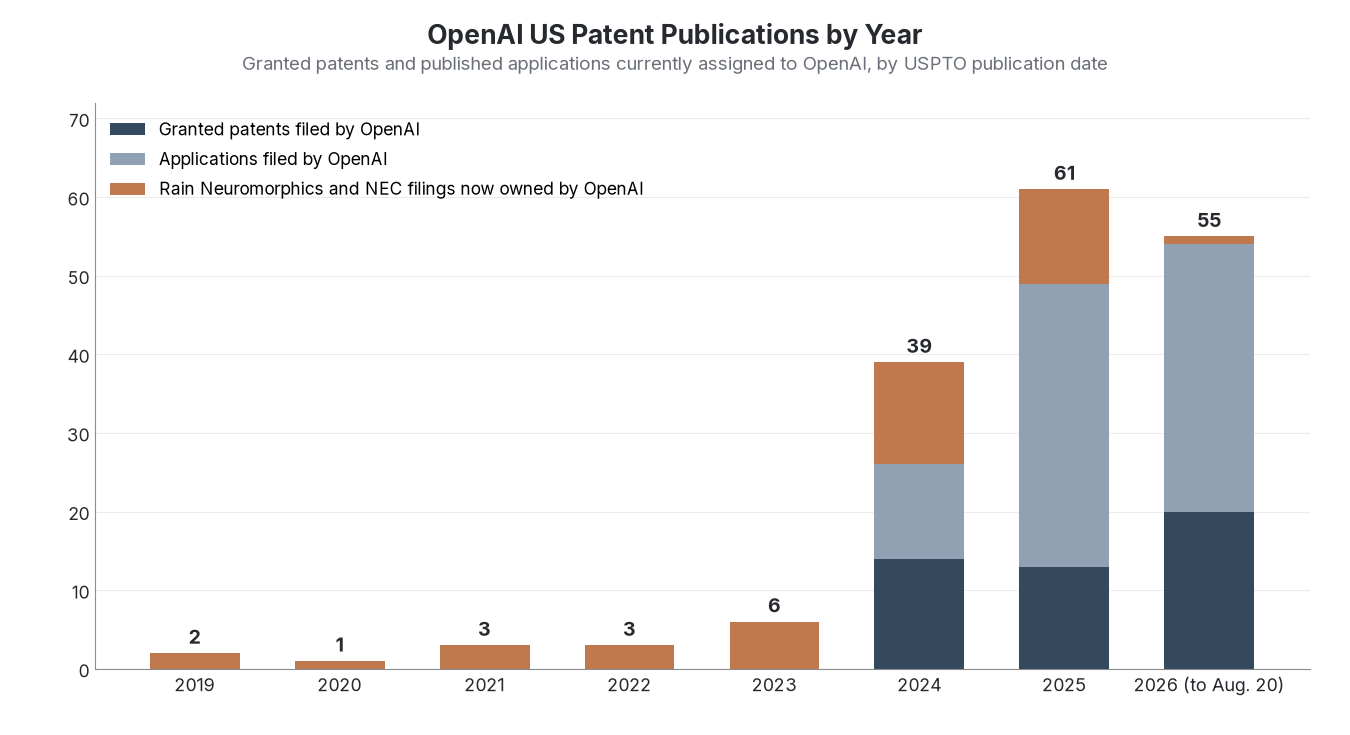
- OpenAI's own filings rose from 26 publications in 2024 to 49 in 2025 and 54 in 2026 through Aug. 20. Of its 129 own filings, 55 claim priority dates in 2023, the first full year after ChatGPT launched.
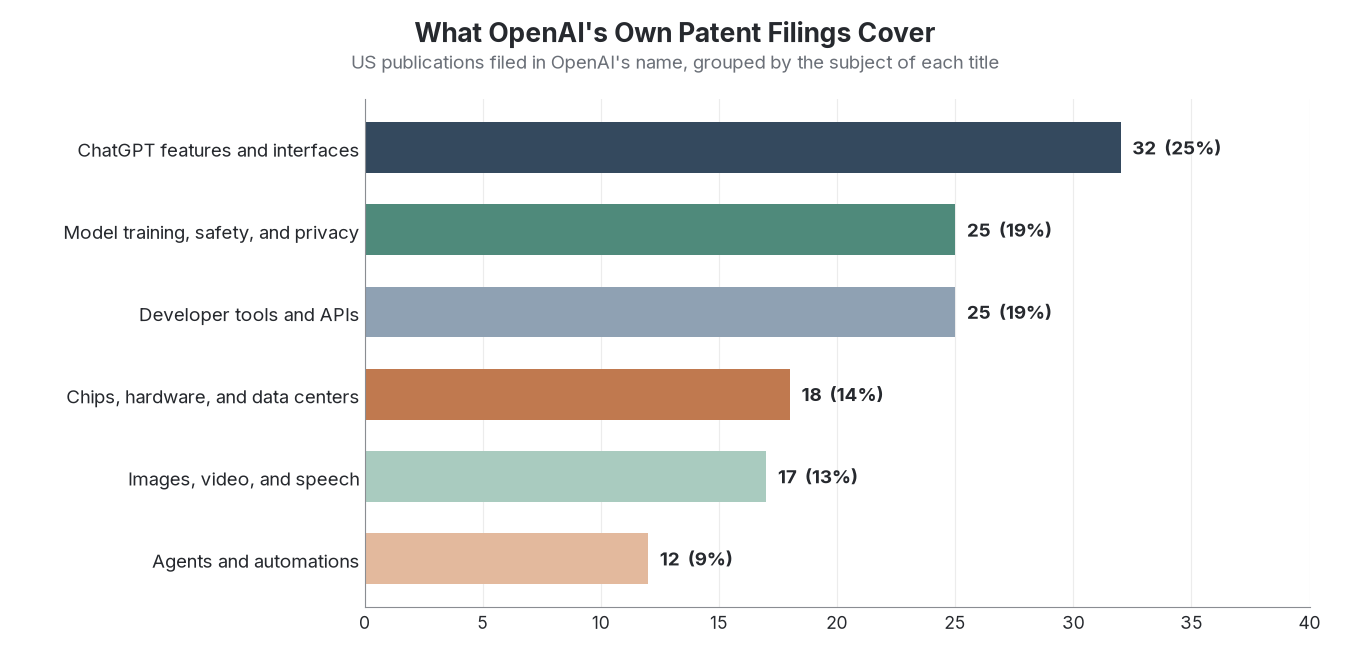
- ChatGPT features and interfaces are the largest group in OpenAI's own filings, 32 of 129, followed by model training and safety and by developer tools at 25 each.
A US patent gives its owner the right to stop others from using an invention for about 20 years, in exchange for publishing how the invention works. AI labs have guarded their training methods as trade secrets, and in October 2024 OpenAI pledged to use its patents only defensively. But the USPTO record shows all three labs building portfolios anyway, and two of them doing it partly by buying patents other companies filed.
In the following sections, we compare the three labs' US portfolios, track OpenAI's filings by year and subject, list the patents OpenAI and Anthropic bought, rank the inventors listed first on OpenAI's filings, set Google DeepMind's record against Google's wider machine learning patents, and add published counts from WIPO, Stanford, and Anthropic's IPO filing.
How Many US Patents OpenAI, Google DeepMind, and Anthropic Hold
We started with the size of each US portfolio held by the companies behind ChatGPT, Gemini, and Claude. The table counts granted patents and published applications separately, since an application gives no rights until the USPTO grants it.
| Lab | Granted patents | Published applications | Total publications | Filed by the lab | Bought from other companies |
|---|---|---|---|---|---|
| Google DeepMind | 363 | 638 | 1,001 | 1,001 | 0 |
| OpenAI | 58 | 112 | 170 | 129 (76%) | 41 (24%) |
| Anthropic | 28 | 35 | 63 | 0 (0%) | 63 (100%) |
Key Findings
- Google DeepMind's 1,001 US publications date back to filings from 2012, when DeepMind was a London startup, and 363 of them are granted patents. OpenAI's earliest own filing claims a priority date of 2022, a decade later.
- OpenAI's 58 granted patents are 2.1 times Anthropic's 28 in the Google Patents index, but Anthropic's count rises to 40 once a September 2026 IBM transfer of 12 more granted patents is added.
- Counts this small leave both newer labs with few patents to assert against rivals. A company sued for patent infringement often counters with its own patents, and DeepMind's portfolio gives Google far more to counter with than OpenAI or Anthropic has.
OpenAI Patent Filings and Grants by Year
Next we tracked when OpenAI's patents became public. US applications are usually published 18 months after the first filing, so the publication year trails the year an invention was filed by about a year and a half.
| Year published | Granted, filed by OpenAI | Applications, filed by OpenAI | Filed by Rain Neuromorphics or NEC | Total |
|---|---|---|---|---|
| 2019 | 0 | 0 | 2 | 2 |
| 2020 | 0 | 0 | 1 | 1 |
| 2021 | 0 | 0 | 3 | 3 |
| 2022 | 0 | 0 | 3 | 3 |
| 2023 | 0 | 0 | 6 | 6 |
| 2024 | 14 | 12 | 13 | 39 |
| 2025 | 13 | 36 | 12 | 61 |
| 2026 (through Aug. 20) | 20 | 34 | 1 | 55 |
Key Findings
- Every publication now owned by OpenAI from 2019 to 2023 was filed by another company. OpenAI's own first grant, for language-model text insertion, was issued on January 30, 2024, and its own filings made up 54 of the 55 publications in 2026 through Aug. 20.
- Of OpenAI's 129 own filings, 55 claim a 2023 priority date and 46 claim 2024. Filings made after early 2025 are mostly still unpublished, so the 2025 priority count of 16 is incomplete.
- OpenAI received 20 grants on its own filings in 2026 through Aug. 20, more than in all of 2024 (14) or 2025 (13).
What OpenAI's Patents Cover
To see what OpenAI is protecting, we grouped its 129 own filings by the subject in each official title. The groups line up with products people use: ChatGPT itself, the developer platform, image, video, and voice tools, and the chips and data centers behind them.
| Subject | Publications | Granted | Share of own filings | Example title |
|---|---|---|---|---|
| ChatGPT features and interfaces | 32 | 13 | 25% | Overlay application and techniques for interfacing with a generative response engine |
| Model training, safety, and privacy | 25 | 10 | 19% | Deliberative alignment of language models to comply with policies |
| Developer tools and APIs | 25 | 11 | 19% | Schema-based integration of external APIs with natural language applications |
| Chips, hardware, and data centers | 18 | 3 | 14% | Microchip package with integrated cold plate |
| Images, video, and speech | 17 | 6 | 13% | Multi-task automatic speech recognition system |
| Agents and automations | 12 | 4 | 9% | Computer using agent with hybrid human and generative response engine control |
Key Findings
- Filings tied to how people use ChatGPT, such as an overlay that works on top of other apps, project folders, file search, and message reactions, make up 25% of OpenAI's own portfolio.
- OpenAI filed 18 chip, hardware, and data center applications in its own name, including liquid cooling, cold-plate chip packages, and memory chiplets, on top of the 39 chip filings it bought from Rain Neuromorphics.
- Model training and safety filings cover methods such as distillation, chain-of-thought reasoning, deliberative alignment, and scrubbing personal data from text. Ten of those 25 have been granted so far.
Patents OpenAI and Anthropic Bought From Other Companies
Buying patents is the fastest way to build a portfolio, because a granted patent from another company comes with years of examination already done. We matched every publication whose original filer was not the lab to the recorded USPTO deed that moved it.
| Buyer | Seller | Deed date | Granted in our data | Applications in our data | Subject |
|---|---|---|---|---|---|
| OpenAI | Rain Neuromorphics | Oct. 21, 2025 | 10 | 29 | Compute-in-memory AI chips and on-chip learning |
| OpenAI | NEC | By Aug. 2026 | 1 | 1 | Server cluster failover |
| Anthropic | Adept AI Labs | April 2, 2025 | 6 | 14 | AI agents that operate software interfaces |
| Anthropic | IBM (first deed) | May 2025 | 22 | 21 | Model training, speech recognition, and question answering |
| Anthropic | IBM (second deed) | Sept. 4, 2026 | 12 | Not in index | Natural language interfaces, search, and event extraction |
Key Findings
- OpenAI's Rain deal moved 39 published Rain filings into OpenAI's name, 10 of them granted, after talks to buy the whole company fell through. OpenAI CEO Sam Altman had invested in Rain personally, and OpenAI signed a letter of intent in 2019 to buy $51 million of Rain chips that were never delivered.
- Anthropic's 20 Adept publications all trace to a single March 20, 2024 filing date and cover AI agents that operate software screens, the kind of computer use Claude offers. Its IBM patents trace to filings as early as 2016.
- Two Rain applications were granted in OpenAI's name on September 29, 2026, after the end of our data, which shows a bought portfolio can keep producing grants for its new owner.
Inventors Listed First on OpenAI's Patents
Patent records also show which researchers OpenAI files inventions for. Google Patents lists the first-named inventor on each publication, so this ranking counts how often each person appears in that spot on OpenAI's own filings.
| Inventor | Publications as first inventor | Granted | Main subject |
|---|---|---|---|
| Noah Deutsch | 23 | 8 | ChatGPT interface and agent features |
| Aditya Ramesh | 9 | 4 | Image generation |
| Andrey Mishchenko | 7 | 3 | Connecting external APIs to language models |
| Mohammed Elneanaei Abdelmoneem Fouda | 7 | 2 | Compute-in-memory chips |
| Mark Chen | 6 | 2 | Code and natural language generation |
| Athyuttam Eleti | 5 | 2 | Assistants API and function calling |
| Nicholas Turley | 4 | 1 | Customized AI models |
| Alec Radford | 4 | 2 | Speech recognition |
Key Findings
- Noah Deutsch is the first-named inventor on 23 of OpenAI's 129 own filings, 18%, more than the next two inventors combined.
- Several of OpenAI's best-known researchers appear first on filings for the products they built: Aditya Ramesh on image generation, Alec Radford on multi-task speech recognition, and Mark Chen on code generation.
- Mohammed Fouda, who is also an inventor on Rain Neuromorphics filings, is first-named on seven compute-in-memory applications filed in OpenAI's own name, which ties OpenAI's chip filings to Rain's engineers as well as its patents.
Google DeepMind and Google Machine Learning Patents by Year
Google files far more patents than either rival, so we looked at two layers: the DeepMind portfolio behind Gemini and the machine learning grants issued to Google LLC as a whole. Both show how much of Google's patent output now goes to AI.
| Year | DeepMind grants | DeepMind publications | Google LLC machine learning grants | Share of all Google LLC grants |
|---|---|---|---|---|
| 2019 | 16 | 58 | 165 | 6% |
| 2020 | 54 | 133 | 287 | 12% |
| 2021 | 27 | 102 | 256 | 14% |
| 2022 | 37 | 81 | 326 | 17% |
| 2023 | 66 | 143 | 469 | 22% |
| 2024 | 65 | 184 | 549 | 24% |
| 2025 | 55 | 154 | 497 | 24% |
| 2026 (through Aug. 20) | 37 | 93 | 272 | 22% |
Key Findings
- Google LLC's machine learning grants rose from 75 in 2016 to 549 in 2024, while its total US grants fell from 3,584 to 2,261. The machine learning share grew from 2% to 24% over the same years.
- DeepMind's publications peaked at 184 in 2024. Its 1,001 publications are 5.9 times OpenAI's 170 and 16 times Anthropic's 63.
- In 2026 through Aug. 20, Google LLC received 272 machine learning grants, 22% of its 1,210 grants, so the share has stayed near a quarter since 2023.
Published Research on AI Lab Patents
Several published studies count AI patents at a wider scale or from filings our data cannot see, such as unpublished applications. We added their figures so the lab counts can be read against the whole field.
| Source | Date | Figure |
|---|---|---|
| Anthropic IPO registration statement (via Litil) | Sept. 30, 2026 | 40 granted US patents, 67 pending US applications (35 provisional), 26 granted foreign patents, 12 pending foreign applications |
| Stanford AI Index 2026 | April 2026 | China received 74.2% of the 131,121 AI patents granted worldwide in 2024; the US share was 12.1%, down from 42.8% in 2015 |
| WIPO Generative AI patent landscape | July 2024 | 54,358 generative AI patent families published from 2014 to 2023; Alphabet/Google ranked eighth among owners |
| WIPO Generative AI patent landscape | July 2024 | OpenAI had filed no patents until early 2023; six OpenAI US patents were published in the first quarter of 2024 |
| GreyB (via Law360) | May 2024 | OpenAI held four issued patents, all in the US, and two pending US applications |
| OpenAI patent pledge | Oct. 11, 2024 | OpenAI pledged to use its patents only defensively unless a party asserts claims against it or harms it or its users |
| Blineip Patent Law Firm | Oct. 9, 2026 | Two former Rain applications granted in OpenAI's name on Sept. 29, 2026: US 12,748,722 and US 12,749,002 |
Key Findings
- Anthropic's IPO filing lists 67 pending US applications, 35 of them provisional. None of its own filings had been published by Aug. 20, 2026, since US applications usually stay confidential for 18 months after the first filing.
- OpenAI went from four issued patents in May 2024 to 58 granted patents in our count through Aug. 20, 2026, 47 of them filed by OpenAI.
- The three labs are a small part of the global AI patent count. The Stanford AI Index counts 97,206 AI patents granted in China in 2024, out of 131,121 worldwide, while the three labs' combined US portfolio, granted and pending, comes to 1,234 publications.
What the Patent Counts Show About the AI Labs
OpenAI and Anthropic both started late, and each found a different way to catch up. OpenAI files most of its patents itself, mostly on product features its users see, while Anthropic bought a ready-made portfolio from IBM and Adept and has not yet published a filing of its own.
Google is in a different position. DeepMind alone holds about 6 times as many US publications as OpenAI, and machine learning now accounts for about a quarter of all patents Google receives, a share that was 2% in 2016.
The OpenAI filings closest to ChatGPT's daily use are its interface patents. Its overlay application, which links a generative AI model to the programs on a person's own device, appears on five publications, the most of any OpenAI title except its schema-based integration of outside APIs with language models, which appears on seven.
Data: openai-patents-statistics-2026.csv
Data Collection and Methodology
Source 1 is our own research, compiled on November 22, 2026: a ledger of 1,234 US patent publications currently or originally assigned to OpenAI, Anthropic, and Google DeepMind, with each publication's grant status, dates, original filer, and first-named inventor, plus a subject classification of OpenAI's own filings and yearly counts of Google LLC grants.
Records come from Google Patents, which republishes USPTO grants and published applications. We searched by assignee name with country set to the US and language duplicates kept, so a granted patent and the published application it came from count as two publications. The latest publication in the index on November 22 was dated August 20, 2026, and that date is the end of our data. Kind codes B1 and B2 and design patents count as granted; A1 and A2 count as applications.
OpenAI covers OpenAI OpCo, LLC and spelling variants in USPTO records; one publication from an unrelated Italian company named OpenAI S.R.L. was removed. Google DeepMind covers publications that list DeepMind Technologies as filer or owner, including those since moved to GDM Holding LLC; 54 were filed by Google and later moved to DeepMind and count as DeepMind's own, since they stayed within Alphabet. Anthropic covers Anthropic, PBC, including records listed under the misspelling Anthropic PBNC.
A publication counts as bought when its original filer was another company. Purchases were matched to USPTO assignment deeds: Rain Neuromorphics to OpenAI (reel 073238/0425, executed Oct. 21, 2025), IBM to Anthropic (reel 071201/0198, May 2025, and reel 075991/0666, executed Sept. 4, 2026), and Adept AI Labs to Anthropic as reported by Litil. The 12 patents in the September 2026 IBM deed were not yet listed under Anthropic in the index and are counted only where stated. Subjects for OpenAI's filings were assigned from keywords in each official title, checked by hand. The machine learning class is CPC group G06N; Google LLC yearly counts use grant publication dates.
Sources
- Top GEO Agencies, US patent publication ledger for OpenAI, Anthropic, and Google DeepMind with origin, grant status, and subject classification (Source 1, our research), compiled Nov. 22, 2026. Download the data
- Google Patents, USPTO grant and application full text, searched Nov. 22, 2026. patents.google.com
- USPTO assignment record, Rain Neuromorphics Inc. to OpenAI OpCo, LLC, reel 073238/0425, recorded Oct. 23, 2025. thepatentplace.com
- USPTO assignment record, IBM to Anthropic, PBC, reel 071201/0198, recorded May 22, 2025. plainsite.org
- USPTO assignment record, IBM to Anthropic, PBC, reel 075991/0666, recorded Sept. 11, 2026. thepatentplace.com
- Aaron Kelly, Where Anthropic Got Its IPO Patents, Litil, Nov. 18, 2026. litil.ai
- Big Tech Patent Brief: OpenAI and Rain AI, Blineip Patent Law Firm, Oct. 9, 2026. blog.blineip.com
- OpenAI adds Rain AI chip patents, Cryptopolitan, August 2026. cryptopolitan.com
- OpenAI, Our approach to patents, first published Oct. 11, 2024. openai.com
- OpenAI Says It Will Only Use Its Patents 'Defensively', Law360, Oct. 15, 2024. law360.co.uk
- WIPO, Patent Landscape Report: Generative Artificial Intelligence, 2024. wipo.int
- Stanford HAI, The 2026 AI Index Report, Research and Development chapter, April 2026. hai.stanford.edu
- Cheng Yu, Report affirms China's AI rise, China Daily, April 17, 2026. chinadaily.com.cn
Source: Top GEO Agencies analysis of USPTO publications via Google Patents, pulled Nov. 22, 2026 (Source 1).
Source: Top GEO Agencies analysis of USPTO publications and assignment records (Source 1).
Source: Top GEO Agencies analysis of USPTO publications via Google Patents (Source 1).
Source: Top GEO Agencies classification of official USPTO titles (Source 1).
Source: Top GEO Agencies analysis (Source 1); USPTO assignment records via The Patent Place and PlainSite; Litil, Nov. 18, 2026.
Source: Top GEO Agencies analysis of USPTO publications via Google Patents; machine learning class is CPC G06N (Source 1).
Sources: Litil; Stanford HAI via China Daily; WIPO; Law360; OpenAI; Blineip.