Wikipedia's Impact on AI Visibility and Recommendation Share: 2026 Study
Published October 20, 2026
When someone asks ChatGPT for the best CRM software or payroll provider, the answer usually comes back as a list of companies. Large, well-known companies tend to have a Wikipedia article, so a single answer cannot show whether the article helps a company get recommended or simply comes with being large. We set out to measure it.
Our analysts put 45 questions about the best B2B software and service providers, such as CRM software, payroll, and cybersecurity, to ChatGPT in October 2026, recorded the 897 brand recommendations in its answers and checked each brand against English Wikipedia. Brands with an article reached the top three places in 19.4% of their recommendations, against 7.2% for brands without one. We also ran 10 of the same questions on Gemini as a smaller supplementary sample, and compared our results with published studies on how ChatGPT, Gemini, Google's AI search features, and Claude use Wikipedia.
In the following sections, we compare recommendation share and list position in ChatGPT for brands with and without a Wikipedia article, show which list positions went to each group, compare positions within the same answer, test whether the gap holds for brands with websites of similar size, and look at employee counts. We then report our supplementary Gemini sample, set our results beside other studies that tested Wikipedia presence, and look at how ChatGPT, Gemini, and Claude cite Wikipedia across published research.
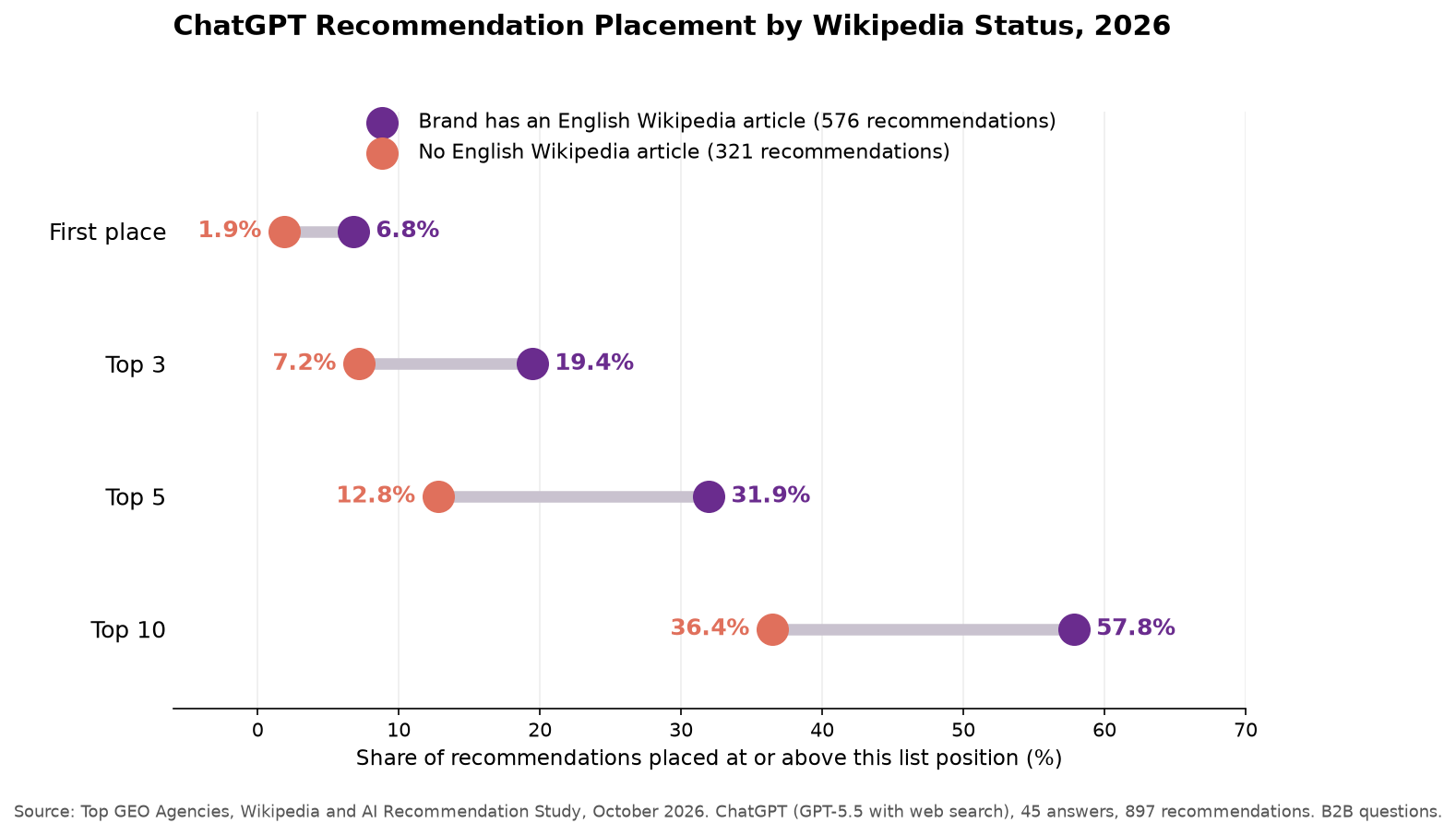
Recommendation Share and Position in ChatGPT for Brands With and Without Wikipedia
Two numbers describe how much of an AI answer each group holds: its share of all recommendations, and how often its recommendations land near the top of the list. Position can matter because readers of a long AI answer may not read all the way to the end of the list, and ChatGPT's lists in our study held about 20 brands each.
| Measure | Brands With a Wikipedia Article | Brands Without a Wikipedia Article |
|---|---|---|
| Distinct brands recommended | 540 | 320 |
| Share of distinct brands | 62.8% | 37.2% |
| Recommendations | 576 | 321 |
| Share of recommendations | 64.2% | 35.8% |
| Placed first | 6.8% | 1.9% |
| Placed in the top 3 | 19.4% | 7.2% |
| Placed in the top 5 | 31.9% | 12.8% |
| Placed in the top 10 | 57.8% | 36.4% |
| Average position | 10.8 | 13.8 |
| Median position | 9 | 13 |
- Brands with a Wikipedia article were placed first 3.6 times as often as brands without one, and reached the top three 2.7 times as often.
- The gap narrowed further down the list. By the top 10, brands with an article were placed there 57.8% of the time against 36.4%, a difference of 21.4 percentage points.
- Brands with an article made up 62.8% of the 860 distinct brands ChatGPT recommended, so they were already the majority before position was taken into account.
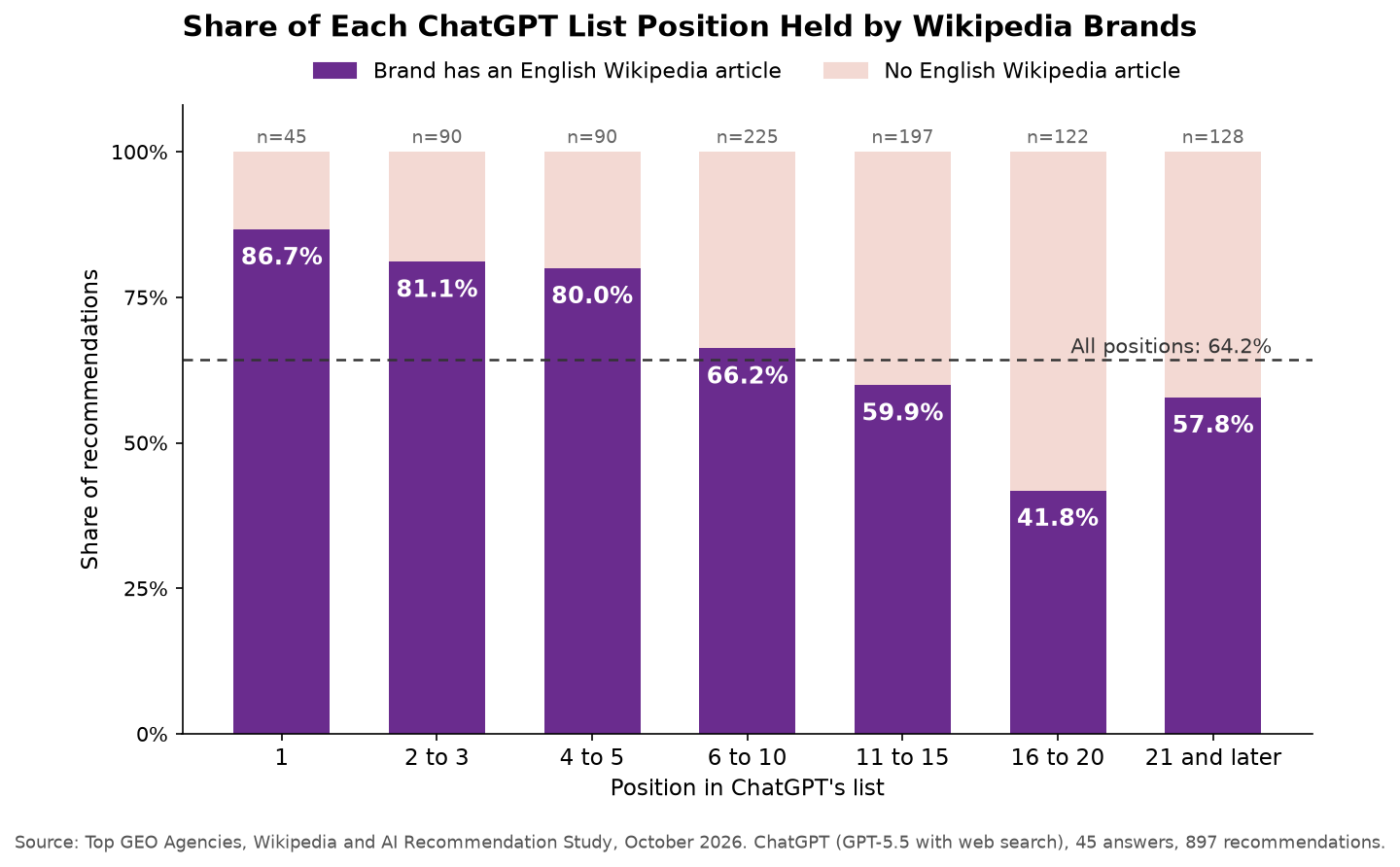
Which ChatGPT List Positions Went to Brands With Wikipedia Articles
Looking at each place on the list shows where the advantage sits. Brands with an article took 64.2% of all ChatGPT recommendations, and their share was highest at the top of the list.
- Of the 45 brands ChatGPT placed first, 39, or 86.7%, had a Wikipedia article. In positions 2 to 5 the share was about 80%.
- The share fell below the overall average after position 10 and reached its low point of 41.8% in positions 16 to 20. Positions 21 and later rose again to 57.8%, because the longest lists came from categories such as data warehouse software, where every brand recommended had an article.
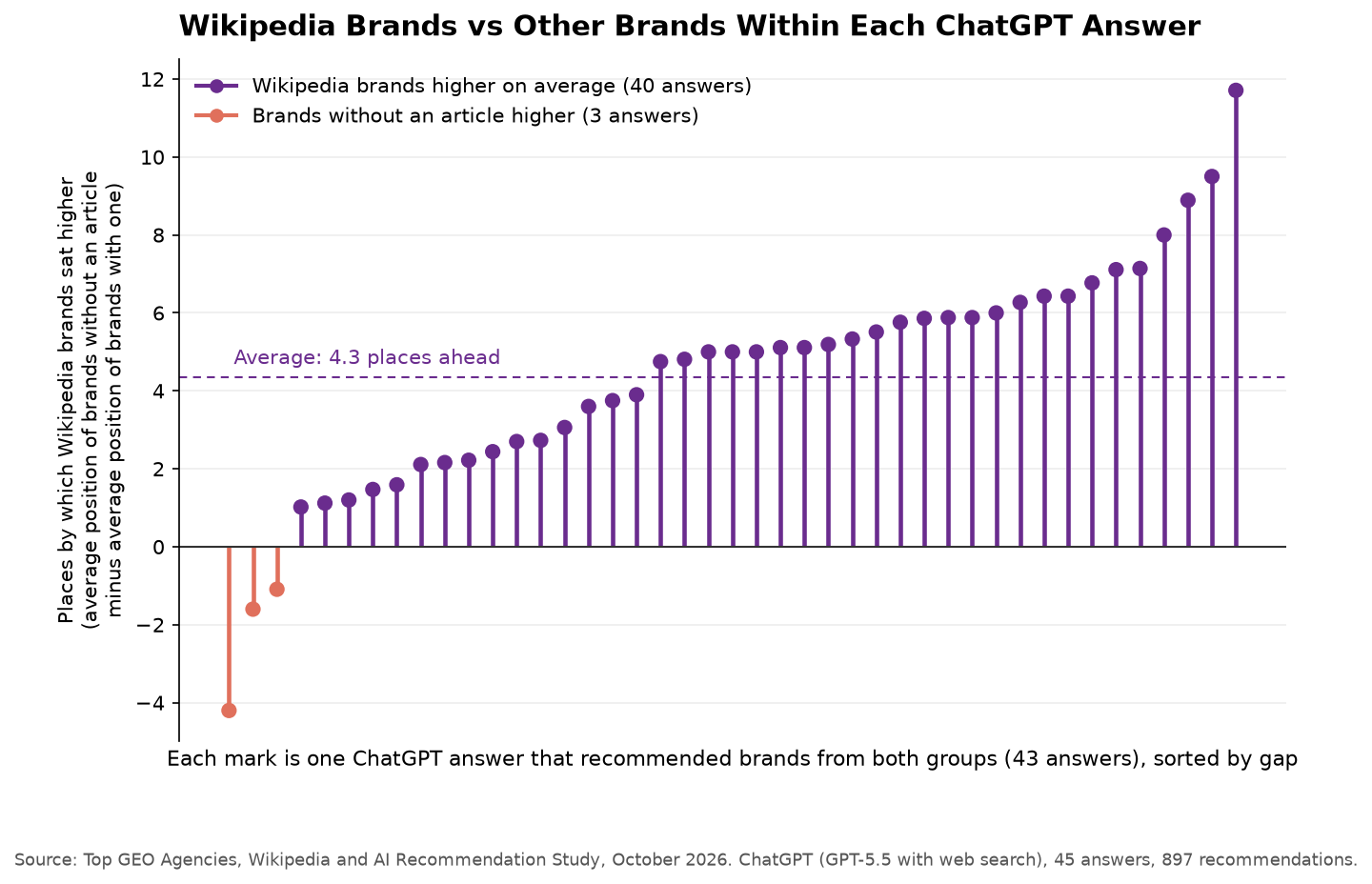
Wikipedia Brands Ranked Higher Within the Same ChatGPT Answer
Comparing brands inside a single answer removes differences between categories, such as data warehouse software, where all 20 brands ChatGPT recommended had an article, and SEO agencies, where none of the 18 did. In the 43 ChatGPT answers that recommended brands from both groups, we compared the average position of each group.
| Measure | Value |
|---|---|
| Answers with brands from both groups | 43 |
| Answers where Wikipedia brands ranked higher on average | 40 |
| Answers where brands without an article ranked higher | 3 |
| Average positions ahead for Wikipedia brands | 4.3 |
| Median positions ahead for Wikipedia brands | 5.0 |
- In 40 of the 43 answers, or 93.0%, the brands with a Wikipedia article sat higher on average than the brands without one.
- The three exceptions were the answers on PR firms, marketing automation software, and third-party logistics, where brands without an article sat between 1.1 and 4.2 places higher on average.
- Because each comparison holds the question fixed, this result does not depend on which categories happen to have more Wikipedia articles. It still mixes in company size, which the next section addresses.
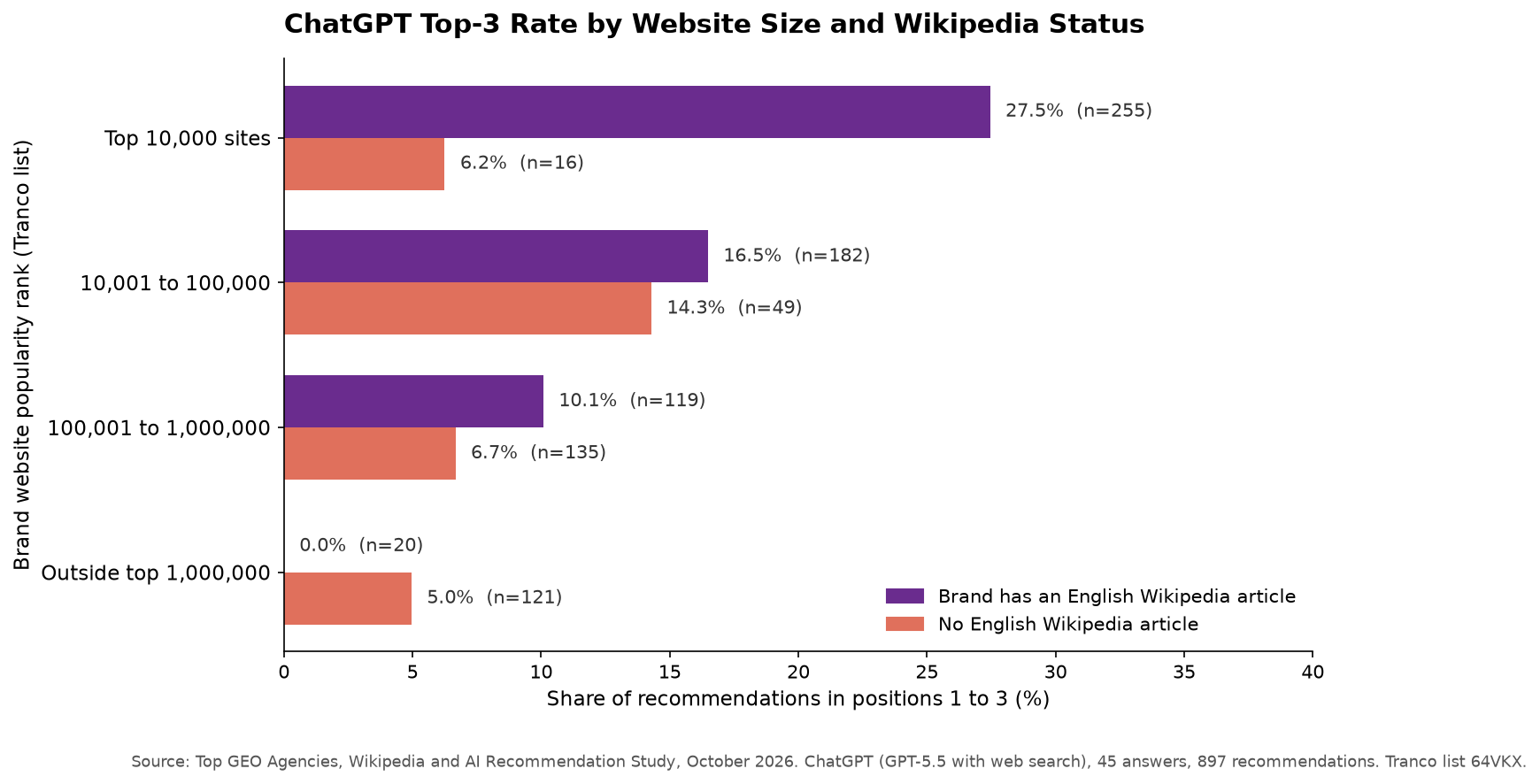
ChatGPT Visibility After Controlling for Company Size
Larger, better-known companies are more likely to have a Wikipedia article and more likely to be recommended, so the raw gap mixes the two. To separate them, brands were grouped by the popularity rank of their website on the Tranco list, a research ranking of the most visited sites, and the two groups were compared within each size band.
| Website Popularity Rank | Recommendations With Wikipedia | Top-3 Rate With Wikipedia | Recommendations Without Wikipedia | Top-3 Rate Without Wikipedia | Average Position With Wikipedia | Average Position Without Wikipedia |
|---|---|---|---|---|---|---|
| Top 10,000 sites | 255 | 27.5% | 16 | 6.3% | 8.2 | 11.6 |
| 10,001 to 100,000 | 182 | 16.5% | 49 | 14.3% | 11.8 | 10.0 |
| 100,001 to 1,000,000 | 119 | 10.1% | 135 | 6.7% | 14.2 | 14.2 |
| Outside top 1,000,000 | 20 | 0.0% | 121 | 5.0% | 16.3 | 15.2 |
- Weighting each band by its number of recommendations, brands with a Wikipedia article had a top-3 rate 7.2 percentage points higher than brands of similar website size without one.
- Average position showed a much smaller difference. After the same size adjustment, brands with an article sat 0.4 places higher on average, and in the 10,001 to 100,000 band the brands without an article were placed higher, at 10.0 against 11.8.
- The largest gap was among the biggest websites, where only 16 recommendations went to brands without an article. In the two middle bands, where both groups were well represented, the top-3 gap was 2.2 and 3.4 percentage points.
Company Size Among Brands With Wikipedia Articles
Wikidata, the structured database linked to Wikipedia, lists an employee count for some companies. Among brands with a Wikipedia article and a listed employee count, ChatGPT's top-3 rate stayed between 22.0% and 28.3% in each band from 1,000 to 9,999 employees up to 100,000 or more. The 10 brands with fewer than 1,000 employees had a top-3 rate of 9.1%, from only 11 recommendations.
| Employees in Wikidata | Brands | Recommendations | Top-3 Rate | Average Position |
|---|---|---|---|---|
| Fewer than 1,000 | 10 | 11 | 9.1% | 9.8 |
| 1,000 to 9,999 | 40 | 46 | 28.3% | 9.3 |
| 10,000 to 99,999 | 41 | 46 | 23.9% | 10.2 |
| 100,000 or more | 55 | 59 | 22.0% | 10.9 |
| No employee count listed | 394 | 414 | 17.9% | 11.1 |
Supplementary Sample: Gemini on 10 of the Same Questions
We also put 10 of the 45 questions to Google's Gemini 3.8 Flash, without Google Search turned on. With 99 recommendations, this sample is too small to stand on its own, so we report it next to ChatGPT's answers to the same 10 questions rather than as a headline figure.
| Platform | Recommendations | Share to Brands With Wikipedia | Top-3 Rate With Wikipedia | Top-3 Rate Without Wikipedia | Average Position With Wikipedia | Average Position Without Wikipedia |
|---|---|---|---|---|---|---|
| Gemini (Gemini 3.8 Flash, no search) | 99 | 82.8% | 34.1% | 11.8% | 5.7 | 7.5 |
| ChatGPT (GPT-5.5, web search) | 185 | 75.7% | 19.3% | 6.7% | 11.3 | 13.3 |
- Gemini gave about 10 brands per answer against about 19 for ChatGPT on these questions, which lifts every group's top-3 rate on Gemini.
- The direction matched ChatGPT. In all 7 Gemini answers that recommended brands from both groups, the brands with an article sat higher on average, by 3.4 places.
- Only 17 of Gemini's 99 recommendations went to brands without an article, so the gap between the groups on Gemini rests on a small number of brands.
Published Studies That Tested Wikipedia Presence and AI Visibility
We searched for other research that tested whether having a Wikipedia article goes with being mentioned or recommended by AI assistants. Four studies did, each with its own brands, questions, and measures, so their figures are reported as their authors published them and are not combined with ours.
| Source | Data and Period | What Was Tested | Finding |
|---|---|---|---|
| Loamly, The Wikipedia Effect (February 2026) | 2,014 companies, four AI assistants including ChatGPT, Claude, and Gemini | Average AI visibility score, companies with and without a Wikipedia page | 24.0 with a page, 6.9 without |
| Loamly, The Wikipedia Effect (February 2026) | Same companies, by platform | Share of queries in which the company was cited, with and without a page | ChatGPT 76.1% vs 69.2%, Claude 72.8% vs 62.2%, Gemini 68.3% vs 55.5% |
| Digital Authority Partners, The Recommendation Gap (2026) | 49 brands, 4,018 checks across five AI assistants including ChatGPT, Gemini, and Google AI Overviews | Correlation between having a Wikipedia page and being recommended by name | 0.03, and slightly negative on ChatGPT |
| Malthouse et al., Northwestern University and Boston University (arXiv, September 2026) | 82 consumer brands, 2,400 lists from GPT-5.5, Gemini 3.1 Pro, Claude Opus 4.7, and three other models, web search off | Wikipedia page views as a predictor of how high a brand was recommended, alongside four other signals | Not significant (p = 0.60); Google search interest was the strongest predictor |
| Franco and da Silva, friction AI (May 2026) | 12 apparel brands, 14,140 responses from five AI systems including ChatGPT, Gemini, Claude, and Google AI Overviews | Whether brands were still recognized with web search turned off | Only the 3 brands without an English Wikipedia article lost recognition |
- The raw pattern in our ChatGPT data matches Loamly's. Companies with a Wikipedia page scored 3.5 times as high on its visibility measure, and Loamly notes that those companies also scored about three times as high on its brand authority measure, 90.9 against 32.1.
- Studies that accounted for other signals found a much weaker link. Digital Authority Partners found almost no correlation between a Wikipedia page and being recommended by name, and the Northwestern team found that Wikipedia page views added little once search interest and online conversation about a brand were counted. Our own size-adjusted gap was 7.2 points on the top-3 rate and 0.4 places on average position.
- Wikipedia may matter most when an assistant answers from memory. In the friction AI study, the brand Varley was recognized with a score of 0.76 out of 1 with web search and 0.36 without it, and LNDR fell from 0.91 to 0.73. Every brand with a Wikipedia article, including Gymshark, was recognized at or near 1.0 in both conditions.
- None of these studies, and not our own, can show that adding an article causes a brand to be recommended more. The friction AI authors disclose that they work in AI brand visibility, and Loamly's figures come from brand reports run on its own platform, using its own visibility score.
How Often Each AI Platform Cites Wikipedia, Across Published Studies
A brand's Wikipedia article can also reach an AI answer as a cited source. Several research teams have counted how often each platform cites Wikipedia, each with its own questions and counting rules, so we charted their figures study by study. The chart below and the tables in the next three sections come from those studies, not from our measurements.
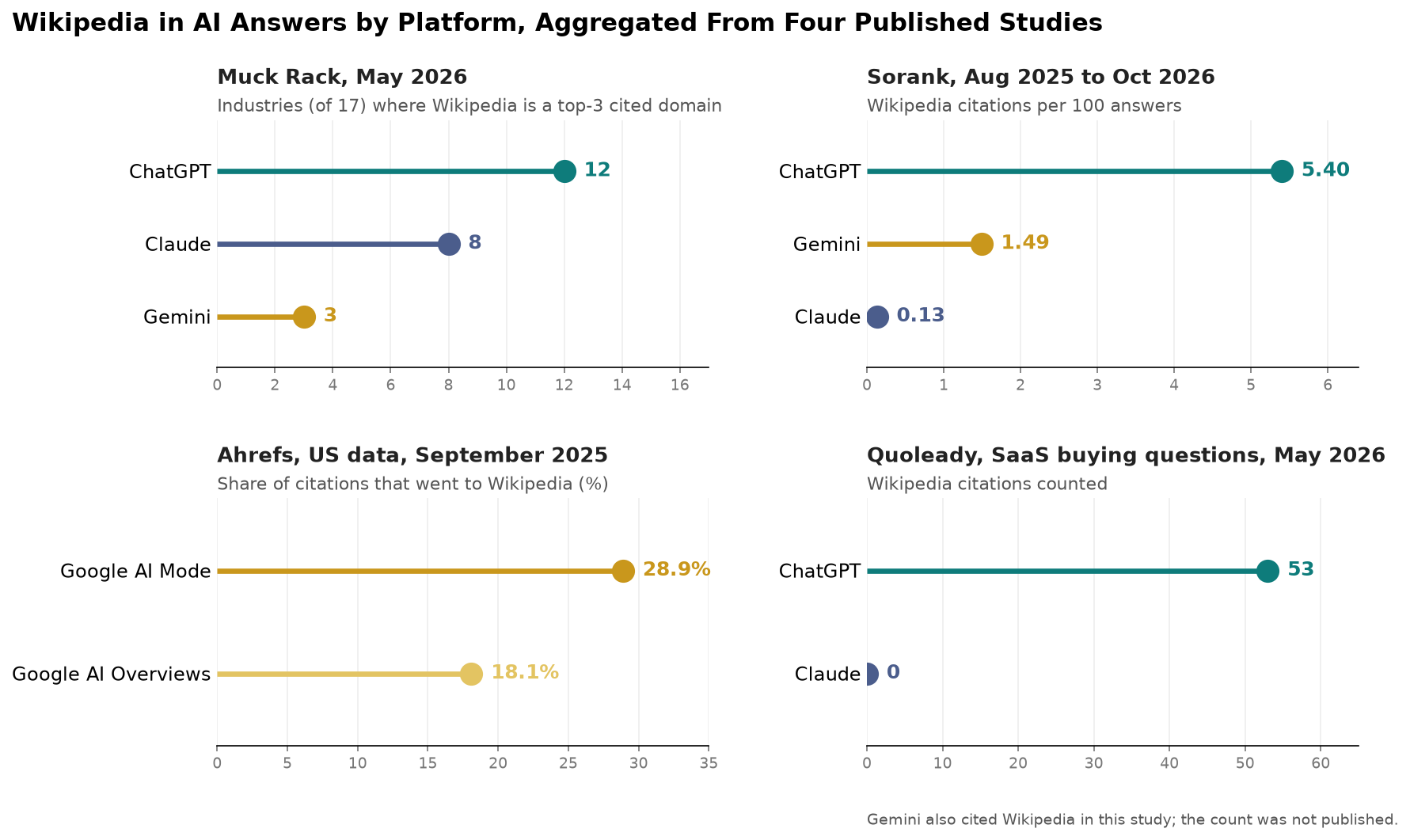
- ChatGPT cited Wikipedia more than any other platform in every study that measured it alongside others. In Muck Rack's analysis of more than 25 million cited links, Wikipedia was one of ChatGPT's three most-cited domains in 12 of 17 industries, against 8 for Claude and 3 for Gemini.
- The studies disagree most about Claude. Muck Rack ranked Wikipedia as Claude's second most-cited domain, while Sorank's panel of buyer questions and Quoleady's software buying questions found Claude almost never cited it.
- Sorank's panel also tracked a steep decline over time. Wikipedia appeared in 5.28% of its measured answers across the AI platforms it tracked in August 2025, peaked at 11.31% in October 2025, and fell to 1.39% by August 2026, so studies from 2025 may show more Wikipedia than AI answers contain today.
Wikipedia in ChatGPT: Training Data, Citations, and Recommendations
ChatGPT draws on Wikipedia in two ways. The models behind it learned from Wikipedia text during training, and when ChatGPT searches the web, Wikipedia pages are among the sources it can retrieve and cite. OpenAI's documentation says ChatGPT search rewrites a question into one or more search queries, sends them to third-party search providers, and shows the pages it used as citations.
| Source | Data and Period | What Was Measured | Figure |
|---|---|---|---|
| Brown et al., Language Models are Few-Shot Learners (OpenAI, 2020) | GPT-3 training data | Wikipedia's weight in the training mix | 3%, read about 3.4 times during training |
| Muck Rack, What Is AI Reading? (May 2026) | More than 25 million cited links, 17 industries | Wikipedia's rank among cited domains | 1st |
| Semrush, AI Visibility Study (September 2025) | Prompts in five industries | Wikipedia citations per 100 ChatGPT prompts | 167 in digital technology, 152 in business services |
| Semrush, The Most-Cited Domains in AI (November 2025) | 230,000 prompts, July to October 2025 | Share of responses citing Wikipedia | About 55% in early August 2025, under 20% by mid-September |
| Sorank, Wikipedia in AI Answers (August 2026) | 301,025 answers to buyer questions, August 2025 to August 2026 | Wikipedia citations per 100 answers | 3.43 |
| Quoleady, LLM citations study (May 2026) | More than 10,000 citations from SaaS buying questions | Wikipedia's share of ChatGPT citations | 13.2% (53 citations) |
| BrightEdge, AI search insights (April 2026) | ChatGPT responses that cited Wikipedia | Share that also cited Encyclopedia Britannica | 43% |
- In our ChatGPT answers, brands with an article took 39 of the 45 first places. Wikipedia is also one of the sources ChatGPT cites most on business topics: in Semrush's business services prompts, it cited Wikipedia about one and a half times per prompt on average.
- GPT-3 is the last OpenAI model whose training mix was published. Wikipedia made up 3 billion of the roughly 499 billion tokens in its listed datasets, but OpenAI weighted it so the model read it about 3.4 times, against less than once for most of the web crawl.
- Semrush recorded a sharp change in September 2025, when the share of ChatGPT responses citing Wikipedia fell from about 55% to under 20%. Wikipedia stayed one of ChatGPT's two most-cited domains afterward, which shows how quickly the weight of a single source can shift.
Wikipedia in Gemini, Google AI Overviews, and AI Mode
Google's AI answers reach people through the Gemini assistant and through AI Overviews and AI Mode in Google Search. Google's documentation says AI Overviews and AI Mode may run several related searches for one question, a method it calls query fan-out, and that pages need no special markup to appear as supporting links. Our supplementary Gemini sample, without search, gave 82.8% of its recommendations to brands with an article.
| Source | Data and Period | What Was Measured | Figure |
|---|---|---|---|
| Muck Rack, What Is AI Reading? (May 2026) | Gemini, 17 industries | Wikipedia's rank among Gemini's cited domains | 4th, behind Reddit, YouTube, and Quora |
| Sorank, Wikipedia in AI Answers (August 2026) | Gemini answers to buyer questions | Wikipedia citations per 100 answers | 1.38 |
| Ahrefs, Insights From 55.8M AI Overviews (May 2025) | 55.8 million AI Overviews across 590 million searches | Mentions of English Wikipedia | 2,920,525, second to Reddit's 2,971,746 |
| Ahrefs, AI Mode and AI Overviews study (2025) | 540,000 US query pairs, September 2025 | Share of citations that went to Wikipedia | 28.9% in AI Mode, 18.1% in AI Overviews |
| Semrush, The Most-Cited Domains in AI (November 2025) | AI Mode, July to October 2025 | Share of responses citing Wikipedia | About 2% to 3% |
| BrightEdge, AI search insights (April 2026) | Keywords where Wikipedia ranks and an AI Overview appears | Wikipedia citations that came with a top-3 organic ranking | 75%, with Wikipedia cited on fewer than half of those keywords |
| Calderon et al., Google Research (arXiv, 2026) | Facts drawn from a sample of 10,000 Wikipedia pages, Gemini 3 Pro | Facts recalled directly, most viewed vs least viewed fifth of pages | 84.6% vs 63.3% |
- The Google Research paper found that Gemini 3 Pro had stored nearly all the facts it was tested on, 99.5% from the most-viewed pages and 94.5% from the least viewed, but recalled the less popular ones far less reliably. A company whose Wikipedia page draws few readers is the kind of subject a model may know about and still fail to bring up.
- Muck Rack found Gemini cited sources in 82% of its answers, averaging 8 citations when it did, and its most-cited domain was Reddit.
- Within Google Search, Wikipedia carried more weight in AI Mode than in AI Overviews in Ahrefs' data, while Semrush counted it in only a few percent of AI Mode responses. The two studies counted in different ways over different queries, so their figures cannot be reconciled with each other.
Wikipedia in Claude: What Published Research Shows
We did not run our questions on Claude, so this section reports what other researchers have published about how Claude uses Wikipedia. Each study counted something different, so the rows cannot be compared with one another or with our own tables.
| Source | Data and Period | What Was Measured | Figure |
|---|---|---|---|
| Muck Rack, What Is AI Reading? (May 2026) | More than 25 million cited links, 17 industries | Industries where Wikipedia was one of Claude's three most-cited domains | 8 of 17 |
| Sorank, Wikipedia in AI Answers (August 2026) | 20,011 Claude answers to buyer questions | Wikipedia citations per 100 answers | 0.03 |
| Quoleady, LLM citations study (May 2026) | Citations from SaaS buying questions | Wikipedia citations counted | 0 |
| Loamly, The Wikipedia Effect (February 2026) | Claude answers about 2,014 companies | Share of queries citing the company, with and without a Wikipedia page | 72.8% vs 62.2% |
| Chu and Hou, Incumbent Advantage (arXiv, 2026) | Claude Sonnet, 112 English trials with identical products | Trials in which Claude picked the real, well-known brand | 112 of 112 |
- Muck Rack found Wikipedia was Claude's second most-cited domain overall, after the medical research database PubMed Central. Claude cited sources in only 55% of its answers, against 96% for ChatGPT, and averaged 13 citations when it did.
- On software buying questions, Claude leaned on list-style articles. In Quoleady's study, 71.5% of Claude's citations went to "best tools" roundups and similar lists, the highest share of any model it tested.
- Claude can also recommend a company it learned about in training without citing any page. In Chu and Hou's test, a rival with a slightly better rating won Claude's pick 11% of the time, against 94% for GPT-4o-mini and 88% for Gemini 3 Flash. Anthropic's documentation says Claude decides for itself when to run a web search and attaches citations to the sources it uses.
- Together these studies suggest that, on buying questions, Claude relies more on brands it already knows and on list articles than on Wikipedia pages it retrieves, while companies with a Wikipedia page are still cited more often in its answers.
What Wikipedia AI Visibility Trends Mean for 2027 and Beyond
When a business buyer asks ChatGPT for vendors, the companies placed near the top of the answer tend to be the ones that independent writers have covered well enough to earn a Wikipedia article. That pattern favors established companies, and it leaves newer firms competing for the lower places on the list.
Wikipedia also shapes these answers in ways that citation counts do not show. The Wikimedia Foundation says almost all large language models train on Wikipedia datasets, even as human pageviews on Wikipedia in mid-2025 ran about 8% below the same months of 2024, so more of what people learn from Wikipedia now reaches them through AI answers that may never link to it.
Wikipedia's notability guideline for companies asks for significant coverage in independent, reliable sources before a company gets an article. A company with an article can keep it accurate and well sourced, and a company without one can start by earning that kind of coverage in independent publications.
Data Collection and Methodology
The Top GEO Agencies research team wrote 103 prompts in October 2026 asking for the best companies or brands in 50 B2B and 53 B2C categories, from CRM software and payroll providers to mattresses and cruise lines, each ending with a request to list specific companies or brands. Each prompt was sent once to each platform. OpenAI's GPT-5.5, which stands in for ChatGPT in this study, was called through a third-party API with that service's web search tool turned on on October 13, 2026, and it answered 45 prompts, all of them B2B, before the study's API credit ran out. No B2C prompt was answered, so every measured figure covers B2B categories only.
The supplementary Gemini sample used Google's Gemini 3.8 Flash through the Gemini API on October 21, 2026, without Google Search grounding, which the study's Gemini access did not include. It answered 10 of the same 45 B2B prompts before reaching the API's daily request limit, giving 99 recommendations, of which 17 went to brands without an article. That is too few for size-adjusted or employee-count figures, so Gemini is reported only in its own section, and its figures should be read as a first look.
Claude was not tested, because the study had no working API access to it. The sections on published studies and on how each platform cites Wikipedia report figures from the studies, papers, and documentation listed in Sources, as their authors published them. We did not recalculate, combine, or extend those figures, and they are not mixed into our measured tables. The studies used different question sets, periods, countries, and counting rules, and several included AI assistants beyond the three this article covers in their totals. Chart 5 shows each study in its own panel with its own scale for that reason. Three other reports were left out: one was taken offline before we could check it, one did not describe its method, and one had no comparison group of brands without an article.
A separate low-cost model call read each answer and listed the brands it recommended in order of first appearance, with each brand's official website. Position is that order, counting each brand once per answer. Product names were kept as written, so "Paychex Flex" counts as a recommendation of Paychex.
Each brand was checked against English Wikipedia through the Wikipedia and Wikidata APIs. A brand counted as having an article when an article's Wikidata record listed the same official website, including a parent company's website for product names, or when the article title matched the brand name and its description identified a company, brand, or product. Disambiguation pages did not count. Two automated results were corrected by hand: Sage was matched to Sage Group and Linear to Linear Orbit, Inc. In an earlier manual check of 40 brands marked as having no article, 1 had one, so the without-Wikipedia group includes a small number of misclassified brands.
Recommendation share is a group's recommendations divided by all recommendations. The top-3 rate is the share of a group's recommendations that appeared in positions 1 to 3, and the first-place, top-5, and top-10 rates are defined the same way. Average position is the mean list position. The website size bands use each brand's domain rank on the Tranco list 64VKX, downloaded in October 2026; domains not in the top million form the last band. The size-adjusted gap is the difference between the groups within each band, weighted by the band's total recommendations and computed from unrounded rates.
The study is correlational and controls for company size through website popularity bands. It shows that brands with Wikipedia articles were placed higher by ChatGPT, and it cannot show that adding an article would move a given brand up, since brand age, press coverage, and the volume of reviews and comparison articles affect both. Each prompt was run once, and AI answers vary between runs. Both models were reached through APIs, whose answers can differ from the ChatGPT and Gemini apps. Domains came from the extraction model and were not all checked by hand, and Wikidata employee counts exist mainly for companies that already have an article.
Sources
- Top GEO Agencies, Wikipedia and AI Recommendation Study (October 2026): 996 brand recommendations from ChatGPT and Gemini checked against English Wikipedia. Our analysts put 45 "best X" questions about B2B software and services to OpenAI GPT-5.5 with web search, and 10 of them to Google Gemini 3.8 Flash, extracted the brands recommended in order, matched each brand to English Wikipedia and Wikidata, and compared recommendation share, list position, top-3 rate, same-answer position, and website-size-adjusted placement for brands with and without an article.
- Wikimedia Foundation, MediaWiki Action API, English Wikipedia
- Wikimedia Foundation, Wikidata API
- Tranco, A Research-Oriented Top Sites Ranking, list 64VKX
- Loamly, The Wikipedia Effect: 3.5x Higher AI Visibility (2,014-Company Study)
- Digital Authority Partners, The Recommendation Gap: An Original Data Study
- Malthouse, Lee, Yang, Pal, and Feng, Evaluating Brand Retrieval and Ranking in Large Language Model Recommendations, arXiv 2609.16304
- Franco and da Silva, Beyond Knowledge Graph Strength: What 14,140 LLM Queries Revealed About Brand Visibility in Generative AI, friction AI
- Muck Rack, What Is AI Reading? May 2026
- Sorank, Wikipedia in AI Answers: a Data Study of Its Decline over 13 Months
- Semrush, How AI Search Really Works: Findings from Our AI Visibility Study
- Semrush, The Most-Cited Domains in AI: A 3-Month Study
- Ahrefs, Insights From 55.8M AI Overviews Across 590M Searches
- Ahrefs, Are AI Mode and AI Overviews Just Different Versions of the Same Answer? (730K Responses Studied)
- BrightEdge, How Google AI Overviews and ChatGPT Cite Wikipedia Differently
- Quoleady, A Study of 10,000 LLM Citations: Where AI Pulls Data From (SaaS High-Intent Prompts)
- Calderon et al., Empty Shelves or Lost Keys? Recall Is the Bottleneck for Parametric Factuality, arXiv 2602.14080
- Brown et al., Language Models are Few-Shot Learners, arXiv 2005.14165
- Chu and Hou, Incumbent Advantage: Brand Bias and Cognitive Manipulation Dynamics in LLM Recommendation Systems, arXiv 2606.17443
- OpenAI, Searching the web with ChatGPT
- Google Search Central, AI features and your website
- Anthropic, Web search tool documentation
- Wikimedia Foundation, New User Trends on Wikipedia
- Wikipedia, Notability (organizations and companies)