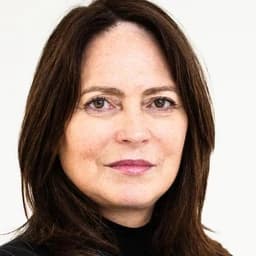
Pattie Maes
Professor of Media Technology; Germeshausen Professor
MIT Media Lab
Pattie Maes is a Belgian-born computer scientist at the MIT Media Lab in Cambridge, Massachusetts, where she leads the Fluid Interfaces group and co-directs the Advancing Humans with AI program. She pioneered software agents and collaborative filtering in the 1990s, and her group now tests how AI shopping agents respond to prices, ratings and persuasive nudges.
Recommendation Engines and the Advertising Bargain
"So we learned with social media that because of the advertising model, basically the incentives of the company and the user are not aligned," Maes said on the Pioneers of AI podcast in July 2025. "I am worried that with AI the situation is only going to be worse."
In the 1990s her team at the Media Lab built collaborative filtering, which recommends books, music and films by matching a person's taste with the tastes of similar people. The group argued early that a recommender should "not just give you what you like or more stuff like what you like," and should also show people things outside their usual interests. Once the method went commercial, she said, the business model decided how it was used, and ad-funded sites tuned it toward whatever people were most likely to click.
Sending AI Agents Shopping
That concern now runs through her group's work on AI agents that buy on a person's behalf. With Manuel Cherep and Nikhil Singh, Maes co-authored ABxLab, an ICLR 2026 study that ran more than 80,000 experiments in a realistic web store with 17 AI agents. Changing a product's price, rating or position, or adding a persuasive line built on authority, social proof or scarcity, shifted what the agents picked, even when the products were otherwise identical. People shown the same pages were far less swayed. The framework is released as an open benchmark.
A companion paper in PNAS in June 2026 tested leading language models on a human decision task with defaults, suggestions and highlighted information. The models reacted to weak cues far more strongly than people did, and chain-of-thought prompting did not reliably steady them.
Benchmarks for Human Flourishing
"We think that these AI models should also be evaluated on the human impacts of what happens to people when basically they rely on these systems day in, day out," Maes said on the same podcast. She and her colleagues ran a month-long study with about 1,000 participants, in collaboration with OpenAI, comparing chatbot models. The heaviest daily users tended to become lonelier, socialize less and grow more dependent on the AI.
She worries that chatbots can turn into private echo chambers. "With AI, basically I think we risk getting bubbles of one, where basically you and your AI keep echoing back to one another certain points of view or beliefs," she said. Her view of who should set the direction is blunt: "We cannot leave it just up to Silicon Valley or entrepreneurs and engineers to decide what kind of future with AI we want."
From Brussels to the MIT AI Lab
Maes earned her bachelor's degree and PhD in computer science and artificial intelligence at the Vrije Universiteit Brussel in Brussels, Belgium. She came to the MIT Artificial Intelligence Lab as a visiting professor and research scientist, working with Marvin Minsky and Rodney Brooks, before joining the Media Lab faculty. She traces her agent research to 1994, the year she became a mother. "I wrote my first paper about the idea that we need to build software agents that help us with task overload and information overload," she said.
She co-founded Firefly Networks, which took the collaborative filtering work to market and was sold to Microsoft. She also co-founded Open Ratings, which scored supplier performance from transaction data and was sold to Dun & Bradstreet, and Tulip, which makes software for factory floor operations.
She has published more than 500 peer-reviewed articles and edited four books. In 2025 the ACM gave her its Lifetime Achievement Award in Human-Computer Interaction, and she holds honorary doctorates from the Vrije Universiteit Brussel and the Open Universiteit in the Netherlands.