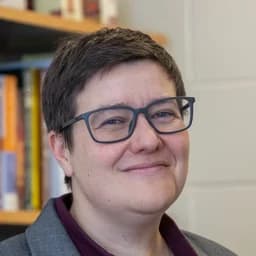
Sorelle Friedler
Shibulal Family Professor of Computer Science; Co-Director, Michael B. Kim Institute for Ethical Inquiry and Leadership
Haverford College
Sorelle Friedler is a computer scientist at Haverford College in Haverford, Pennsylvania, where she directs the AI & Society Lab and co-directs the Michael B. Kim Institute for Ethical Inquiry and Leadership. A co-founder of the ACM FAccT conference and a co-author of the White House Blueprint for an AI Bill of Rights, she co-authored the first published audit of the ads OpenAI began showing inside ChatGPT.
Auditing the First Ads Inside ChatGPT
"Figure out what your product is and test it to make sure it works," Friedler said at a Haverford Founders Porch discussion on the ethics of AI. "I always feel a little silly saying that. It seems like it should be really obvious."
Her lab at Haverford works closely with Danaé Metaxa's lab at the University of Pennsylvania, and in 2026 the two groups tested how advertising arrived in ChatGPT. With Emma Lurie and Ro Encarnación, they ran 91 accounts signaling different races and income levels and collected more than 3,000 ads from 186 advertisers. Lower-income accounts were more likely to see ads, with no evidence that race played a role. Writing for Brookings, where Friedler is a nonresident senior fellow, the authors called for mandatory transparency rules and researcher access to served ads. "Policymakers should act now to protect independent monitoring and constrain potentially deceptive advertising practices across these AI platforms," they wrote.
Chatbots and City Services in Philadelphia
In October 2025, Friedler testified at a Philadelphia City Council hearing on how city government should use AI. "It's important to understand that a lot of generative AI (chatbots) are just trained on the entire internet, that means they're not necessarily trained to do what the city needs them to do," she said, as PhillyVoice reported. "They're trained to give answers that are pleasing to people, that doesn't necessarily mean correct answers."
She pointed to useful government applications, such as working through the backlog of cases at the U.S. Department of Veterans Affairs, while warning about job losses and the power and pollution of data centers. At Haverford she framed the stakes for public services in numbers: "If an AI system works correctly 98% of the time, that would be pretty good. But a government can't work only for 98% of the people."
From Alphabet's X Lab to the White House
Before teaching, Friedler was a software engineer at Alphabet, where she worked in the X lab and on search infrastructure. She holds a bachelor's degree from Swarthmore College in Swarthmore, Pennsylvania, and a PhD in computer science from the University of Maryland, College Park. Her research covers fairness and interpretability in machine learning, AI auditing, and AI policy, including early work on disparate impact in machine learning, and it has been funded by the NSF, DARPA, the Ford Foundation, and the MacArthur Foundation.
She served as Assistant Director for Data and Democracy in the White House Office of Science and Technology Policy, where she co-authored the Blueprint for an AI Bill of Rights and contributed to rules for federal agencies' use of AI. She now chairs the ACM's U.S. Technology Policy Committee and writes regularly on AI policy, from a 2025 Tech Policy Press op-ed with Nicol Turner Lee on generative AI in schools to 2026 testimony on the New York AI Act.