The AI Citations Drivers Paper, Explained
Published November 5, 2026
Generative search engines such as ChatGPT, Gemini, and Perplexity answer a question with written text and a handful of source links. Those links decide which Web pages, and which brands, readers see. A growing industry of generative engine optimization advises publishers to earn citations by adding FAQ blocks, structured data, summary boxes, and author information, yet whether those practices work outside controlled tests has been hard to tell, because popular websites both adopt the practices and get cited for other reasons.
Our researchers read What Drives AI Citations? Content, Retrieval and Model Knowledge in Generative Engine Optimization (GEO), a paper by Mahe Chen and Nick Koudas of the University of Toronto, and wrote this report to explain its findings in simple terms and what they mean for brands and publishers. The paper was posted to arXiv on October 10, 2026 (arXiv 2610.15033). The authors studied two 90-day collections of daily answers to commercial questions: a consumer market of US home internet providers (651 questions, 143,249 answers, 396,188 citations) and a niche market of small business-software vendors (55 questions, 14,850 answers, 71,849 citations), for 158,099 answers and 468,037 citations in total. They compared pages of the same website, replayed every question through the engines' APIs to see what each search retrieved, probed what the models already knew without search, and ran controlled experiments that changed source order and brand names one factor at a time (Abstract; pages 1 to 3, Introduction).
In the following sections, we explain how the study was built, what the authors concluded, which page features go with more citations within a website, how recommended GEO practices look across websites versus within them, how much ChatGPT's own retrieval explains, how retrieval differs from Google and Bing, how the model's prior knowledge shapes brands and citations, what the controlled experiments found, how the niche market compared, and the limits the authors note themselves.
How the Study Was Built
The authors asked three research questions. Which properties of a page go with more citations when pages are compared within the same website? How much of the variation in citations do page properties explain, and what explains the rest? How do the engine's retrieval and the model's own knowledge shape which pages are cited and which brands are mentioned (page 1, Abstract)?
Two markets and three engines
The main dataset covers answers from ChatGPT, Gemini, and Perplexity between June 24 and September 21, 2026, for 651 US home-internet questions. A second dataset covers 55 niche B2B software questions over a matching 90-day window. Table 1 summarizes the main dataset by engine (page 3, Table 1).
| Metric | ChatGPT | Gemini | Perplexity |
|---|---|---|---|
| Answers | 58,590 | 26,069 | 58,590 |
| Citations | 116,530 | 263,300 | 16,358 |
| Pages cited per answer | 2.0 | 10.1 | 0.3 |
| Answers without a citation | 30.8% | 15.6% | 95.8% |
| Unique URLs / websites | 15,833 / 2,190 | 23,640 / 5,452 | 3,498 / 1,067 |
| Citations to brand websites | 64.3% | 16.8% | 6.8% |
- ChatGPT cited about two pages per answer and sent 64.3% of its citations to brand websites. Gemini cited 10.1 pages per answer, with 83% of citations on third-party sites (Reddit alone 13%). Perplexity left 95.8% of answers without a citation (page 3, Table 1 and Section 3).
- Every cited URL was downloaded once; 63.2% of 39,059 URLs returned usable HTML. The authors measured fourteen page features, including how well the title and paragraphs matched the query set, structural counts, and markers for FAQ blocks, summary boxes, author bylines, and schema.org markup (pages 3 and 4, Section 3.2).
Within-website comparisons and five robustness tests
A page on a popular website is cited more often than one on an obscure website for reasons that have nothing to do with the page. The authors therefore compared each page only with other pages of the same website, and called a feature real only if it passed five tests: false-discovery-rate control, stability selection, double machine learning, a sensible partial-effect shape, and the same sign in at least four of five data variants (pages 3 and 4, Section 3.3). Continuous features are reported as the percentage more citations per standard deviation; yes/no markers compare a page that has the marker with one that does not.
What the Paper Concluded
The authors summarize the results in three terms from their title. Content matters in one way: pages whose title and paragraphs match the questions people ask are cited more, whereas FAQ blocks, structured data, summary boxes, author boxes, and page speed appear effective only across websites. Page properties explain little of the variation between pages of a website (2.8% for ChatGPT). Retrieval explains far more of that variation (32%), because every page ChatGPT cites is one its own search retrieved, and those rankings rarely match Google or Bing. The model's knowledge shapes both steps and the answer itself: ChatGPT writes brands it knows into its searches, prefers websites it knows, and mentions brands without any supporting page (46% of its brand mentions), and controlled experiments show that brand names reorder its rankings of products with identical facts (pages 1 and 2, Abstract and Introduction).
In short, pages are cited when they are searched; brands are also mentioned when they are remembered. The findings replicate in a market of small B2B vendors, with differences that track how little the models already know about those brands (page 2, Introduction).
Which Page Features Go With More Citations Within a Website
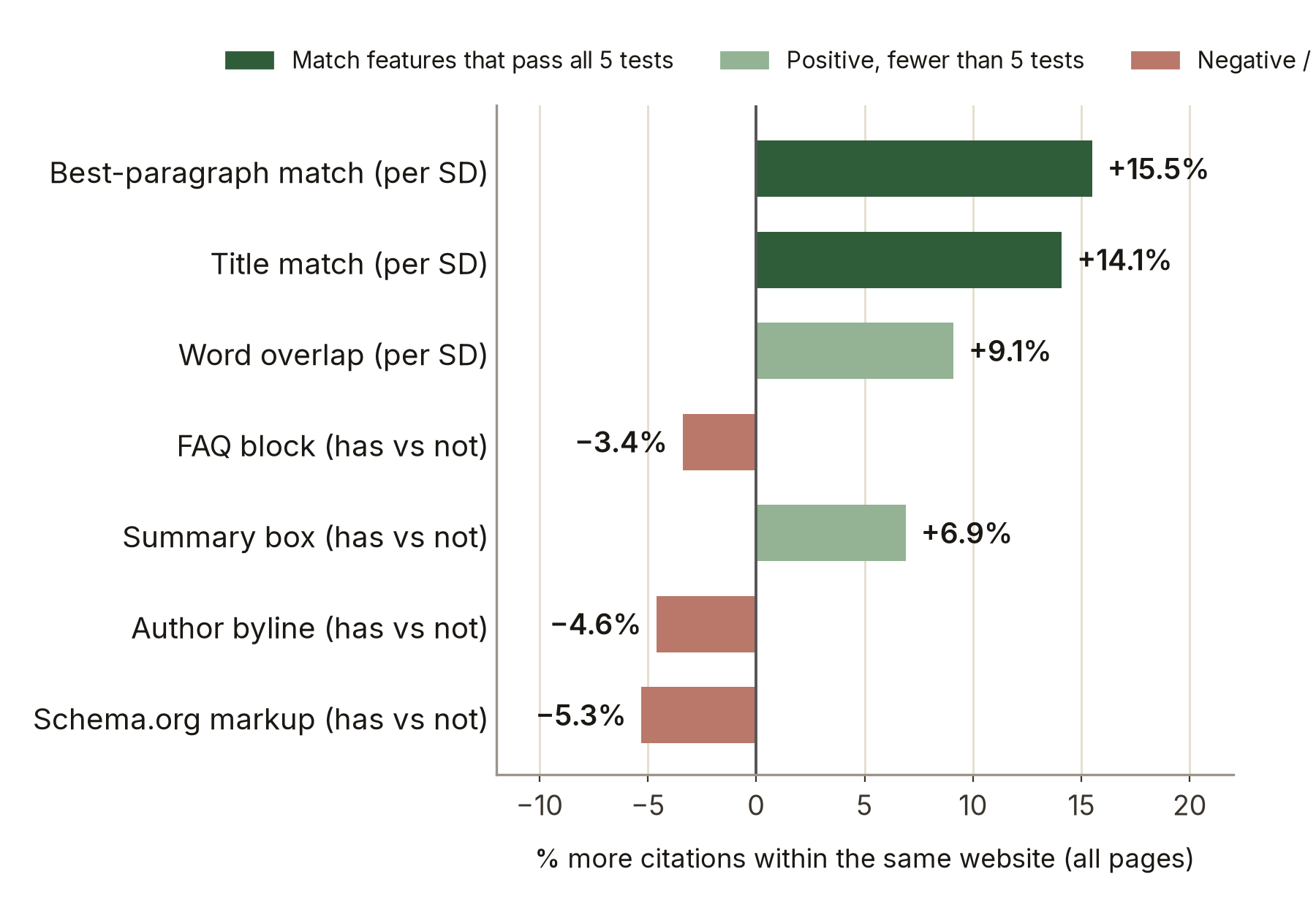
Table 2 reports the within-website effect of each feature on all pages, on brand pages, and on third-party pages, with the number of the five tests passed in parentheses. Only match features pass all five tests on all pages (page 4, Table 2).
| Feature | All pages | Brand pages | Third-party pages |
|---|---|---|---|
| Best-paragraph match (per SD) | +15.5% (5) | +5.2% (2) | +25.7% (5) |
| Title match (per SD) | +14.1% (5) | +7.4% (4) | +23.6% (5) |
| Word overlap (per SD) | +9.1% (4) | +11.9% (3) | +12.8% (5) |
| First-paragraph match (per SD) | +5.9% (4) | +7.8% (4) | +3.1% (3) |
| FAQ block (has vs not) | −3.4% (2) | −1.9% (2) | −9.2% (3) |
| Summary box (has vs not) | +6.9% (2) | +2.6% (2) | +5.1% (2) |
| Author byline (has vs not) | −4.6% (2) | −15.8% (4) | +3.7% (2) |
| Schema.org markup (has vs not) | −5.3% (2) | −12.2% (2) | +11.7% (2) |
- Comparing two pages of the same website, one standard deviation better best-paragraph match goes with 15.5% more citations (95% CI 11.1–20.1%), title match with 14.1% (10.7–17.6%), and word overlap with 9.1% (4.4–13.9%). On third-party pages the effects rise to 25.7%, 23.6%, and 12.8% (page 4, Section 4.1).
- Best-paragraph match holds for each engine (ChatGPT +9.5%, Gemini +7.8%, Perplexity +4.8%). Title match goes with more citations from Gemini (+16.8%) and Perplexity (+4.7%) but not from ChatGPT (−0.2%), which rewrites questions into its own searches (page 4, Section 4.1; Appendix Table 8).
- Length, outbound links, headings, lists, and tables show no robust effect. Page age goes with fewer citations (−5.1% per SD) but is not selected consistently. No feature passes all five tests on brand pages alone, where shared templates leave less within-website variation (page 4, Section 4.1).
- One standard deviation more referring websites goes with 22.7% more citations within websites, mostly for Gemini (+33.7% per SD, against +3.7% for ChatGPT). Because links were measured after the citations, the direction is not established (page 4, Section 4.1).
Recommended Practices Across Websites vs Within Them
Across websites, every common GEO practice appears to help. Within the same website, none remains significant. The chart contrasts the two comparisons for FAQ blocks, summary boxes, author bylines, schema.org markup, and page speed (page 5, Section 4.2 and Figure 1).
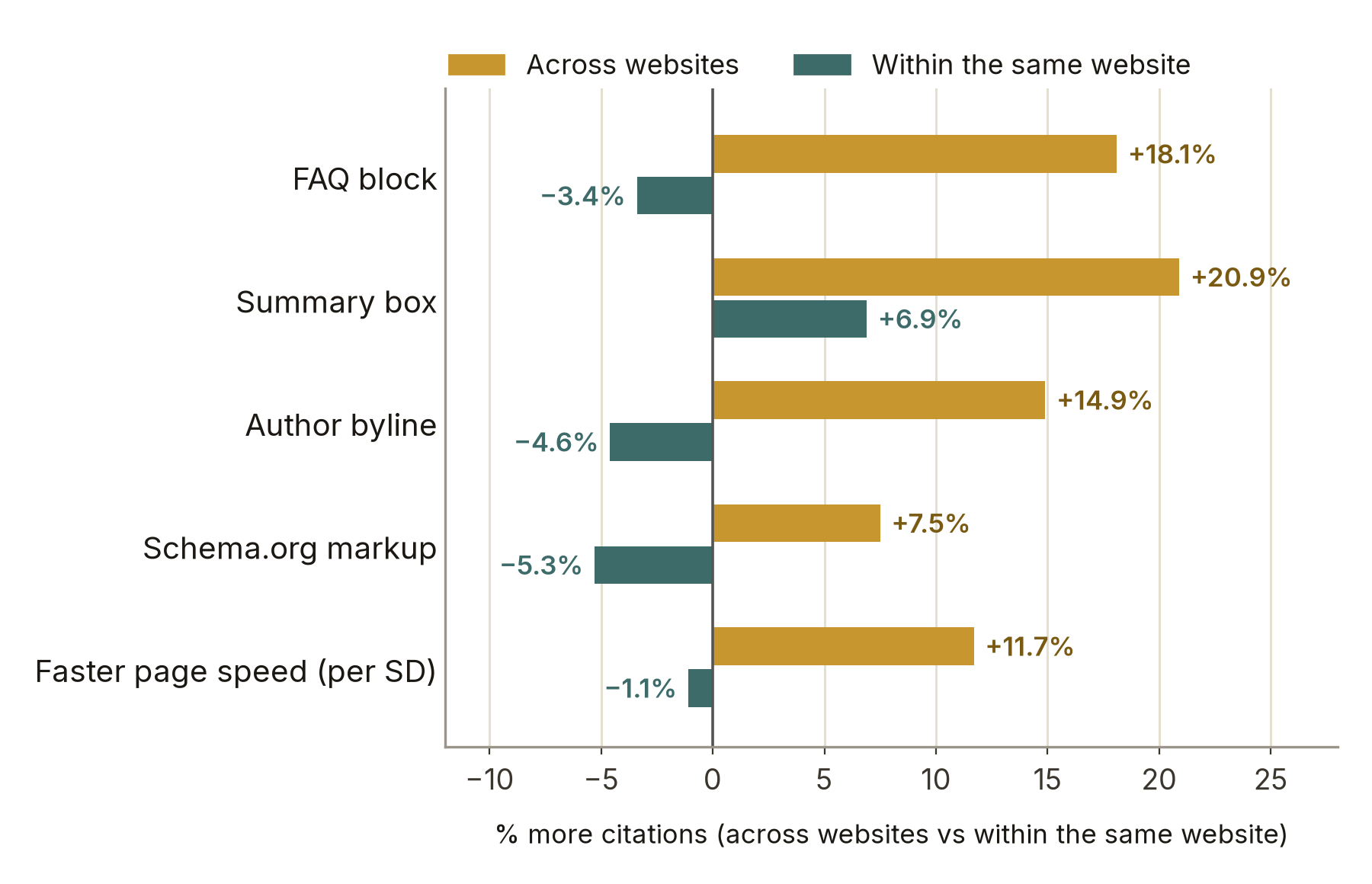
- Across websites, an FAQ block goes with 18.1% more citations, a summary box 20.9%, an author 14.9%, schema.org markup 7.5%, and one SD faster page speed 11.7%, all significant (page 5, Section 4.2).
- Within websites the same markers are not significant: −3.4%, +6.9%, −4.6%, −5.3%, and −1.1%. FAQ blocks appear on 43% of the pages of the websites that use them most, so the across-website lift tracks website popularity more than the practice itself (page 5, Section 4.2).
- At equal retrieval rank, author boxes (×0.77), FAQ blocks (×0.93), and schema.org markup (×0.92) go with slightly lower odds of being cited among the pages ChatGPT already retrieved (page 6, Section 6.2).
How Much Retrieval Explains
In a mixed model, 13% of citation-count variation lies between websites and 87% between pages of the same website. Page features explain 42% of the between-website part but only 3.4% of the within-website part. Odd-day and even-day citation counts correlate at 𝑟 = 0.82, so about 10% of the variation is day-to-day chance and most of the rest is repeatable but unexplained by page features (page 5, Section 5.1).
To see what the collection cannot show, the authors replayed the 651 questions through the engines' APIs with web search enabled. Table 3 summarizes the ChatGPT replay (page 6, Table 3).
| Replay result (ChatGPT) | Value |
|---|---|
| Pages consulted / cited per question | 26 / 3 |
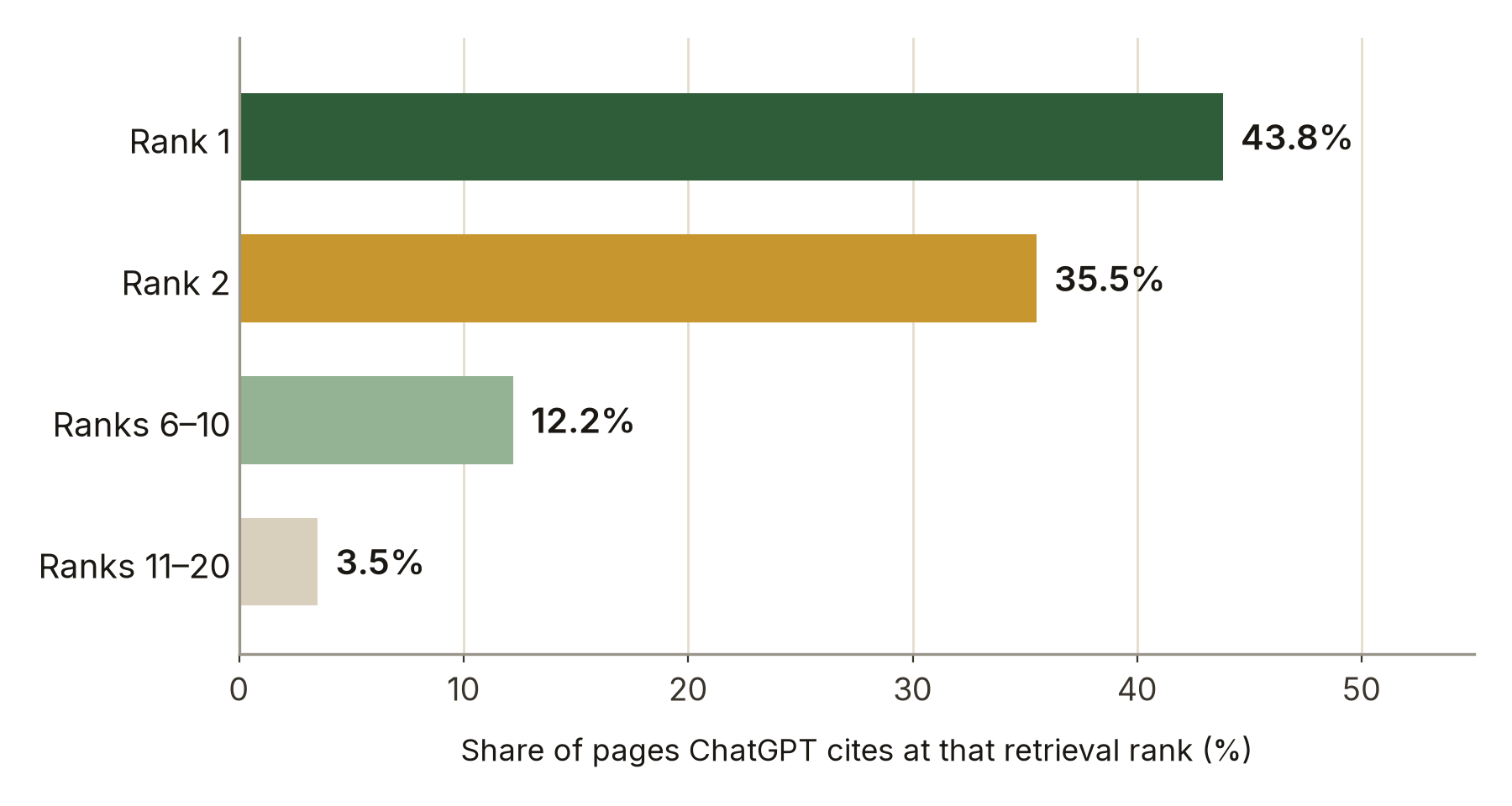
| Cited at rank 1 / 2 / 6–10 / 11–20 | 43.8% / 35.5% / 12.2% / 3.5% |
| Choice among consulted pages explained by rank / + content | 26.8% / 32.5% |
| Same question, same day: query / cited-page overlap | 2.7% / 15% |
| Retrieved pages absent from Google top 50 / Bing top 30 | 97% / 99% |
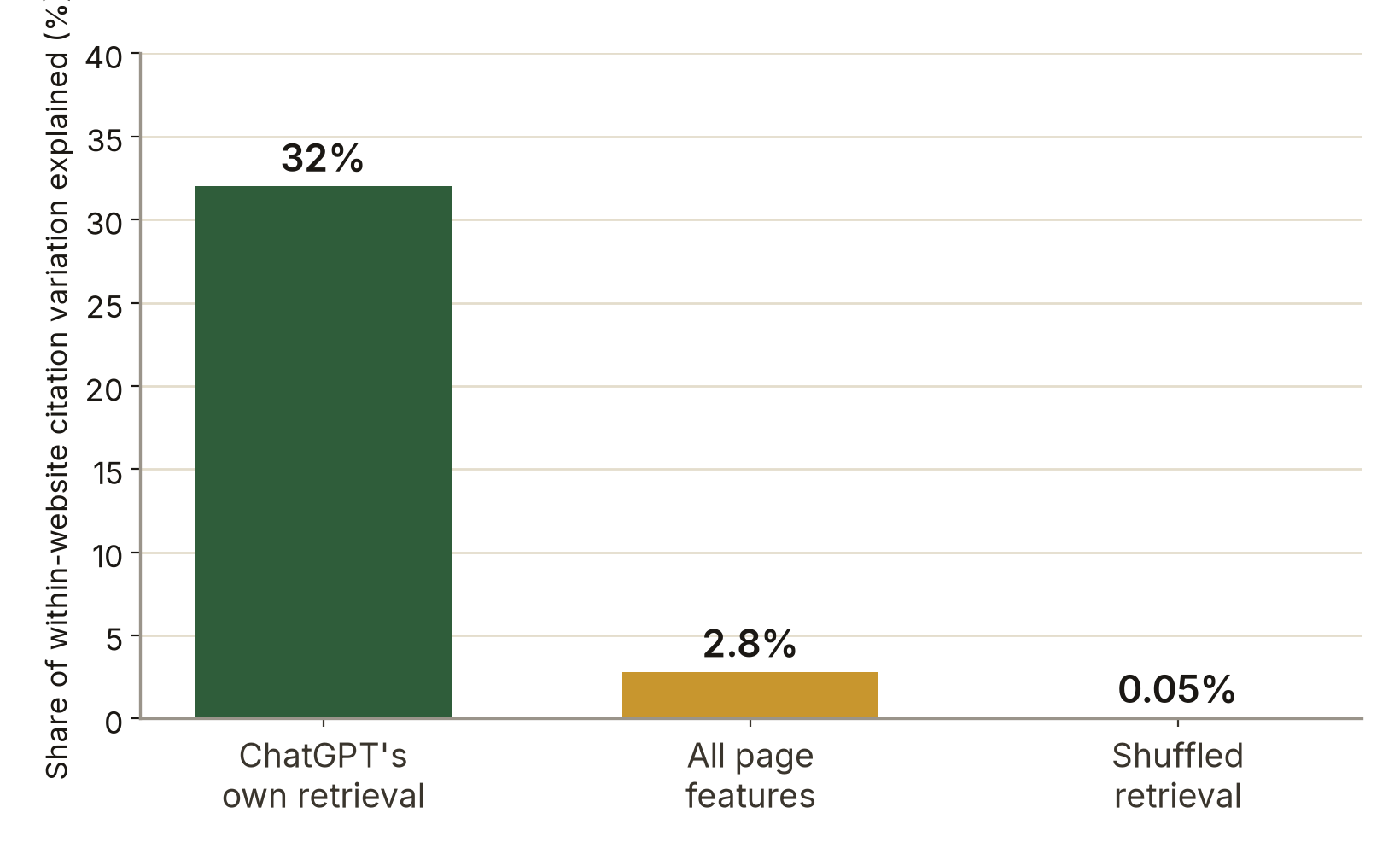
| Within-website variation explained by retrieval | 32% [24, 42] |
| Within-website variation explained by page features / shuffled retrieval | 2.8% / 0.05% |
| Citations from websites the model mentions without search | 47% (baseline 25%) |
- Every page ChatGPT cites is one its searches returned (100.0% of 22,315 cited URLs in the main dataset). A page is cited only after it has been retrieved (page 6, Section 6.1).
- Retrieval explains 32% (95% CI 24–42%) of within-website variation in ChatGPT's 90-day citation counts, against 2.8% for all page features, a gap of 29 points. Shuffling the replay variables between pages of the same website removes the effect (0.05%) (page 6, Section 6.4 and Table 3).
- ChatGPT consults about 26 pages per question and cites 3. Over 4,946 source lists it cites 43.8% of rank-1 pages, 35.5% at rank 2, 12.2% at ranks 6–10, and 3.5% at ranks 11–20 (page 6, Section 6.2 and Table 3).
How Retrieval Differs from Google and Bing
Both engines rewrite each question into new sub-queries on every answer. Between two ChatGPT runs on the same day, query overlap is 2.7% and cited-page overlap is 15%. ChatGPT ranks pages more by meaning than by keyword match, and those rankings are not Google's or Bing's (pages 6 and 7, Section 6.3).
- For the question as asked, 0.1–0.6% of the cited pages sit in Google's top 10. For the engines' own queries, 0.5% (Bing) and 0.7% (Google) of the pages ChatGPT retrieves, and 5.6% of those Gemini cites, are in the top 10 (page 7, Section 6.3).
- Ninety-seven percent of ChatGPT's retrieved pages are absent from Google's top 50 and 99% from Bing's top 30 for all of the answer's queries, as are 93% of Gemini's cited pages. The websites of half of ChatGPT's pages (51%) do appear in Google's top 50: the engines often pick different pages from the same websites (page 7, Section 6.3 and Table 3).
- At equal rank, brand pages are cited more (×1.71), while lists (×0.54), comparisons (×0.34), and Reddit threads (×0.30) are consulted often but cited rarely (page 6, Section 6.2).
How the Model's Knowledge Shapes Brands and Citations
Forty-six percent of ChatGPT's brand mentions in the collected answers have no supporting page in that answer. Forty-seven percent of its citations come from websites the model mentions even without search, against a 25% baseline if citations were independent of that prior list (page 7, Section 7; Table 3).
Controlled experiments turn the answer step on and off one factor at a time. Table 4 reports the main results (page 8, Table 4).
| Experiment | ChatGPT | Gemini |
|---|---|---|
| Same source first − last, cited (points) | +17.6 [15.1, 20.3] | −0.4 [−2.3, 1.6] |
| Brand names shown: change vs repeat | 2.1× [1.8, 2.6] | 3.3× [2.5, 4.5] |
| Publisher names shown: change vs repeat | 1.3× [1.1, 1.6] | 1.6× [1.3, 2.0] |
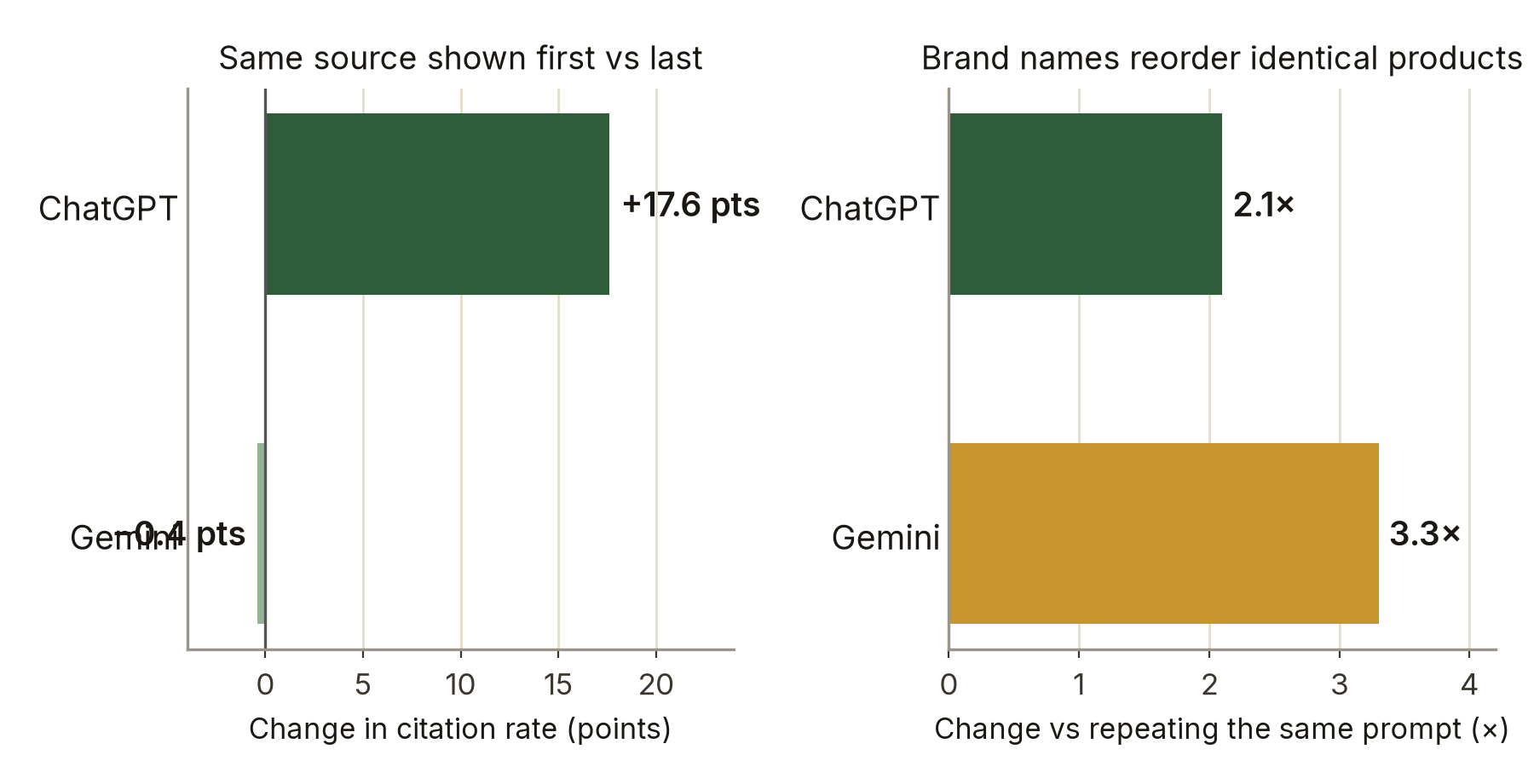
- Showing eight real sources for each of 100 questions in all eight orders (9,600 answers), ChatGPT cites the same source in 60% of answers when it is shown first and 43% when it is shown last, a 17.6-point gap (95% CI 15.1–20.3). Gemini cites it in 57–59% in every position (page 8, Section 7 and Table 4).
- Revealing brand names on otherwise identical product profiles changes each product's top-three rate 2.1 times as much as repeating the same prompt for ChatGPT and 3.3 times for Gemini. Revealing publisher names changes rates only 1.3× and 1.6× (page 8, Table 4).
- In the collected answers, one score per brand predicts held-out pairwise orderings at 74% / 64% for ChatGPT and 77% / 67% for Gemini (per brand-and-question / per brand), and full rankings at 82% / 81% and 77% / 79% (page 8, Table 4).
How the Niche B2B Market Compared
Table 5 repeats the core results in the niche software market, where the models barely know the brands (page 8, Table 5).
| Result | Consumer market | Niche B2B market |
|---|---|---|
| Title match, all / brand pages | +14.1% (5) / +7.4% (4) | +26.4% (5) / +33.6% (5) |
| Best-paragraph match, all pages | +15.5% (5) | +12.9% (5) |
| FAQ block: across / within websites | +18.1% / −3.4% | +22.5% / −1.9% |
| Variation between websites | 13% | 9% |
| Rank 1 / ranks 11–20 cited | 43.8% / 3.5% | 57.1% / 8.3% |
| Retrieval vs page features | 32% vs 2.8% | 30% vs 10.0% |
| Citations from the model’s prior websites | 47% | 32% |
- Title match (+26.4% per SD) and best-paragraph match (+12.9%) still pass all five tests. FAQ blocks again look helpful across websites (+22.5%) and disappear within them (−1.9%) (page 8, Table 5).
- Only 9% of citation variation lies between websites. Retrieval still explains about 30% of within-website variation against 10.0% for page features. Citations from the model's prior websites fall to 32% from 47% in the consumer market (page 8, Table 5).
- ChatGPT cites 57.1% of rank-1 pages and 8.3% of ranks 11–20 in the niche replay, so position in the engine's own list still dominates (page 8, Table 5).
Limits the Authors Note
- The within-website results are associations: the design removes the website but not unmeasured differences between pages of a website (page 3, Section 3.3).
- Page speed exists for only 466 pages. Usable HTML was available for 63.2% of cited URLs (pages 3 and 4, Section 3.2).
- Rank analyses use ChatGPT, because Gemini's grounding metadata does not return a ranked list and Perplexity has no replay (page 6, Section 6.1).
- The experiments use the models behind the replayed engines without search on constructed inputs, so they measure the answer step rather than the full production stack (page 8, Section 7).
- Both markets are English-language commercial questions in specific verticals; the authors release data and code so others can extend the design (page 2, Contributions; page 9, Conclusion).
What This Means for Brands in 2027 and Beyond
For a brand that wants citations in generative search, this paper says the decisive step is being retrieved by the engine's own search, not decorating the page with FAQ blocks or schema alone. Within a website, the features that survive every robustness test are the ones that make the title and best paragraph match the questions people ask (+14.1% and +15.5% citations per standard deviation). The same FAQ, summary, author, and schema practices that look helpful across websites lose that effect once the website is held fixed.
Retrieval dwarfs on-page tuning as an explanation of who gets cited: 32% of within-website citation differences track ChatGPT's own retrieval, against 2.8% for all measured page features, and 97% of the pages ChatGPT retrieves are absent from Google's top 50. Brand knowledge still matters after retrieval. Nearly half of ChatGPT's brand mentions have no supporting page, and revealing brand names on identical product facts reorders the model's ranking by more than twice the noise of a repeated prompt.
So if you publish for AI search, write titles and paragraphs that match the questions your buyers ask, treat classic GEO page templates as unproven within a site, and measure whether the engines retrieve your pages for the sub-queries they rewrite, not only whether you rank on Google.
Data Collection and Methodology
Our researchers read the public PDF of the paper (arXiv 2610.15033v1, posted October 10, 2026) and took every figure in this article from the paper's own text, tables, and figures. Page numbers refer to that PDF.
Engine volumes come from Table 1. Within-website feature effects come from Table 2 and Section 4.1. Across-versus-within practice estimates come from Section 4.2. Replay summaries, rank citation rates, and variance explained come from Table 3 and Sections 6.1 to 6.4. Experiment results come from Table 4. Two-market comparisons come from Table 5. A CSV of the charted values is linked under Sources.
Sources
- Top GEO Agencies, The AI Citations Drivers Paper, Explained, November 2026, New York, New York. Download the data (CSV).
- What Drives AI Citations? Content, Retrieval and Model Knowledge in Generative Engine Optimization (GEO). Mahe Chen and Nick Koudas. University of Toronto. arXiv 2610.15033, October 2026. PDF.