The AutoGEO Paper, Explained
Published October 16, 2026
What Generative Search Engines Like and How to Optimize Web Content Cooperatively is a 2025 paper by Yujiang Wu, Shanshan Zhong, Yubin Kim, and Chenyan Xiong of Carnegie Mellon University and the company Vody, posted to arXiv in October 2025 as a work-in-progress preprint. The original GEO paper tested nine rewriting methods that people designed by hand. This paper introduces a system called AutoGEO that has AI models study thousands of examples to learn what AI search engines prefer, rewrites pages using those learned rules, and checks whether the rewrites lower the quality of the AI's answers (pages 1 and 2, Section 1).
Our researchers read through the paper and created this report to break down its findings in simple terms and talk about what they mean for brands and marketers. In the following sections, we explain how the experiment worked, what the authors concluded, how the learned rewrites compared with the original methods, how they did on different AI models, what the engines preferred, whether answer quality suffered, and the limits of the study.
The Main Experiment
The authors wanted to find out what AI search engines prefer when they choose which retrieved pages to use in an answer, and whether rewriting pages to match those preferences raises visibility without making the answers worse (page 1, Section 1).
The setup
The researchers built their own AI search engines in the same style as the original GEO paper. Each question was paired with 5 web documents retrieved from ClueWeb22, a large collection of web pages, and an AI model wrote an answer that cited those documents after every sentence (page 6, Section 4; page 24, Appendices G and H). One of the five documents was picked at random as the page to rewrite (page 24, Appendix G). The answer engines ran on three models: Google's Gemini 2.5 Flash-Lite, OpenAI's GPT-4o-mini, and Anthropic's Claude 3 Haiku (page 6, Section 4).
The data
The table below lists the three question sets, using Section 4 of the paper (page 6).
| Question Set | Where the Questions Came From | Training Questions | Test Questions |
|---|---|---|---|
| GEO-Bench | The benchmark from the original GEO paper | 8,000 | 1,000 |
| E-commerce | Shopping questions filtered from LMSYS-Chat-1M, a public set of real chatbot conversations | 1,667 | 416 |
| Researchy-GEO | Open-ended research questions from the Researchy Questions dataset | 10,000 | 1,000 |
How the rules were learned
For each question, the system found the two documents with the biggest gap in visibility in the AI's answer and passed them through four steps, each run by a language model (pages 3 and 4, Section 3.1).
- An explainer compared the two documents and described how they differed.
- An extractor turned that comparison into short insights about what the engine favored.
- A merger combined tens of thousands of insights into candidate rules, working in batches.
- A filter removed rules that were vague or did not reflect a real preference.
The two rewriting tools
- AutoGEO API places the learned rules into the instructions for a large commercial model, Gemini 2.5 Pro, which rewrites the page (pages 4 and 6, Sections 3.2.1 and 4).
- AutoGEO Mini is a small open model, Qwen3-1.7B, trained to rewrite pages. Its training rewarded higher visibility, following the rules, and keeping the page's original meaning (page 5, Section 3.2.2). The authors estimate it costs about 0.0071 times as much to run as the API version (page 5, Section 3.2.2; page 23, Appendix E).
How they measured
- Visibility used the three scores from the original GEO paper: how many words of the answer are tied to the page, how early those words appear, and an overall score that combines the two (page 6, Section 4; pages 24 and 25, Appendix I).
- Answer quality, which the authors call generative engine utility, was scored with a framework called DeepResearchGym. It checks whether citations support the claims, how many claims are cited, and how clear and insightful the answer is. Two more checks, covering how many key points the answer includes and whether it contradicts them, needed reference answers and were run only on Researchy-GEO (page 6, Section 4).
What the Paper Concluded
The authors concluded that rules learned from the engines' own behavior beat the hand-designed rewriting methods. The API version improved on the strongest earlier method, Fluency Optimization, by up to 50.99%, and the Mini version by 20.99% on average (page 6, Section 5.1). Across their tests, the authors report "an average improvement of 35.99% in GEO metrics while maintaining utility" (page 2, Section 1). They also found that preferences differ by type of question and by AI model, and that rules learned for a specific engine worked best on that engine (page 2, Section 1; page 9, Section 5.3).
How the Learned Rewrites Compared with the Original Methods
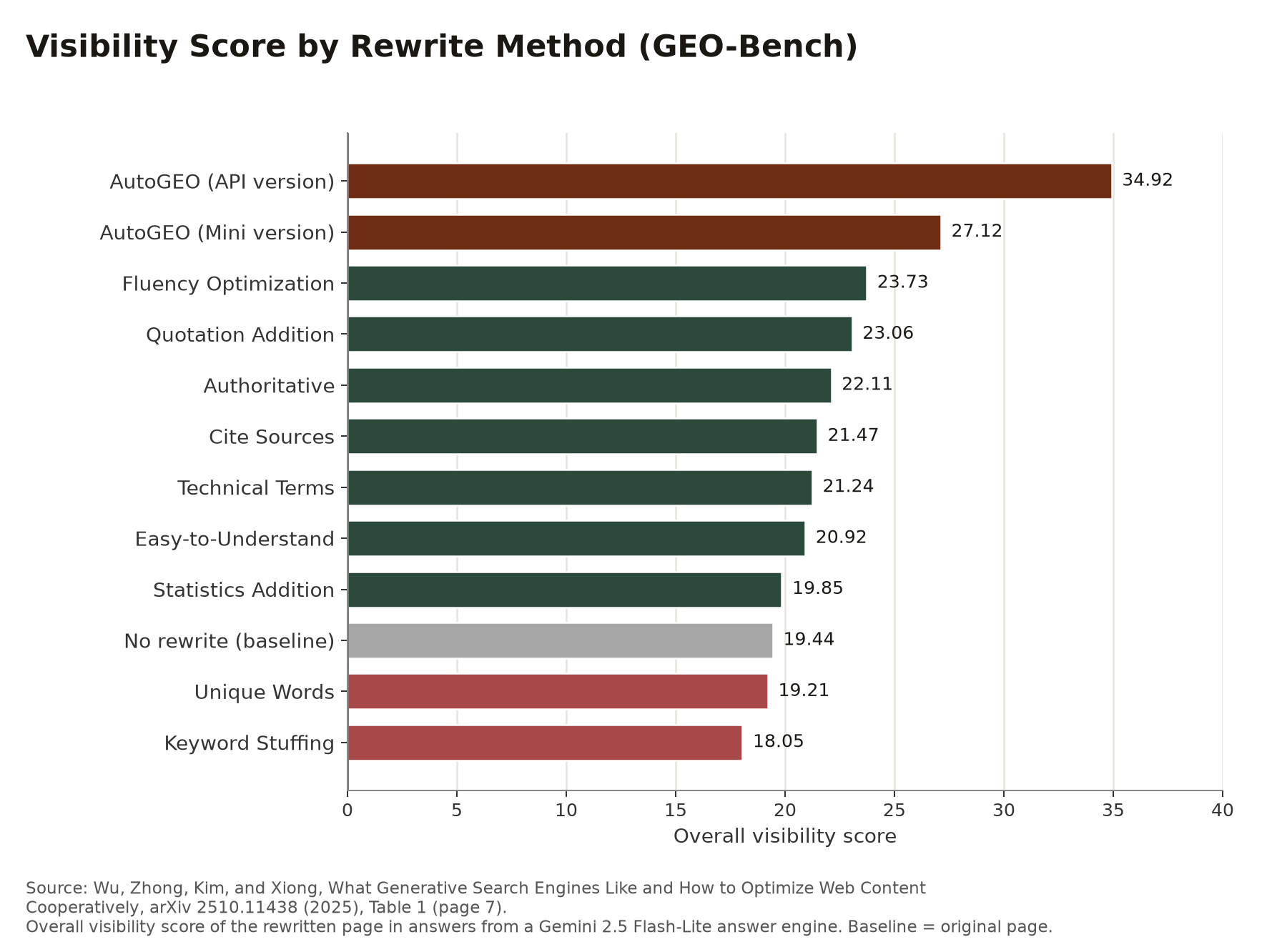
The chart below shows the overall visibility score of the rewritten page on the GEO-Bench question set, with Gemini writing the answers, for each method in Table 1 of the paper (page 7).
Re-charted from Wu et al. Table 1.
- Both AutoGEO versions scored above every earlier method on all three question sets (page 6, Section 5.1; page 7, Table 1).
- Among the original methods, Fluency Optimization did best on all three question sets in this study (page 7, Table 1).
- Keyword stuffing and adding unusual words scored below the unedited page on GEO-Bench, and adding statistics barely moved it (page 7, Table 1).
Results on Different AI Models
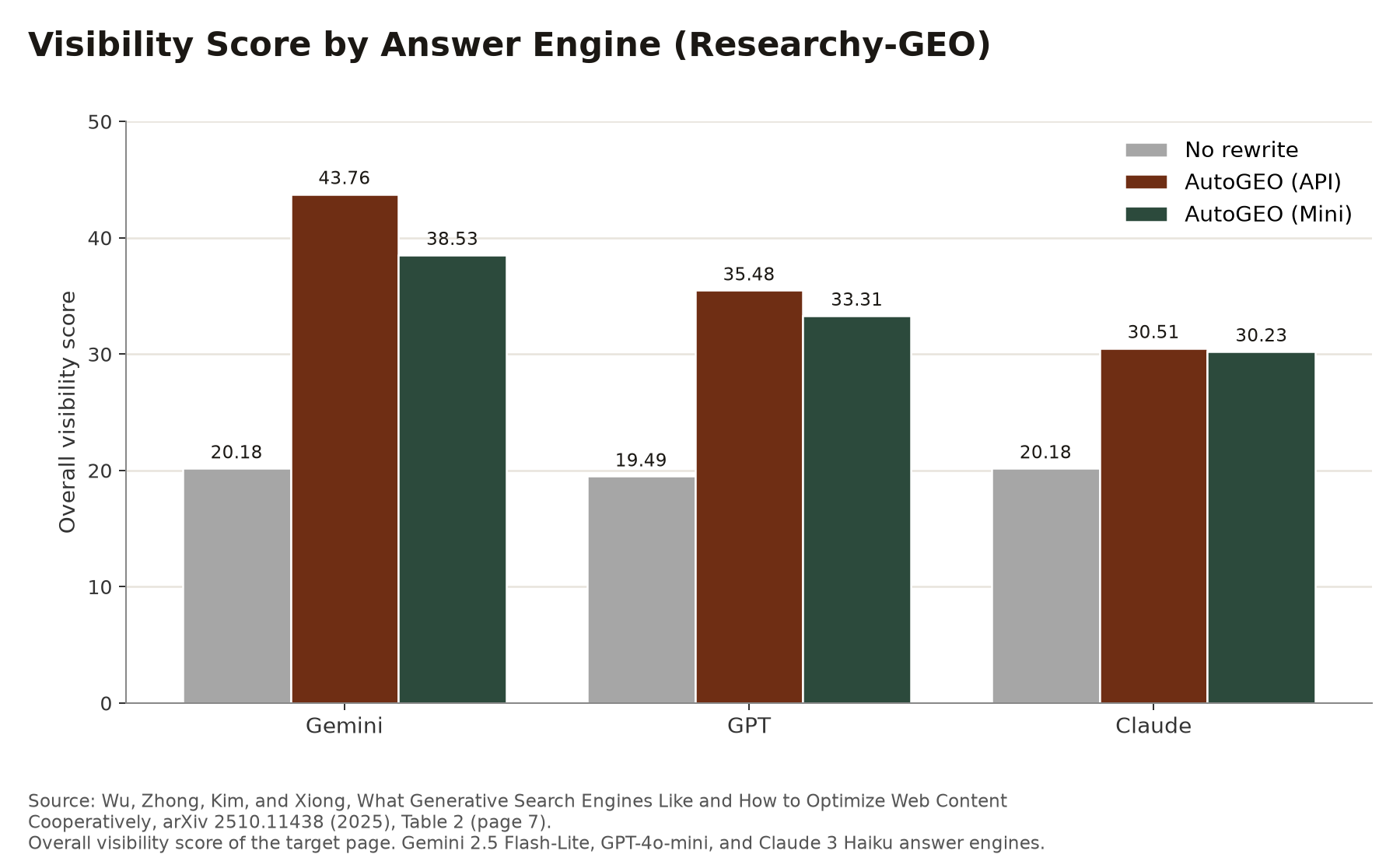
The authors repeated the test with GPT-4o-mini and Claude 3 Haiku writing the answers, learning a separate rule set for each model (page 6, Section 5.1; page 7, Table 2). The chart below shows the results on the Researchy-GEO question set.
Re-charted from Wu et al. Table 2.
- Both versions raised visibility on all three models and all three question sets (page 7, Section 5.1).
- The gains were smaller on Claude 3 Haiku, and on the GEO-Bench questions the Mini version scored higher than the API version on that model (page 7, Table 2).
What the AI Engines Preferred
The learned rules are written in plain language, so the authors could compare them. The table below shows examples of rules learned from the Gemini engine on research questions and on shopping questions, from Table 7 of the paper (page 15, Appendix A).
| Rule | Research Questions | Shopping Questions |
|---|---|---|
| Source citation | Attribute all factual claims to credible, authoritative sources with clear citations. | Establish credibility by citing authoritative sources, providing evidence, or demonstrating clear expertise. |
| Neutral tone | Maintain a neutral, objective tone, avoiding promotional language, personal opinions, and bias. | Present information objectively, avoiding promotional bias and including balanced perspectives where applicable. |
| Logical structure | Structure content logically with clear headings, lists, and paragraphs to ensure a cohesive flow. | Organize content with a clear, logical structure using elements like headings, lists, and tables to facilitate scanning and parsing. |
| Conclusion first | State the key conclusion at the beginning of the document. | Not in this rule set |
| Specific evidence | Substantiate claims with specific, verifiable data, statistics, or named examples. | Not in this rule set |
| Step-by-step guide | Not in this rule set | Provide actionable information, such as step-by-step instructions or clear recommendations. |
| Product details | Not in this rule set | Provide specific, verifiable details such as names, model numbers, technical specifications, and quantifiable data. |
- The rule sets for the three AI models were largely the same. Gemini and GPT shared 78.95% of rule keywords, and Gemini and Claude shared 84.21%, the same share as GPT and Claude (page 9, Section 5.3).
- Rules changed more by type of question. The two general question sets shared 88.24% of their rules, but their overlap with the shopping questions dropped to 34.78% and 40.00% (page 9, Section 5.3).
- Shopping rules leaned toward practical guidance, such as step-by-step instructions and product details, while research rules leaned toward in-depth explanation (page 9, Section 5.3).
- Rules learned on one model or one question set still beat the unedited page when applied elsewhere, but rules learned for the specific engine did best (page 9, Section 5.3).
Did the Rewrites Hurt Answer Quality?
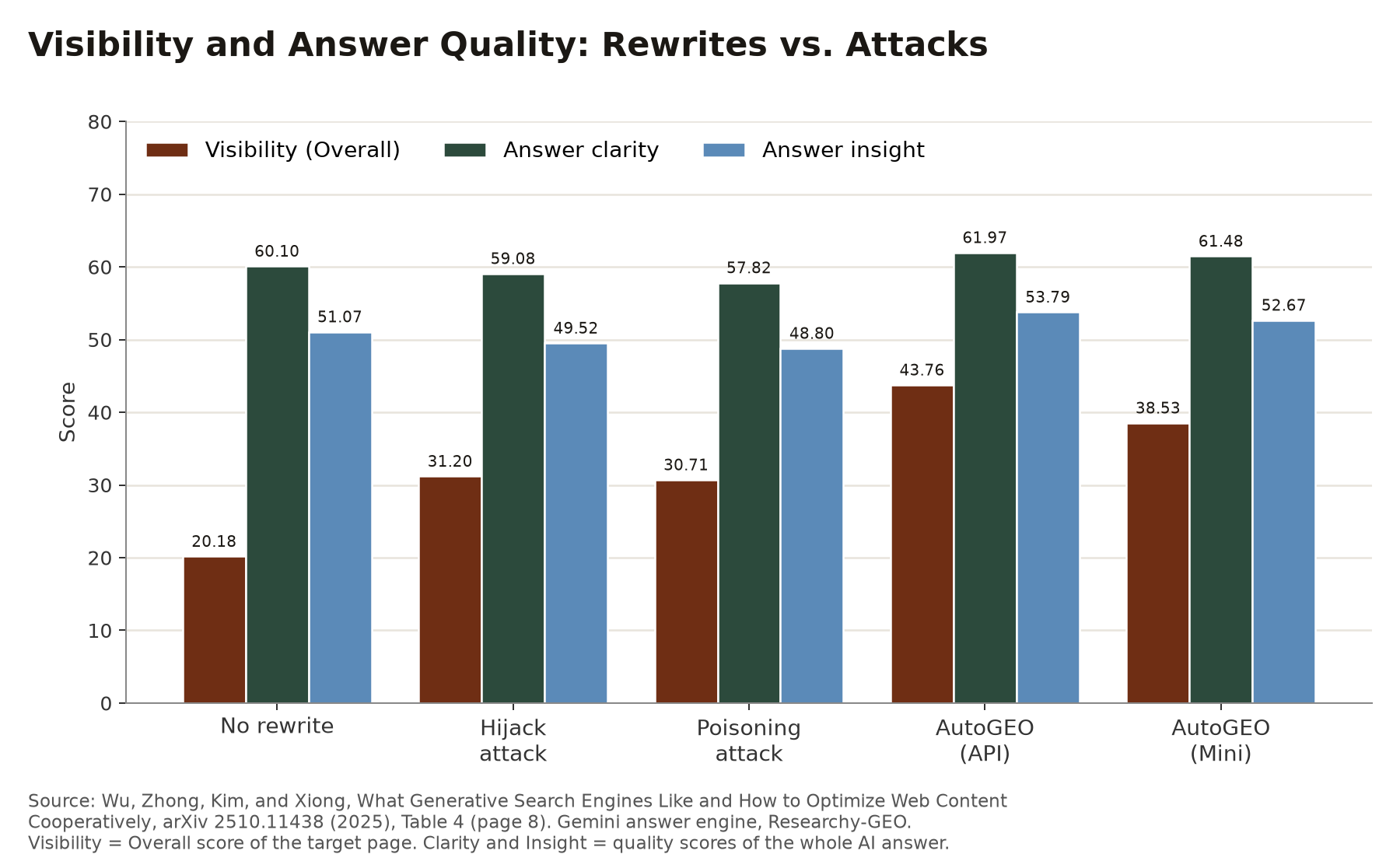
The authors compared AutoGEO with two manipulative methods from earlier research, a "hijack" attack and a "poisoning" attack. Both insert hidden instructions telling the AI to ignore the other sources (page 8, Section 5.2; pages 25 and 26, Appendix J). The chart below shows the target page's visibility next to two quality scores for the whole answer, using Table 4 of the paper (page 8).
Re-charted from Wu et al. Table 4.
- The attacks raised visibility but always lowered the quality of the answers, while both AutoGEO versions raised visibility and kept quality level or slightly higher (page 8, Section 5.2).
- The authors summarize that "AutoGEO cooperates with generative engines while enhancing GEO effectiveness" (page 8, Section 5.2).
- The full results in Table 2 include some exceptions. With Claude 3 Haiku writing answers to research questions, the API version lowered citation precision from 96.51 to 84.98, and some shopping results on GPT and Claude also dipped below the unedited page (page 7, Table 2).
The Hardest Cases
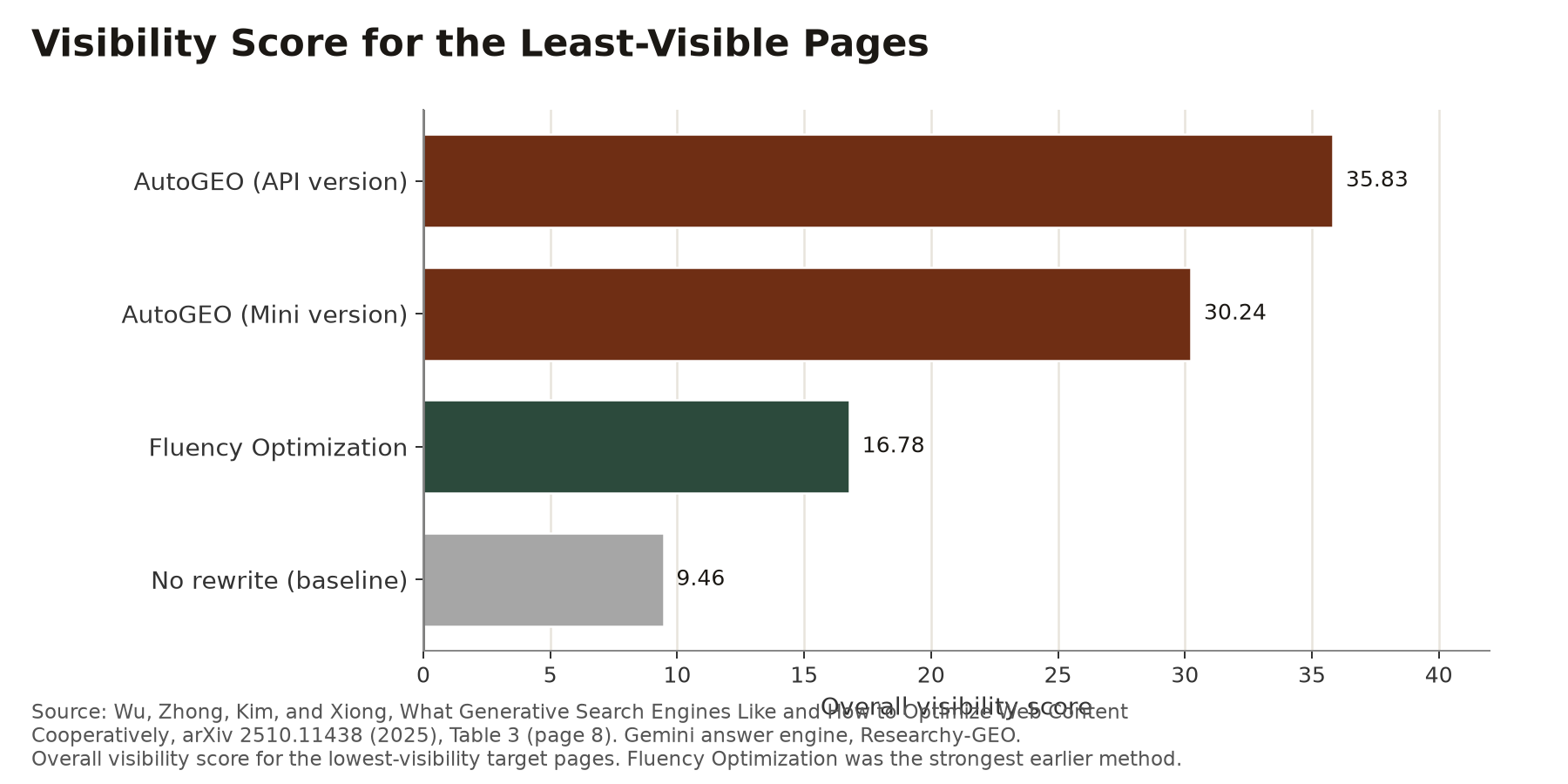
To test the method where it is hardest, the authors took the documents with the lowest visibility in the Researchy-GEO set and rewrote them (page 7, Section 5.1).
Re-charted from Wu et al. Table 3.
Both AutoGEO versions lifted these pages far more than Fluency Optimization did, and answer quality stayed close to the unedited baseline (page 8, Table 3). In a separate test, removing the rule-following reward from the Mini version's training caused the largest drop in visibility of any component, to an overall score of 31.41 (page 10, Section 5.4 and Table 6).
Limits the Authors Note
The paper does not have a separate limitations section. These limits come from the paper's own descriptions of its setup and its stated future work.
- The paper is labeled a work in progress on every page.
- The answer engines were research setups built by the authors, each reading 5 documents per question, and they ran on smaller, low-cost versions of each company's models (page 6, Section 4).
- The key point checks of answer quality were run only on the Researchy-GEO questions, because the other sets have no reference answers (page 6, Section 4).
- The authors name agentic and multimodal AI engines, and the interests of the many parties in the web ecosystem, as areas still to study (page 10, Section 6).
- The work is supported in part by Vody, the company of one of the authors (page 10, Acknowledgments).
What This Means for Brands in 2027 and Beyond
The rules the AI engines favored read like a good editor's checklist: cover the topic fully, back claims with named sources and specific evidence, keep a neutral tone, put the main conclusion first, and organize the page with clear headings and lists. Brand pages that read like advertising tend to break several of those rules at once.
What the engines want also depends on the question. Shopping questions favored practical steps and concrete product details such as model numbers and specifications, while research questions favored depth and explanation, so a product page and a guide on the same topic may need different treatment.
The comparison with the attacks points the same way. Hidden instructions raised visibility less than honest rewrites did and made the answers worse. Review your most important pages for complete coverage, cited sources, a neutral tone, and clear structure, and rewrite the weakest ones first.
Data Collection and Methodology
Our researchers read the public PDF of the paper (arXiv 2510.11438v1) and took every figure in this article from the paper's own text, tables, and figures. Page numbers refer to that PDF, which restarts its printed page numbers in the appendix.
The method chart uses the GEO-Bench Overall column of Table 1. The answer engine chart uses the Researchy-GEO Overall rows of Table 2. The quality chart uses the Overall, Clarity, and Insight columns of Table 4, and the least-visible pages chart uses the Overall column of Table 3. The rules table quotes Table 7.
The charts were redrawn as sorted bars and grouped bars so the results are easier to read than the original academic layout. A CSV of the charted values is linked under Sources.
Sources
- Top GEO Agencies, The AutoGEO Paper, Explained, October 2026, New York, New York. Download the data (CSV).
- What Generative Search Engines Like and How to Optimize Web Content Cooperatively. Yujiang Wu, Shanshan Zhong, Yubin Kim, and Chenyan Xiong. Carnegie Mellon University and Vody. Preprint (work in progress), October 2025. arXiv 2510.11438.