The Brand Bias Paper, Explained
Published November 24, 2026
When someone asks an AI search engine which running shoes or which travel insurance to buy, the answer usually recommends a handful of brands by name and links a few websites as sources. A brand left out of that short answer is invisible to the person asking. AI models learn about brands from the web pages they were trained on, and famous brands appear on far more of those pages than small ones, so a fair question is whether AI search favors big brands simply because it knows them better. A team of researchers in Milan set out to measure that advantage and to test whether rewriting a product page can make up for it.
Our analysts read The Popular Get More Popular: Auditing Brand Bias in Generative Search, a paper by Giorgio Monaco, Jacopo Lenti, and Francesco Pierri of Politecnico di Milano, and wrote this report to explain its findings in simple terms and what they mean for brands. The paper was posted to arXiv on November 5, 2026. The authors asked the AI models behind ChatGPT, Gemini, and Perplexity 80 shopping questions in Italian, collected 19,200 answers, and checked how often each of 1,176 brands was mentioned and cited against how often people search for that brand on Google. They then ran 38,400 controlled rankings in which they changed only the brand name on a product page, or only the way the page was written, to see which change moved the page up.
In the following sections, we explain how the two experiments worked, what the authors concluded, how much more often popular brands were mentioned and cited, where the brands in the answers came from, how buyer details in a question changed the results, how a real brand name compared with GEO rewriting, and the limits to keep in mind.
The Two Experiments
The authors ran two studies. The first was an audit of what deployed AI search engines recommend for real shopping questions. The second was a controlled test that held a product page fixed and changed one thing about it at a time.
The audit of 19,200 answers
The questions came from what people in Italy search for. The authors pulled shopping keywords that mention no brand from DataForSEO, a commercial search data provider, in four sectors: insurance, travel, fashion and beauty, and sport. They turned each keyword into a question, such as "Which motorbike liability insurance should I choose?", and kept 20 questions per sector. Each question was asked on its own and again after each of three short buyer descriptions, called personas, with web search turned off and on, 10 times, to three models through their developer APIs. All 19,200 calls were made on October 14, 2026, with the user located in Rome.
| Model | Maker | In the audit | In the ranking test | Audit calls with search on that searched the web |
|---|---|---|---|---|
| GPT-5.5 | OpenAI | Yes | Yes | 98% |
| Gemini 3.6 Flash | Yes | Yes | 44% | |
| Perplexity Sonar | Perplexity | Yes | Yes | 100% |
| DeepSeek V3.2 | DeepSeek | No | Yes | Not in the audit |
Key Findings
- A brand counted as mentioned when its name appeared in the answer text, and as cited when its official website was among the answer's sources. The authors knew the official website for 683 of the 1,176 brands, so citation results cover those 683.
- A brand's popularity was the average number of monthly Google searches for its name in Italy over 12 months. A brand entered the study when at least one engine mentioned it five or more times in a sector.
- With search on, GPT-5.5 searched the web in 98% of calls and Perplexity in all of them, while Gemini 3.6 Flash chose to search in 44%.
The controlled ranking test
The audit shows which brands get recommended, but it cannot say whether an engine prefers a brand for its name or for what its page says. So the authors picked 24 of the questions, six per sector, and gave each model five real product pages taken from the official websites of brands the engines had recommended for that question in the audit. The model answered the question using the pages and ranked all five from first to fifth, with web search off. One page, the target, was changed in two ways.
First, the authors swapped the names on the target page: the brand, the product, and its web address. The same words were signed by the true brand, by the true brand with a made-up product name, by a better-known real brand, by a less-known real brand, or by an invented brand. For a running shoe question, for example, an ASICS page was also shown under Nike, Mizuno, and the invented brand Kervino. Second, they rewrote the page text three ways while keeping every fact: Structure put the key information first with headings and lists, and Fluency and Authoritative followed two methods from the original GEO research paper. Every combination was shown in 10 balanced page orders, twice, to four models, for 38,400 rankings collected between October 28 and November 3, 2026.
What the Paper Concluded
The authors conclude that AI search engines give a lasting advantage to brands that are already popular. The more often people search for a brand on Google, the more often the engines mentioned it and, in most sectors, cited its website. Turning on web search did not reduce the advantage in mentions. In the controlled test, the same page ranked higher under its real brand than under an invented one, while rewriting the page in the styles GEO practitioners recommend made almost no difference.
They describe this as a rich-get-richer pattern. Because an AI answer recommends only a few brands, smaller, local, and newer brands can drop out of view, and a brand founded after a model was trained may start at a disadvantage even when its product page is complete. Adding a buyer's budget and situation to the question was the only factor in the audit that weakened the advantage of popular brands.
How Much More Often Popular Brands Were Mentioned
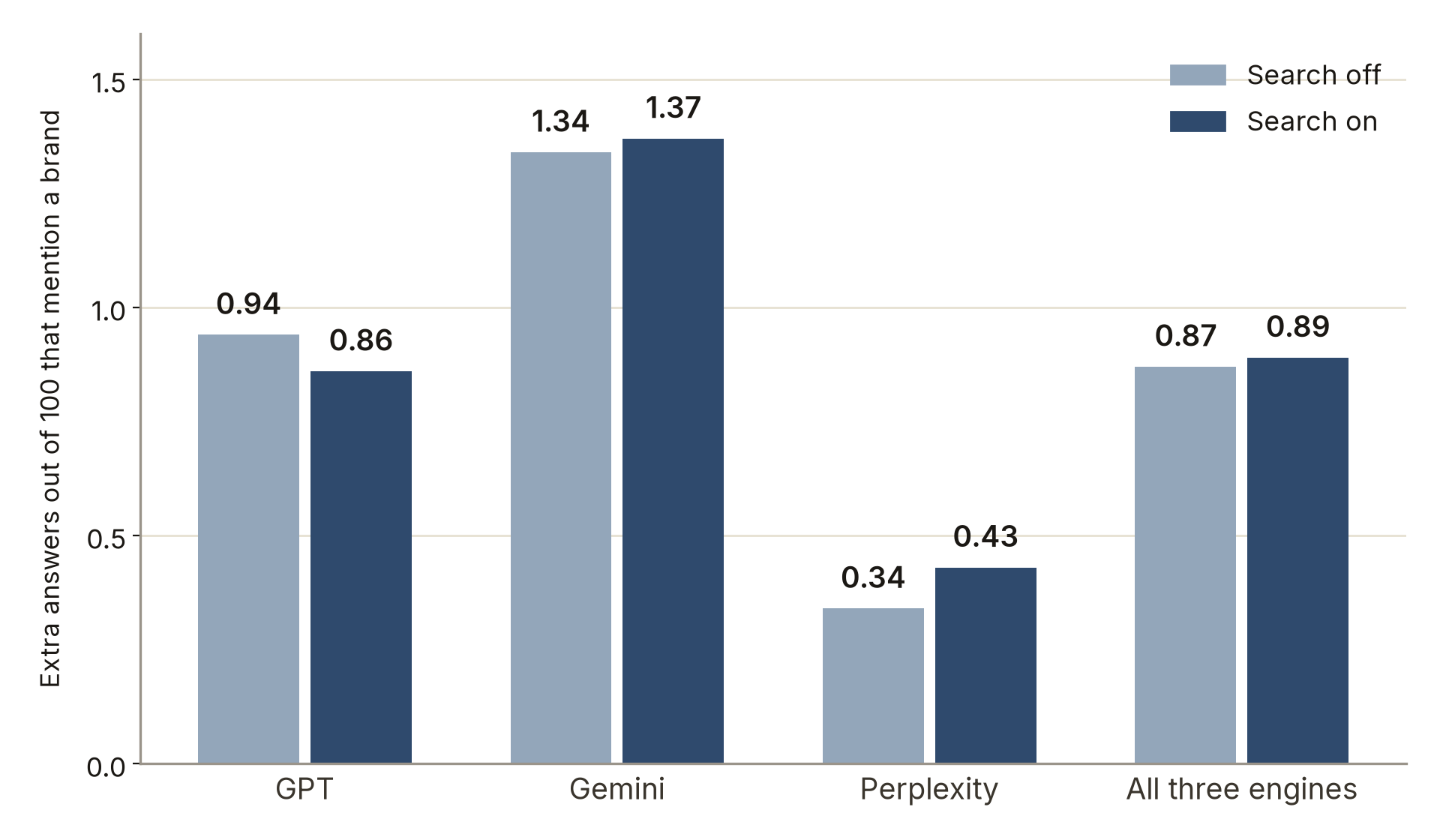
The authors sorted brands into five equal groups by Google search volume within each engine and sector. Mention rates rose from below 1% of answers for the least searched group to between 1.2% and 5.3% for the most searched group, depending on the engine. To put the pattern in one number, they measured how many more answers out of 100 mention a brand for each tenfold rise in its Google searches.
Key Findings
- Across all three engines, a brand searched ten times more often on Google appeared in 0.87 more answers out of 100 with search off and 0.89 more with search on. The difference of 0.02 is within the margin of error, so letting the engine search the web did not shrink the advantage of popular brands.
- The link between popularity and mentions was positive and statistically significant in 23 of the 24 combinations of engine, sector, and search setting. The one exception was Perplexity on travel questions with search off.
- Gemini showed the steepest rise, at 1.34 with search off and 1.37 with search on. On insurance questions, Gemini's figure reached 2.95 with search off and 3.25 with search on, the highest of any engine and sector.
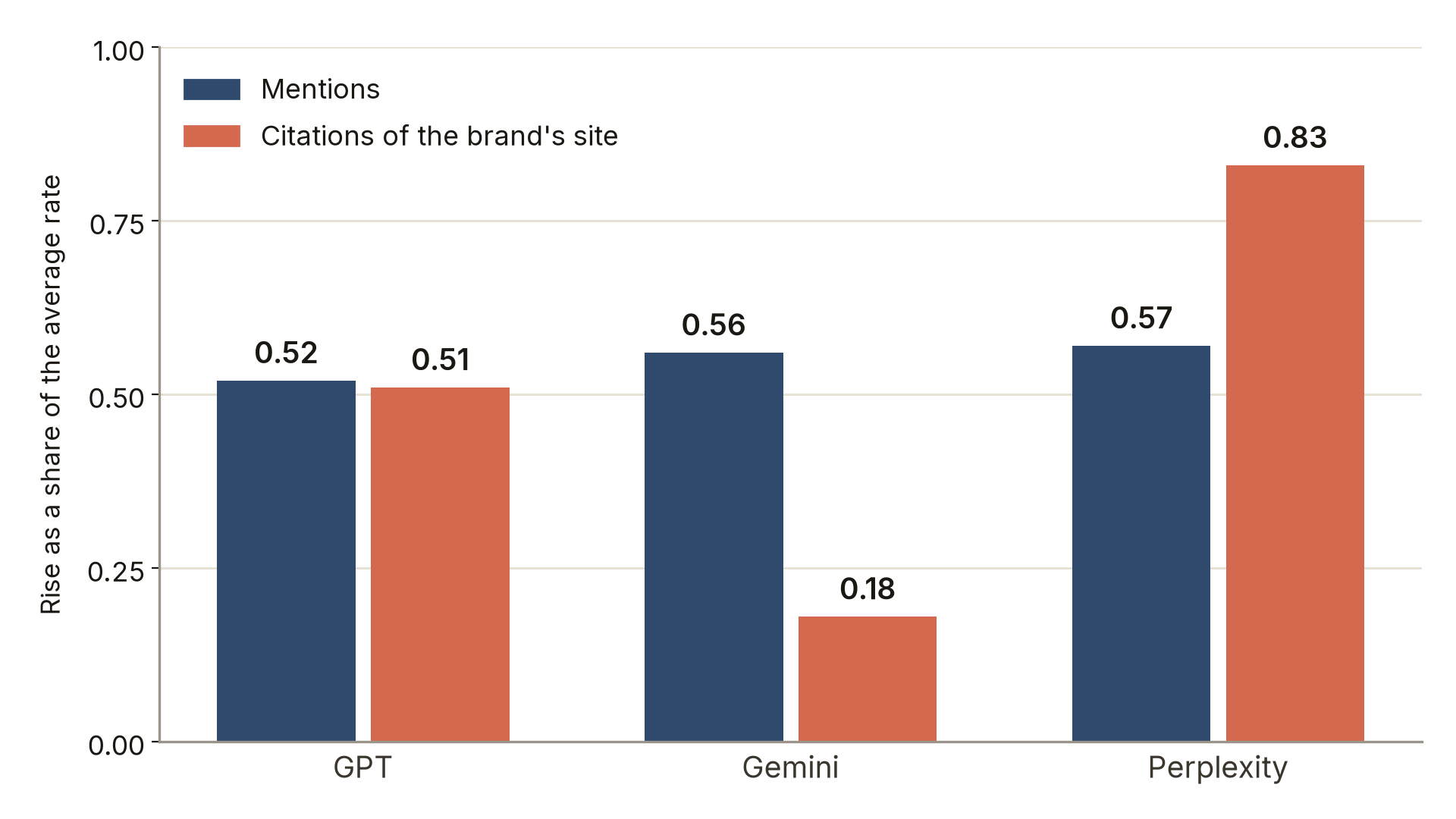
A brand's own website showed the same pattern. Brands in the most searched group were mentioned and cited 1.4 to 2.8 times as often as the average brand of their engine and sector. Because each engine mentions and cites brands at very different overall rates, the authors compared the two on a common scale, as a share of each engine's average.
Key Findings
- On GPT, popularity lifted mentions and citations by the same amount, 0.52 and 0.51 of the average rate for each tenfold rise in searches. Gemini's mentions rose much faster than its citations, and Perplexity's citations rose faster than its mentions.
- The link between popularity and citations was significant in 8 of the 12 engine and sector pairs. It did not hold for sport and travel on GPT and Gemini.
- Being mentioned did not guarantee a citation. When GPT searched, it cited the website of a mentioned brand in 32% to 64% of answers, depending on the sector, compared with 15% to 80% on Perplexity and 3% to 28% on Gemini.
Where the Brands in the Answers Came From
If web search does not weaken the advantage of popular brands, the authors asked, where do the recommended brands come from? They checked whether the name of each mentioned brand appeared in at least one of the web pages the engine returned as sources.
| Engine | Mentions checked | Brand's name found in a returned source | Could not be checked | Name not in any source |
|---|---|---|---|---|
| GPT | 14,336 | 95.5% | 4.5% | 0.0% |
| Gemini | 9,193 | 60.9% | 24.9% | 14.1% |
| Perplexity | 6,341 | 97.3% | 1.8% | 0.9% |
Key Findings
- On GPT and Perplexity, almost every mentioned brand appeared somewhere in the sources. On Gemini, 14.1% of mentions had no match in any source the engine returned, and another 24.9% could not be checked because a source page could not be read.
- In 36.2% of all checked mentions, the brand's name appeared only on pages from other websites and not on the brand's own site. A brand can be recommended in an answer without its website being cited.
- Popular brands entered the process before any web page was read. GPT writes its first search before it sees any results, and in travel the share of mentioned brands already in that first search rose from 7% for the least searched group to 45% for the most searched. In insurance it rose from 1% to 8%.
The authors also compared pairs of answers to the same question. When two answers used more similar searches, they shared more sources, more of the same brands, and more similar wording. On GPT, the overlap in brands grew almost as fast as the overlap in sources, a rise of 3.57 against 4.10 on the authors' scale. The searches an engine writes shape which brands it recommends, and in travel and insurance, popular brands were more likely to be written into those searches from the start.
How Buyer Details in a Question Weakened the Popularity Advantage
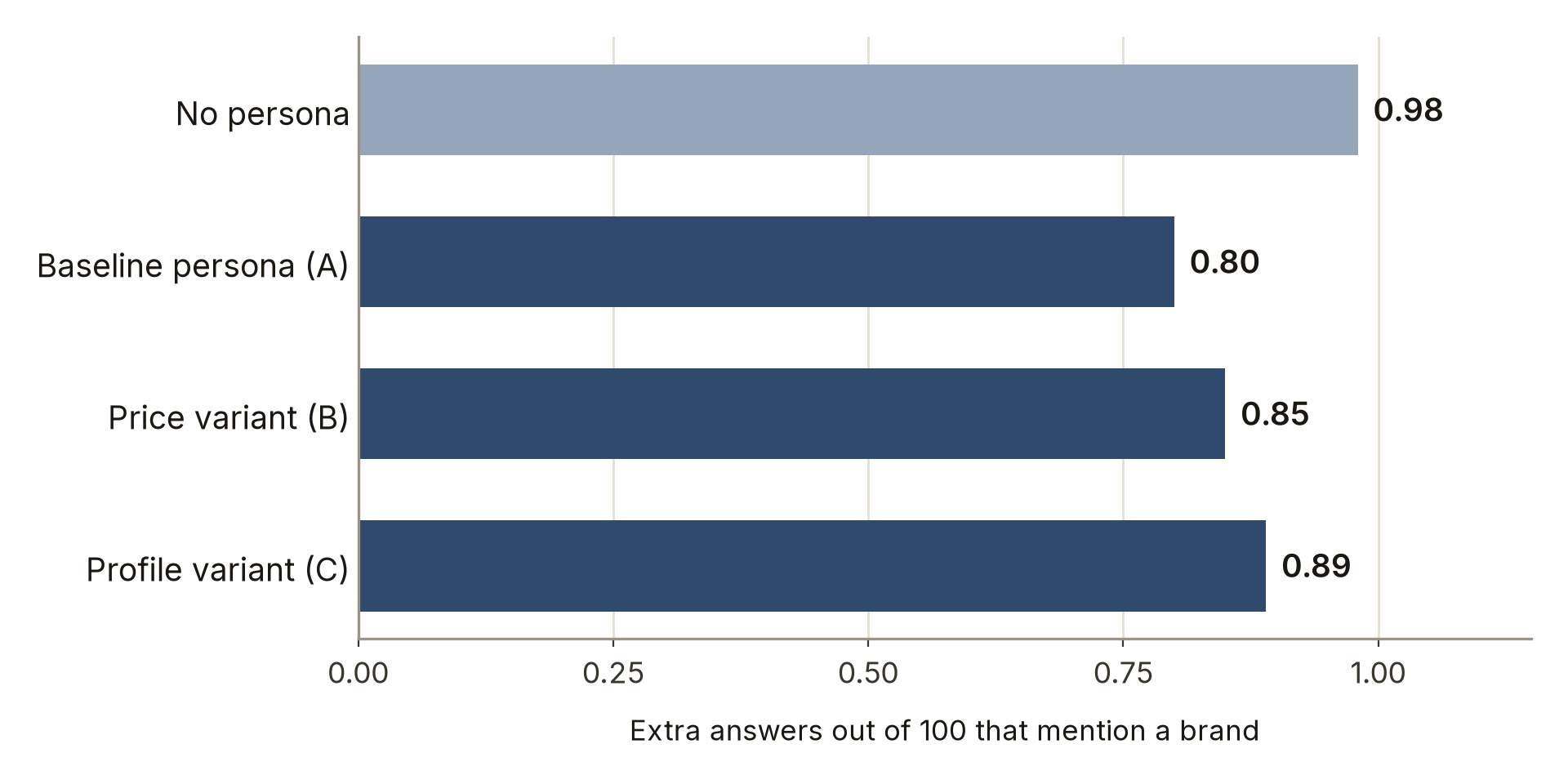
The authors placed one of three short buyer descriptions before each question. The Baseline persona (A) described a life stage, an experience level, and a wish to spend as little as possible, such as "I am a parent of young children. I started doing sport only recently. I try to spend as little as possible." The Price variant (B) changed only the sentence about price, to looking for the best value for money, and the Profile variant (C) changed the life stage or experience level.
Key Findings
- Without a persona, a brand searched ten times more often appeared in 0.98 more answers out of 100. With the Baseline persona the figure fell to 0.80 and with the Price variant to 0.85, both significant drops. The Profile variant's 0.89 was not significantly different.
- In sport, the Baseline persona cut the figure from 1.64 to 1.04 on GPT, from 2.02 to 1.19 on Gemini, and from 0.82 to 0.39 on Perplexity.
- The personas changed what the engines searched for. With the Baseline or Profile persona, at least one search included a price word in 86% to 96% of calls in fashion and beauty, sport, and travel, compared with 25% to 46% without a persona. Answers with different personas also drew on different sources.
A Real Brand Name Moved a Page Up More Than Any Rewrite
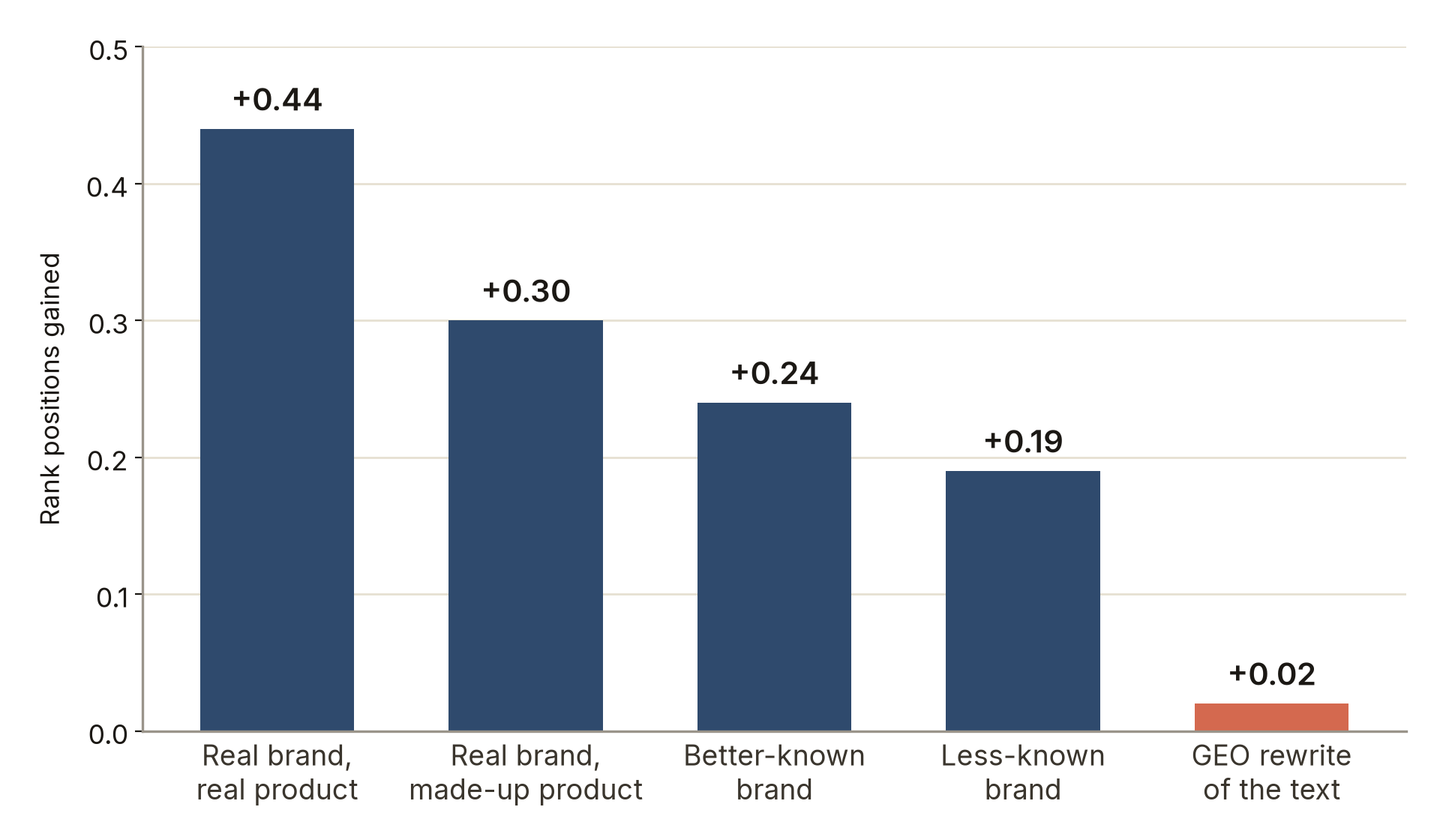
In the ranking test, the target page averaged 3.21 on the scale of 1 to 5 under its true brand and 3.65 under an invented brand, where 1 is the top spot. The chart shows how many positions each version of the page gained over the same page signed by an invented brand, and how many positions the GEO rewrites gained over the original text.
Key Findings
- The true brand with its real product gained 0.44 positions over an invented brand, and the gain was positive for every model and every sector. Keeping the true brand but inventing the product name cost 0.14 positions, so most of the gain, 0.30 positions, came from the brand name alone.
- Any real brand helped. A less-known real brand still ranked the page 0.19 positions above an invented brand. A better-known brand did not help more than a less-known one: the gap between them was 0.05 positions and not significant.
- The three rewrites each moved the page by about 0.02 positions, a result the authors treat as no effect, and their data rule out a gain larger than 0.05 positions. The true brand gained 0.42 positions more than rewriting did.
- The rewrites were written by GPT-5.5 but did not help more when GPT-5.5 was the one ranking the pages.
The same patterns held across the four models and four sectors, though the size of the brand advantage varied.
| Model or sector | Real brand over invented brand | Real product name over made-up name | Less-known real brand over invented brand | GEO rewrite over original text |
|---|---|---|---|---|
| GPT | +0.57 | +0.17 | +0.23 | +0.03 |
| Gemini | +0.42 | +0.10 | +0.15 | +0.03 |
| Perplexity | +0.56 | +0.19 | +0.23 | -0.01 |
| DeepSeek | +0.24 | +0.12 | +0.16 | +0.05 |
| Insurance | +0.56 | +0.06 | +0.32 | +0.06 |
| Fashion and beauty | +0.68 | +0.39 | +0.11 | +0.03 |
| Sport | +0.26 | +0.11 | +0.17 | -0.01 |
| Travel | +0.27 | +0.02 | +0.18 | +0.01 |
| All | +0.44 | +0.14 | +0.19 | +0.02 |
Key Findings
- GPT and Perplexity gave the true brand the largest boost, at 0.57 and 0.56 positions, and DeepSeek the smallest, at 0.24. By sector, the boost was largest in fashion and beauty, at 0.68 positions.
- The GEO rewrites moved the page between -0.01 and +0.06 positions in every model and every sector.
- Removing the names did not fully hide where a page came from. Asked to guess the brand behind a page with every name removed, the models were right in 38% of answers, but how often a page was recognized had no clear link to the size of its brand advantage.
Limits to Keep in Mind
- The study covers the Italian market, with the audit questions asked in Italian from Rome on a single day, so results may differ in the US and in other languages.
- The ranking test ran with web search off and gave each model five pages directly, which allowed full control over the pages but leaves out how live search would reorder them.
- The models were reached through their developer APIs, which may lack system prompts and other features of the consumer ChatGPT, Gemini, and Perplexity apps.
- The rewrites kept every fact and added no statistics, quotes, or claims. The authors left open whether more aggressive rewriting could overcome the brand advantage.
- The authors counted mentions and citations without judging tone, though they found no negative brand mentions when they read the answers.
What This Means for Brands in 2027 and Beyond
For brands, the study points to a hard limit on what page edits alone can do. Brands that people already search for got more mentions and more citations, and the advantage in mentions was the same whether or not the engine searched the web. When the authors held a product page fixed, a real brand name lifted it by 0.44 positions out of five, while three fact-preserving rewrites moved it by about 0.02. The authors write that a new brand may gain more from becoming known in the web sources that AI models learn from and retrieve than from restyling its own pages.
The study also shows that a brand's visibility in AI search is partly decided outside its own website. In more than a third of the mentions the authors checked, the brand's name appeared only on other websites, and GPT often wrote popular travel brands into its first search before reading any results. Questions that carry a buyer's budget and situation narrowed the advantage of famous brands, which gives smaller brands a better chance on specific, detailed questions. Brands that want help building that presence can compare specialist firms in our directory of GEO and AEO agencies.
So if you are a smaller or newer brand, track your mentions across many detailed buyer questions, and work on being covered by the other websites AI engines read alongside any rewriting of your own pages.
Data Collection and Methodology
We read the arXiv version of the paper (2611.07614v1, posted November 5, 2026) and took every figure in this article from the paper's text, tables, and figures.
The design of the audit, the question counts, and the dates come from the paper's Sections 3.1 and 3.2, its Table 1, and its Appendices A and B. The mention and citation results come from Section 4.1, the slopes in the first chart from Appendix Table C.2, and the slopes in the second chart from Appendix Table C.3. The citation ranges for mentioned brands come from Appendix C.1. The source-check table uses the mention counts in Appendix Figure C.5: we divided each outcome by the engine's total checked mentions, which reproduces the paper's 95.5%, 60.9%, 24.9%, and 97.3%. The persona results come from Section 4.1 and Appendix C.3. The ranking-test results come from Section 4.2, Table 2, and Appendix Tables E.1 and E.2. The gains for the real brand with a made-up product and for the better-known brand, each measured against the invented brand, come from Table E.2. The paper publishes 95% confidence intervals for most figures, and we left them out of the charts for readability.
In the paper, positive rank changes mean the page moved closer to first place. In the ranking-test table, the four model rows average all 24 questions, and the four sector rows average six questions and all four models.
Sources
- Top GEO Agencies, The Brand Bias Paper, Explained, November 2026, New York, New York. Download the data (CSV).
- The Popular Get More Popular: Auditing Brand Bias in Generative Search. Giorgio Monaco, Jacopo Lenti, and Francesco Pierri. Politecnico di Milano. arXiv 2611.07614, November 2026. PDF.