GEO Paper Explained: Visibility Lift by Content Method
Published October 15, 2026
Most marketers still treat ranking in AI answers the same way they treat ranking in Google: add keywords, chase backlinks, and hope the page climbs.
Visibility inside an AI-generated answer is not a simple blue-link rank, and the content edits that move it are not the same ones SEO playbooks emphasize.
Our analysts read Aggarwal, Murahari, Rajpurohit, Kalyan, Narasimhan, and Deshpande's KDD 2024 paper GEO: Generative Engine Optimization (arXiv 2311.09735), then re-charted the published results from its tables and figures.
In the following sections, we explain what the paper measured, which content edits lifted visibility, how the lift changed by search rank and domain, and what that means for a brand trying to get recommended in AI search.
Visibility Lift by GEO Method
Position-Adjusted Word Count measures how much of an AI answer is drawn from a source and how early that source appears. Subjective Impression is a separate score that rates relevance, influence, uniqueness, position, and related qualities of each citation. The chart and table below show how each GEO method changed those scores against a no-optimization baseline on GEO-bench.
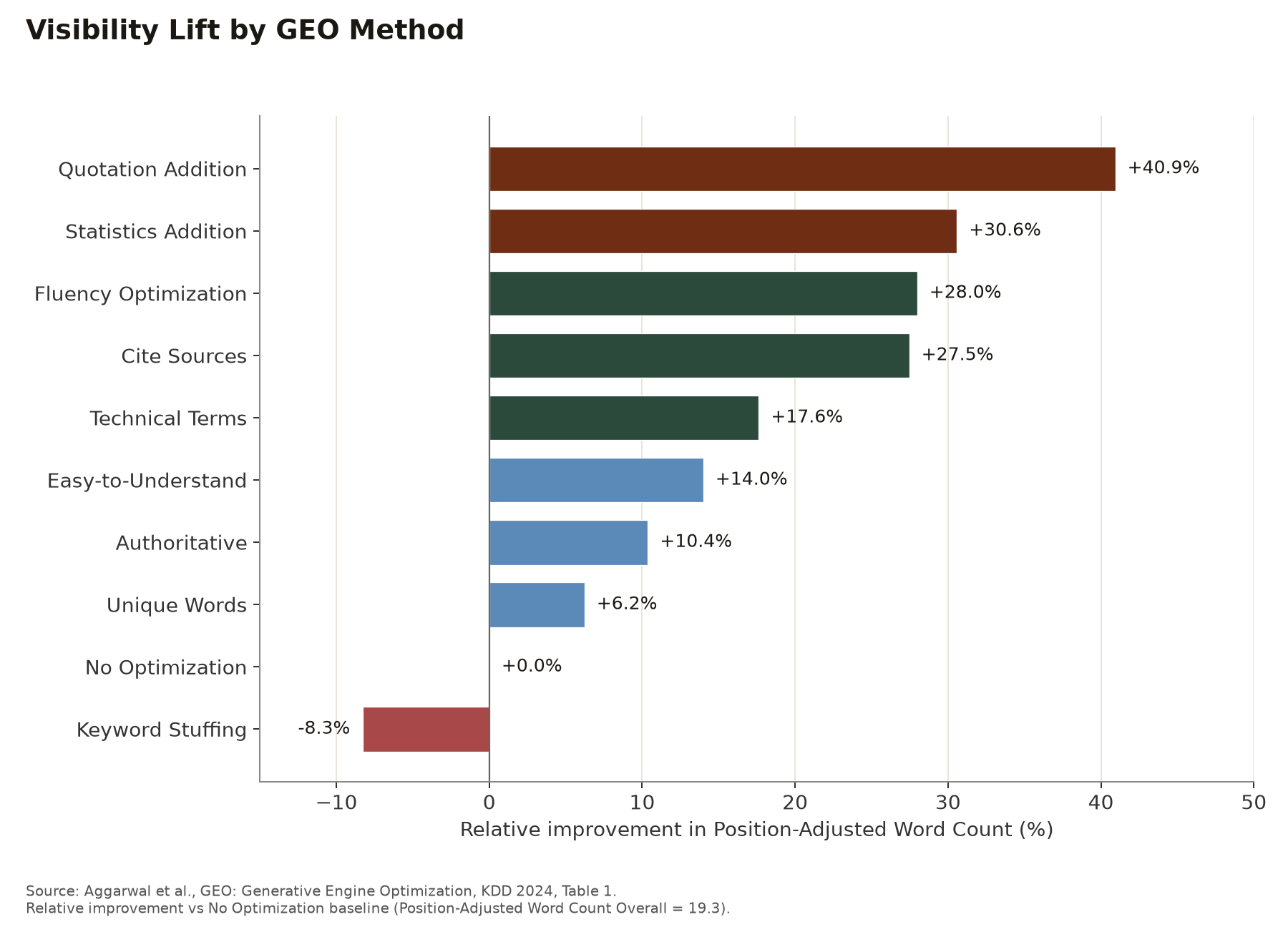
Re-charted from Aggarwal et al. Table 1.
| Method | Position-Adjusted Word Count | Relative Lift vs Baseline | Subjective Impression | Subjective Lift vs Baseline |
|---|---|---|---|---|
| Quotation Addition | 27.2 | +40.9% | 24.7 | +28.0% |
| Statistics Addition | 25.2 | +30.6% | 23.7 | +22.8% |
| Fluency Optimization | 24.7 | +28.0% | 21.9 | +13.5% |
| Cite Sources | 24.6 | +27.5% | 21.9 | +13.5% |
| Technical Terms | 22.7 | +17.6% | 21.4 | +10.9% |
| Easy-to-Understand | 22.0 | +14.0% | 20.5 | +6.2% |
| Authoritative | 21.3 | +10.4% | 22.9 | +18.7% |
| Unique Words | 20.5 | +6.2% | 20.4 | +5.7% |
| No Optimization (baseline) | 19.3 | 0.0% | 19.3 | 0.0% |
| Keyword Stuffing | 17.7 | -8.3% | 20.2 | +4.7% |
- Quotation Addition raised Position-Adjusted Word Count by 40.9% over the baseline (27.2 vs 19.3), the largest lift in Table 1. Statistics Addition was next at 30.6%.
- Fluency Optimization and Cite Sources each lifted that same metric by about 28%. Presentation and credibility edits moved the score without inventing new facts.
- Keyword Stuffing, a classic SEO tactic, cut Position-Adjusted Word Count by 8.3% (17.7 vs 19.3). The paper's best methods improved on the baseline by 41% and 28% on the two headline metrics.
Visibility Lift by Search Engine Rank
The paper also measured what happens when one source is optimized while others stay the same, broken out by that source's original rank in the search results that fed the generative engine. The chart below shows the three highest-performing methods from Table 1 across ranks 1 through 5.
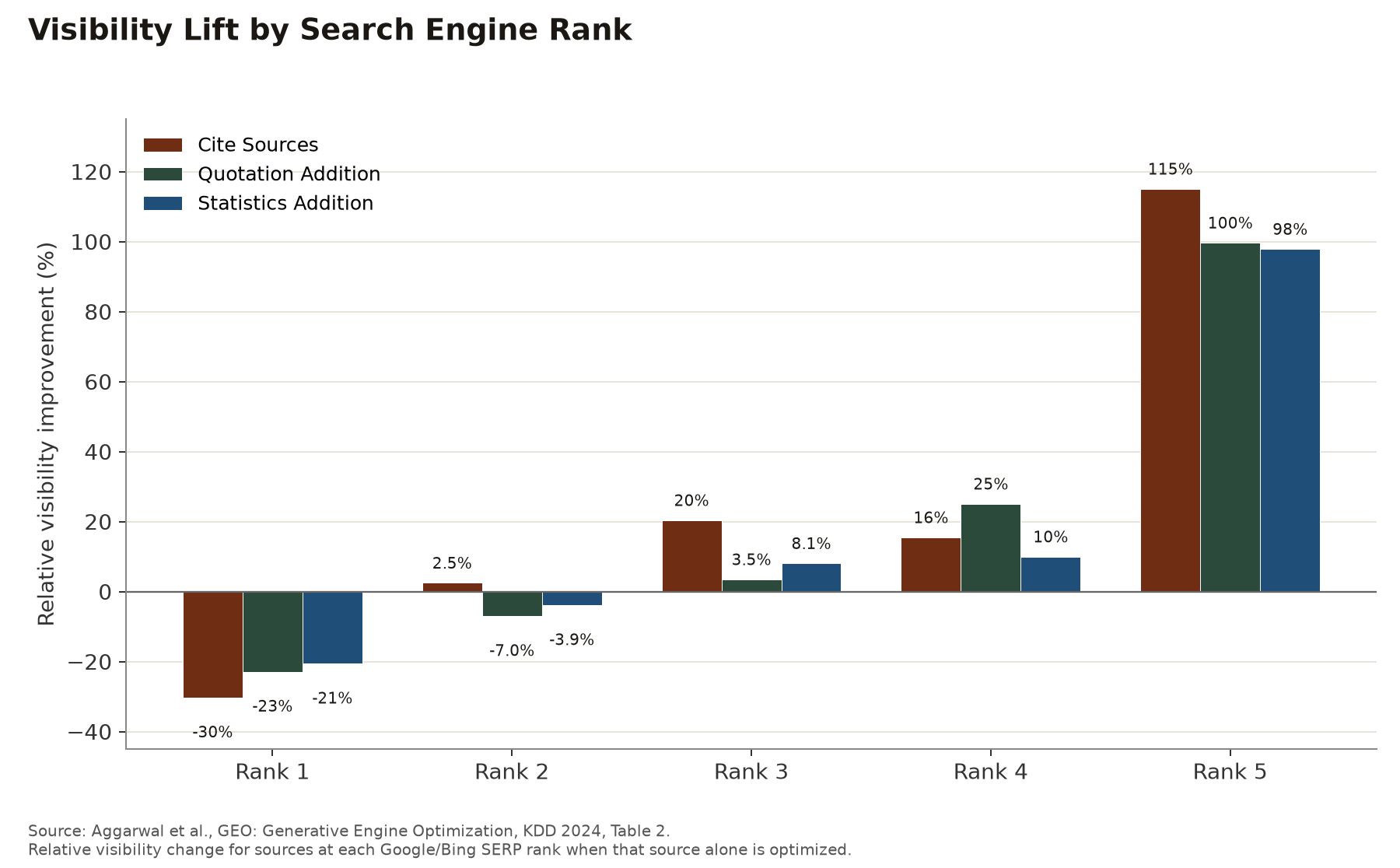
Re-charted from Aggarwal et al. Table 2.
- Sources already ranked first often lost share when optimized: Cite Sources fell 30.3% at Rank 1, Quotation Addition fell 22.9%, and Statistics Addition fell 20.6%.
- Rank 5 sources gained the most. Cite Sources rose 115.1%, Quotation Addition 99.7%, and Statistics Addition 97.9%.
- The pattern in Table 2 is that GEO helped lower-ranked pages far more than pages that already led the retrieval set.
Top Domains for Each GEO Method
GEO-bench tags every query by domain and question type. Table 3 in the paper lists the three categories where each high-performing method worked best. The table below reprints those categories.
| Method | Top Domain / Query Type | Second | Third |
|---|---|---|---|
| Authoritative | Debate | History | Science |
| Fluency Optimization | Business | Science | Health |
| Cite Sources | Statement | Facts | Law & Gov. |
| Quotation Addition | People & Society | Explanation | History |
| Statistics Addition | Law & Gov. | Debate | Opinion |
- Cite Sources led on Statement, Facts, and Law & Gov. queries, where a verifiable reference strengthens the answer.
- Statistics Addition led on Law & Gov., Debate, and Opinion. Quotation Addition led on People & Society, Explanation, and History.
- Authoritative tone helped most on Debate, History, and Science, not across every category equally.
GEO Method Scores on Perplexity.ai
To check whether the methods held up outside their own generative engine setup, the authors ran a 200-query subset on Perplexity.ai. Table 5 reports absolute impression scores for a smaller set of methods.
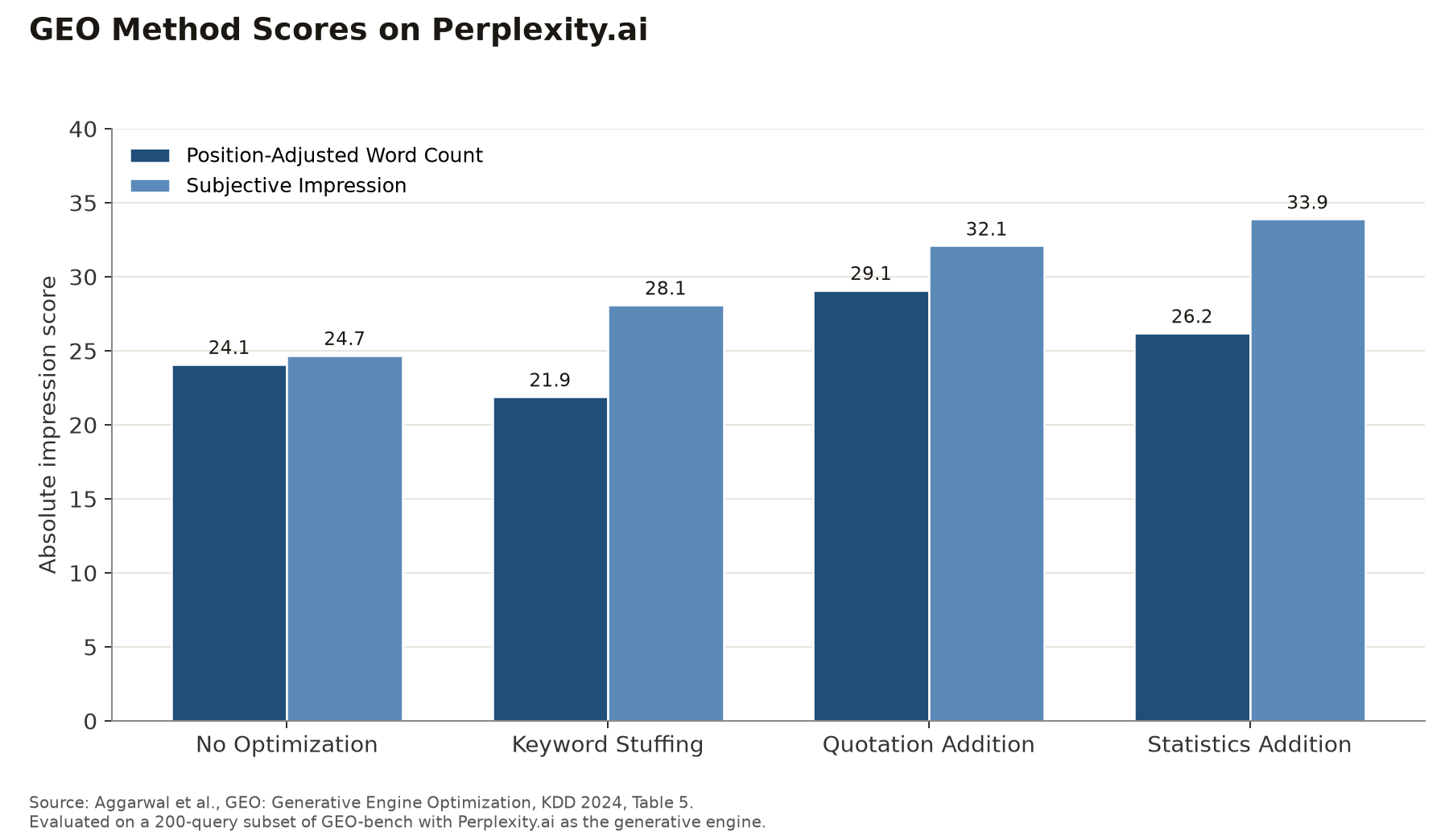
Re-charted from Aggarwal et al. Table 5.
- Quotation Addition scored 29.1 on Position-Adjusted Word Count against a 24.1 baseline, a 20.7% lift, the best of the methods shown for that metric on Perplexity.
- Statistics Addition scored 33.9 on Subjective Impression against a 24.7 baseline, a 37.2% lift, matching the paper's claim of up to 37% on that metric.
- Keyword Stuffing again underperformed on Position-Adjusted Word Count (21.9 vs 24.1), about 9% below the baseline.
Combining GEO Methods
Website owners will often apply more than one edit. Figure 4 in the paper reports relative Position-Adjusted Word Count improvement for every pair among Fluency Optimization, Statistics Addition, Cite Sources, and Quotation Addition, on a 200-query subset.
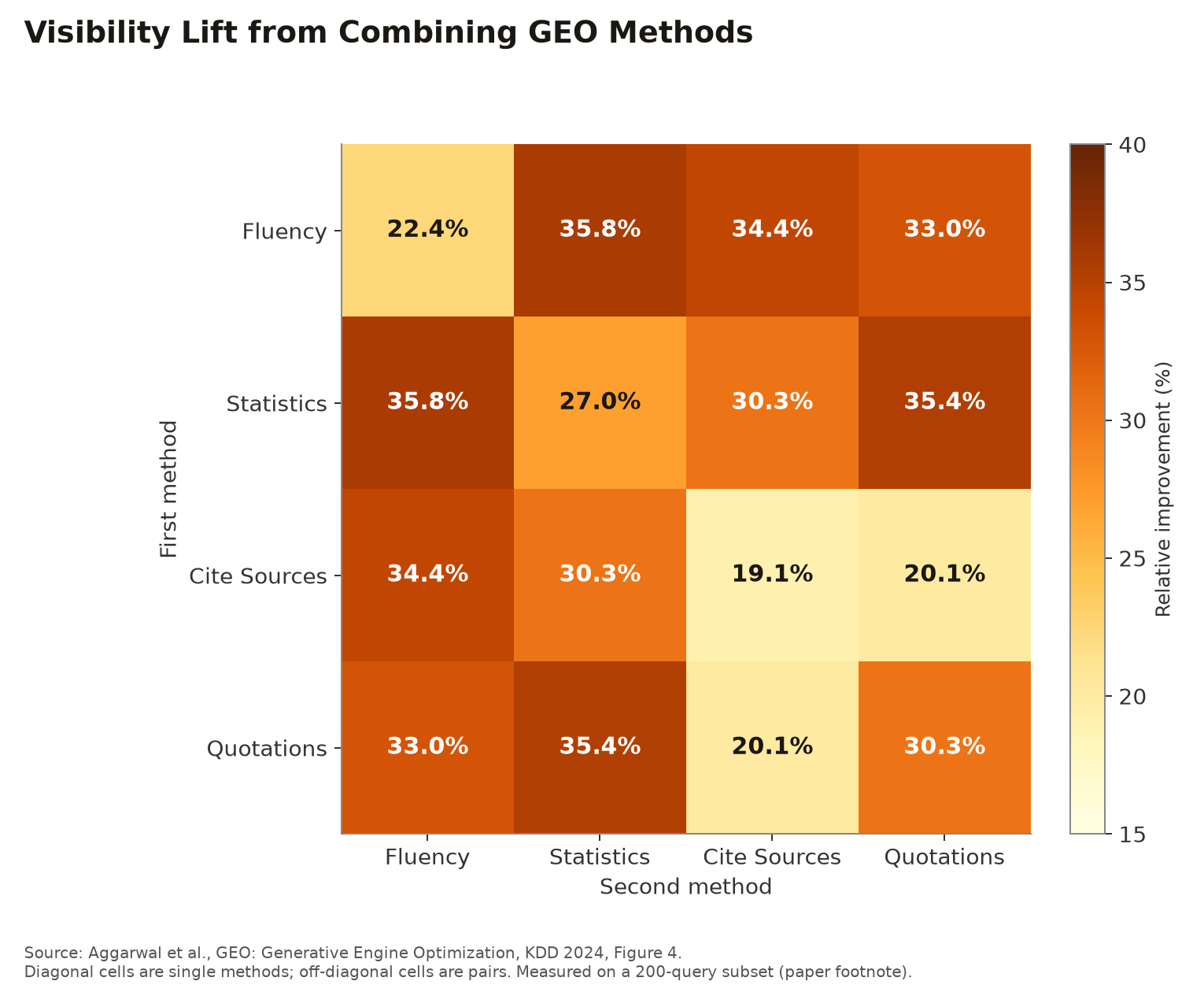
Re-charted from Aggarwal et al. Figure 4.
- Fluency Optimization paired with Statistics Addition reached 35.8%, the highest cell in Figure 4 and more than 5.5 percentage points above any single method on that subset.
- Statistics paired with Quotations reached 35.4%. Fluency paired with Cite Sources reached 34.4%.
- Cite Sources alone scored 19.1% on this subset, but rose when combined with Fluency (34.4%) or Statistics (30.3%).
What the Paper Doesn't Tell Us
The study optimizes one randomly chosen source per query in most runs, on content that the authors rewrite with language-model prompts. It does not measure a live marketing program over months, paid media alongside content edits, or how often a brand is recommended when the question is commercial rather than informational. The Perplexity and combination results use a 200-query subset, so those scores are not directly comparable to the full GEO-bench Table 1 numbers. The paper also does not report ChatGPT, Gemini, or Google AI Overviews as the generative engine under test.
What These Findings Mean in Practice
The methods that moved visibility most were additions of quotations, statistics, and cited sources, plus clearer writing, not keyword stuffing. Lower-ranked pages gained far more than pages that already led the retrieval set, and the best edit depended on the query's domain. On Perplexity, the same pattern held: quotations and statistics helped, and keyword stuffing did not.
When two methods were combined, fluency plus statistics produced the largest lift on the authors' subset. That points to a practical sequence: make the page easier to read, then add verifiable numbers and attributed quotes where the topic supports them.
Audit your key pages for missing statistics, attributed quotes, and cited sources, then rewrite the weakest passages for fluency before you spend more time on keyword density.
Data Collection and Methodology
We downloaded the public PDF of Aggarwal et al., GEO: Generative Engine Optimization, KDD 2024 (arXiv 2311.09735v3), extracted the text with pdftotext, and transcribed every figure in this article from the paper's own tables and figures. Relative lifts for Table 1 were computed from the published absolute scores against the No Optimization baseline of 19.3. Table 2 percentages, Table 3 domain labels, Table 5 Perplexity scores, and Figure 4 combination percentages were taken as printed. We did not invent, estimate, or impute any value.
Charts were redrawn as sorted bars, grouped bars, and a heatmap so a marketer can read the paper's results without the original academic layout. A CSV of the re-charted values is linked under Sources.
Sources
- Top GEO Agencies, GEO Paper Explained: Visibility Lift by Content Method, October 2026, New York, New York. Download the data (CSV).
- GEO: Generative Engine Optimization. Pranjal Aggarwal, Vishvak Murahari, Tanmay Rajpurohit, Ashwin Kalyan, Karthik Narasimhan, and Ameet Deshpande. Proceedings of the 30th ACM SIGKDD Conference on Knowledge Discovery and Data Mining (KDD '24), August 25-29, 2024, Barcelona, Spain. arXiv 2311.09735.