Market Research / GEO/AEO History
The ChatGPT Shock
Chapter 6, November 2022 to 2023
How the release of ChatGPT in November 2022 led Google and Microsoft to announce AI search products within ten weeks, and how publishers, search marketers, and the courts responded through the end of 2023.
By TGA EditorsOctober 30, 20267 min read
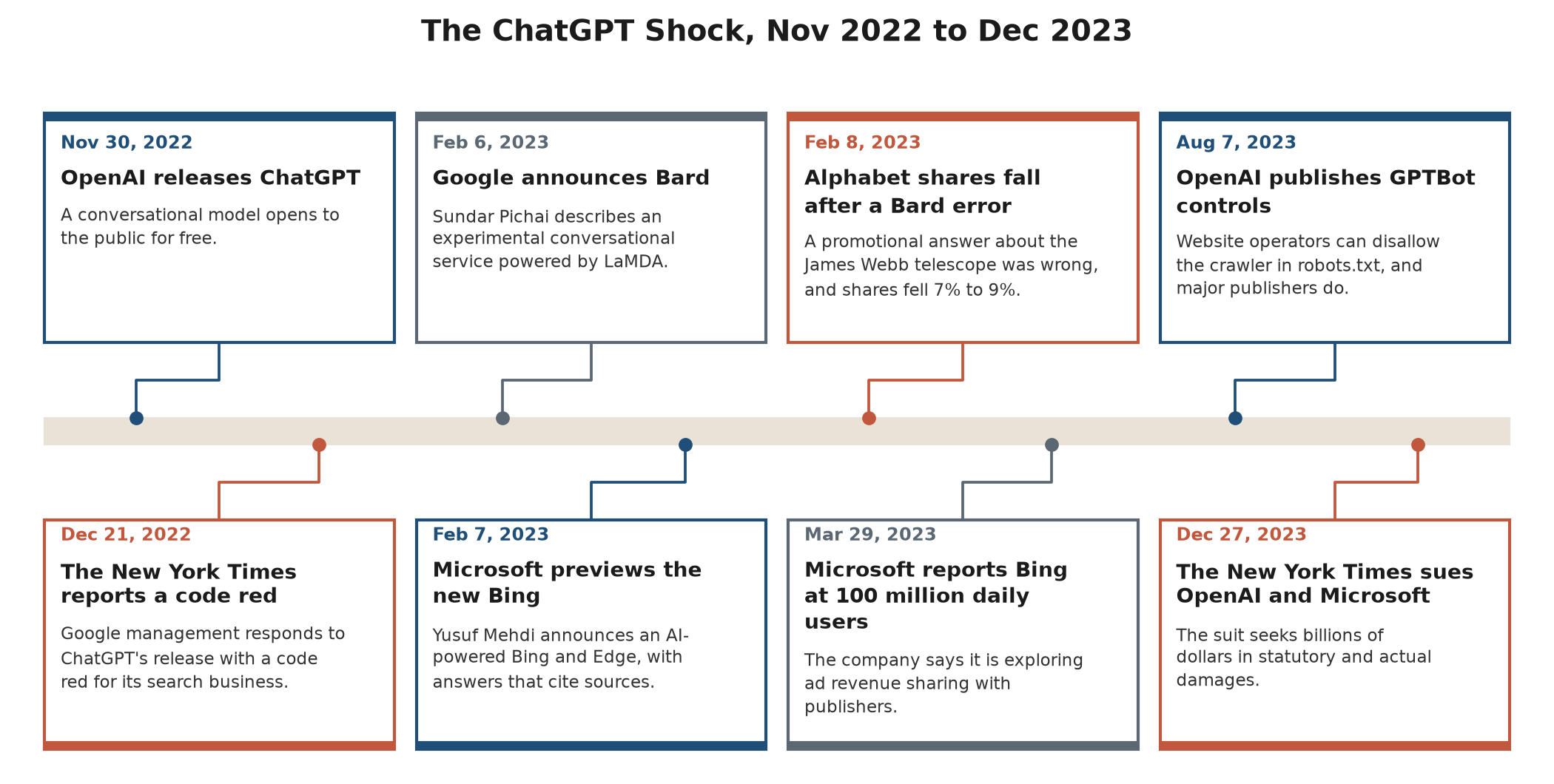
ChatGPT reached the public on November 30, 2022. Within ten weeks, Google and Microsoft had each announced a conversational AI product tied to search, and a start-up called Perplexity had launched a search engine that answered with source links. Over the rest of 2023, newspapers began blocking AI crawlers, and one of them sued. Search had been a settled business for two decades, and this chapter follows how the arrival of a chatbot unsettled it. It covers the public and industry reaction in date order, from the release through the end of 2023. The research papers and optimization services from the same period are in The Origins of GEO, and the models behind ChatGPT are in Machines That Read.
November and December 2022: ChatGPT Spreads, and Google Declares a Code Red
OpenAI released ChatGPT on November 30, 2022, and made it available to the public for free.1,2 ChatGPT gained one million users in five days and 100 million in two months.3 On December 21, Nico Grant and Cade Metz of The New York Times reported that the release had led Google's management to declare a "code red," which they compared to pulling a fire alarm. The article called ChatGPT a possible replacement for the traditional search engine, because it "can serve up information in clear, simple sentences" and not only a list of links, and it quoted one Google executive who described the company's response as make or break for Google's future.4
The article quoted Margaret O'Mara, a University of Washington professor who specializes in the history of Silicon Valley: "No company is invincible; all are vulnerable." It noted that Google had already built a chatbot that could rival ChatGPT, called LaMDA, which drew attention in the summer of 2022 when an engineer claimed it was sentient, a claim the article called untrue. It also reported that the underlying technology of OpenAI's chatbot was developed by researchers at Google. The article explained why Google might hesitate to put chat at the center of search: the technology is not suited to delivering digital ads, which accounted for more than 80 percent of Google's revenue the previous year.4
August to December 2022: Perplexity Launches
Perplexity AI was founded on August 22, 2022, by Aravind Srinivas, Denis Yarats, Johnny Ho, and Andy Konwinski. It launched its main search engine on December 7, 2022, a week after ChatGPT, and reported two million unique visitors in February 2023.5 Perplexity said it had included citations in each answer from the start.6 Its handling of citations is covered in The Citation Economy.
January 2023: The Fastest-Growing Consumer App
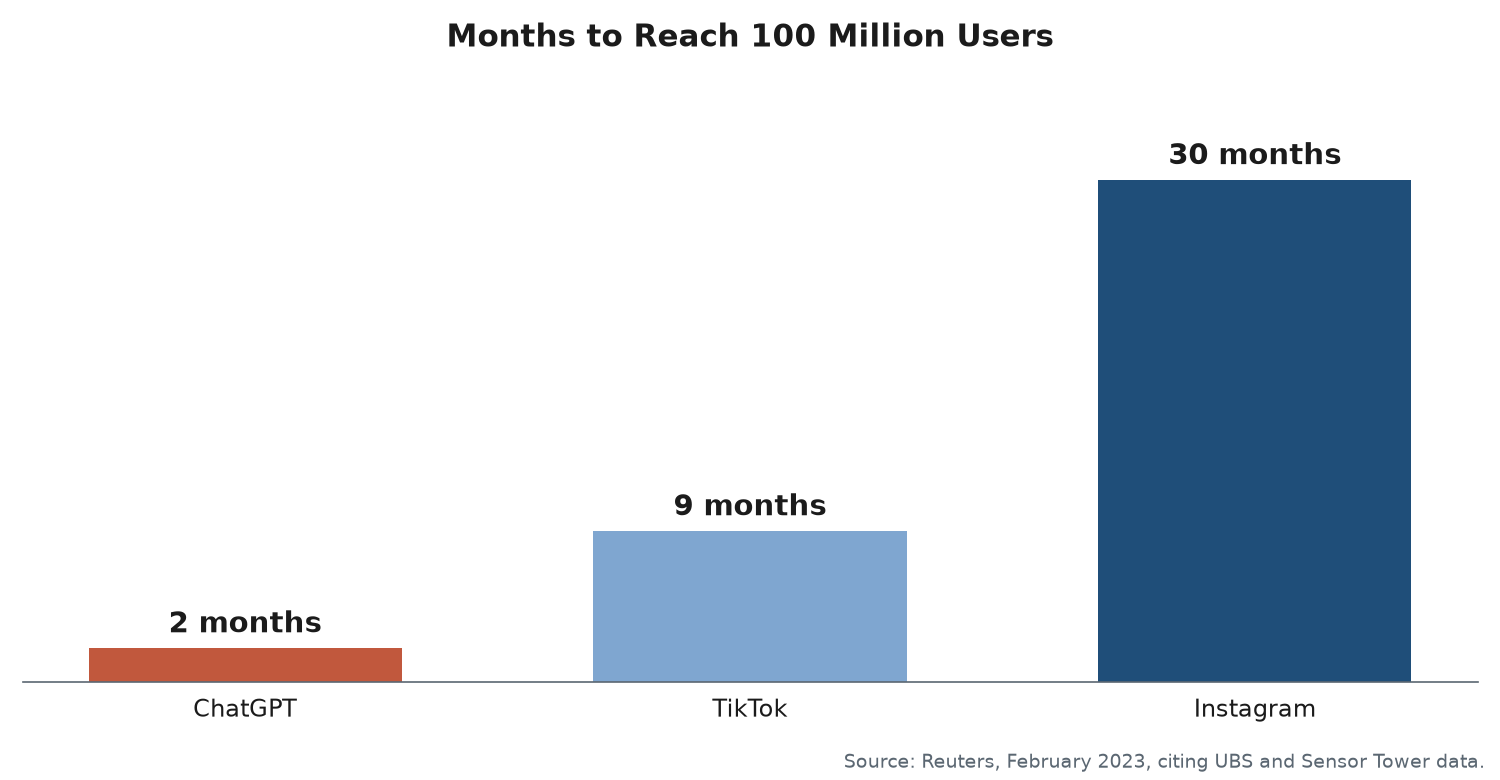
A UBS study published on February 1, 2023, estimated that ChatGPT had reached 100 million monthly active users in January, two months after launch. Using data from Similarweb, the report said about 13 million unique visitors a day had used ChatGPT in January, more than double December's level. "In 20 years following the internet space, we cannot recall a faster ramp in a consumer internet app," the UBS analysts wrote. By the data cited from Sensor Tower, TikTok took about nine months after its global launch to reach 100 million users, and Instagram took two and a half years.2 The next day OpenAI announced a $20 monthly subscription, first for users in the United States, and Microsoft had announced another multi-billion-dollar investment in OpenAI the month before.2
February 6, 2023: Google Announces Bard
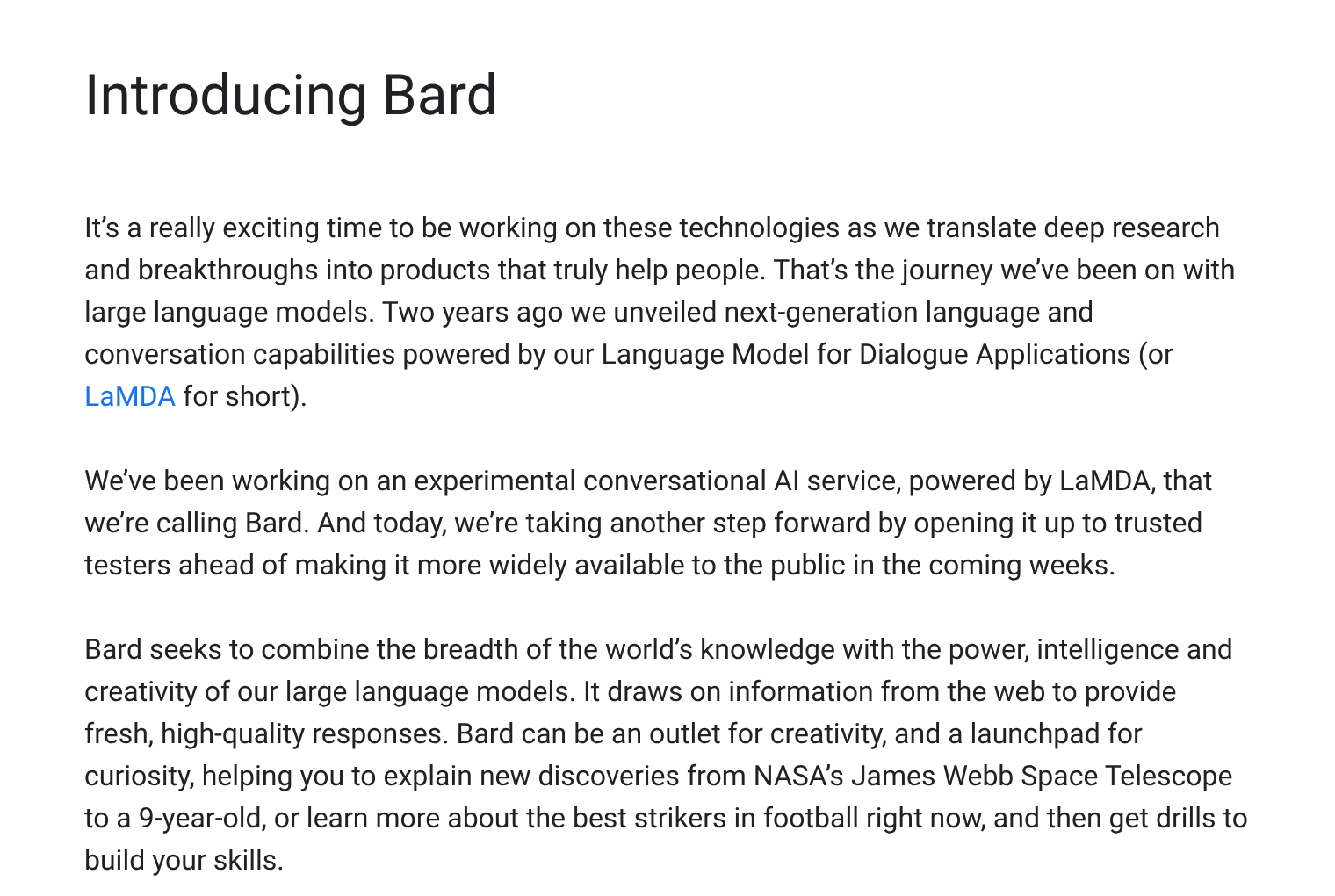
Sundar Pichai, Google's chief executive, announced on February 6, 2023, that Google was working on "an experimental conversational AI service, powered by LaMDA, that we're calling Bard." Bard went first to trusted testers, using a smaller version of LaMDA that needed less computing power, and Pichai said that the next month Google would begin onboarding developers, creators, and enterprises to a Generative Language API, at first powered by LaMDA. Pichai said Bard drew on information from the web, and that Google would bring AI-powered features to Search that "distill complex information and multiple perspectives into easy-to-digest formats."7 Early access opened to users in the United States and United Kingdom on March 21, 2023.8
Google Announces Bard
February 7, 2023: Microsoft Previews the New Bing
A day later, on February 7, Microsoft announced an AI-powered Bing and Edge in limited preview. Yusuf Mehdi, then a corporate vice president and consumer chief marketing officer, wrote that the world runs 10 billion search queries a day and that Microsoft estimated half of them go unanswered. Satya Nadella said AI "will fundamentally change every software category, starting with the largest category of all" in search. The Edge browser gained a sidebar that could summarize a long financial report and a tool for composing text. The new Bing ran on an OpenAI model that Microsoft described as more powerful than ChatGPT, together with a Microsoft technique it called Prometheus. Microsoft said it "also cites all its sources, so you're able to see links to the web content it references."9
Microsoft Announces the New Bing
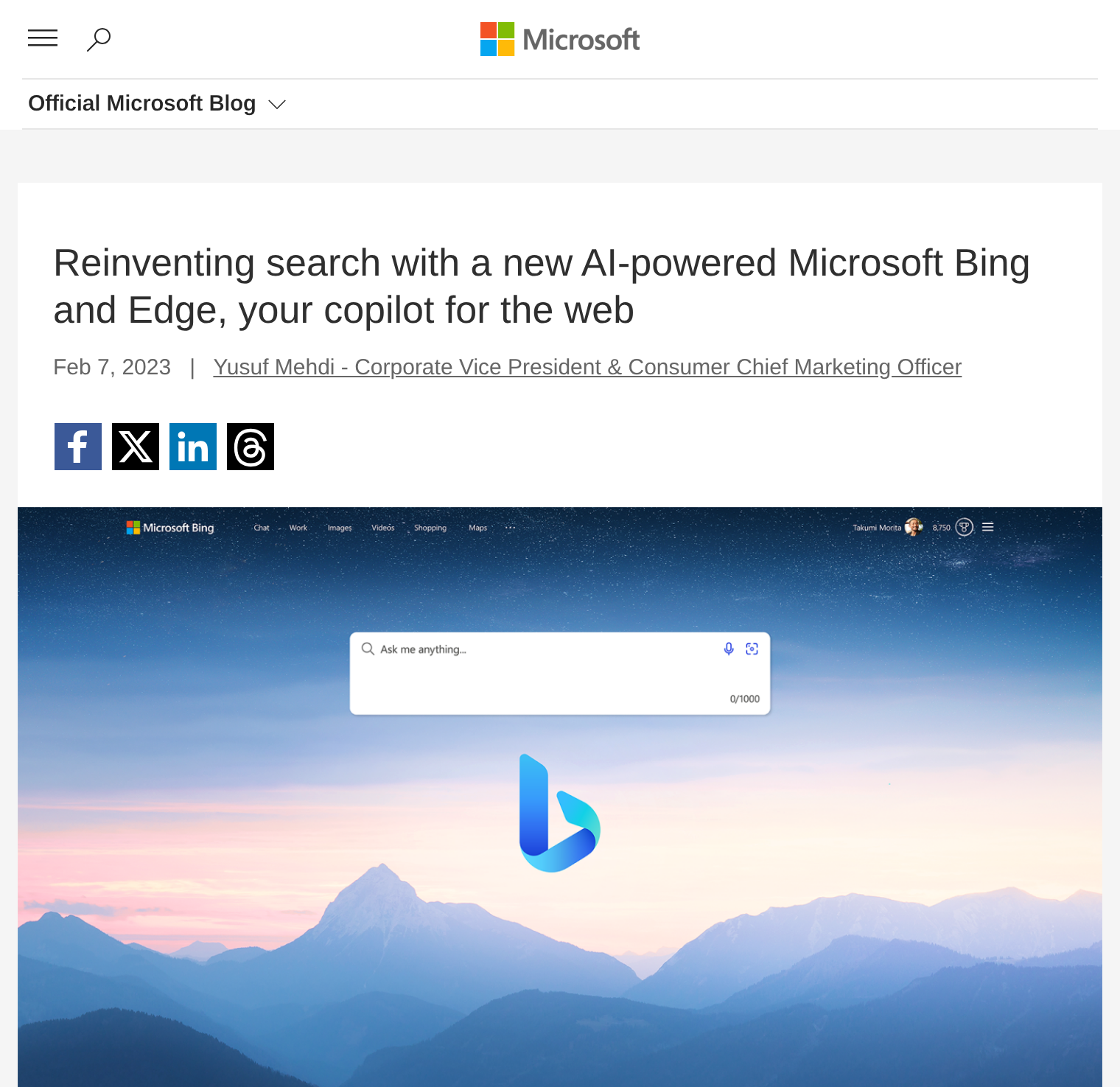
Microsoft also said that the new Bing could generate content, such as an email, a five-day itinerary for a trip to Hawaii with links to book travel, or a trivia quiz.9
February 8, 2023: Alphabet Shares Fall After a Bard Error
A promotional post for Bard that Google released on Twitter on Monday, February 6, asked Bard what to tell a nine-year-old about discoveries from the James Webb Space Telescope. Bard answered that the telescope took the first pictures of a planet outside our solar system. The BBC reported that the European Very Large Telescope took that milestone in 2004, a mistake astronomers quickly noted on Twitter.10 Alphabet shares fell more than 7 percent on Wednesday, February 8, which removed about $100 billion in market value, according to the BBC.10 NPR reported a 9 percent drop.11 Investors were also reported to be underwhelmed by a Google presentation about its AI plans.10
February 2023: Google's Guidance on AI-Generated Content
Website owners asked whether using a chatbot to write pages would damage their rankings. In February 2023, Danny Sullivan and Chris Nelson of Google's Search quality team published guidance on AI-generated content. It said that using automation, including AI, to generate content "with the primary purpose of manipulating ranking in search results is a violation of our spam policies," and that "not all use of automation, including AI generation, is spam." Appropriate use of AI, the FAQ added, is "not against our guidelines." Google advised creators to produce original, high-quality, people-first content that demonstrates experience, expertise, authoritativeness, and trustworthiness, which the post abbreviated as E-E-A-T.12
February to March 2023: Bing Learns From Its Preview
On February 15, 2023, the Bing team reported that it had tested the preview with people in 169 countries. Feedback on the AI answers was mostly positive, with 71 percent of users giving them a thumbs up, and users gave good marks to the citations and references that sit under the answers, which made them easier to fact check. The team also reported problems. Answers that needed very timely data, such as live sports scores, were weak, and in long sessions of 15 or more questions Bing could become repetitive or give responses that did not fit its intended tone.13
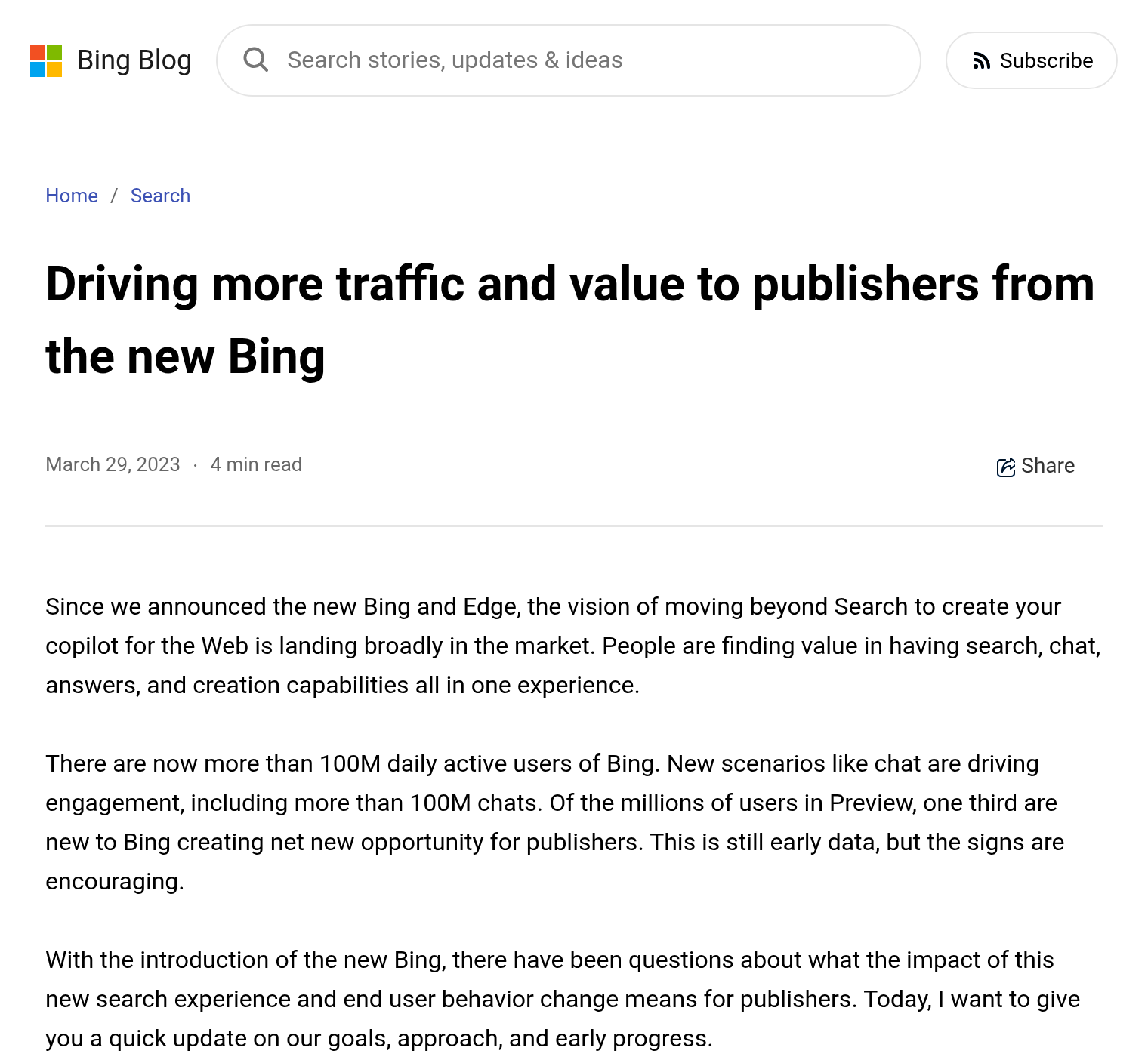
On March 14, Microsoft confirmed that the new Bing ran on GPT-4, and that anyone who had used the preview in the previous five weeks had already seen an early version of it.14 On March 29, Mehdi reported more than 100 million daily active users of Bing and more than 100 million chats, with one third of preview users new to Bing. Citations appeared in the body of chat answers and again below the results, with links to additional sources. In answer to questions from publishers about traffic, Microsoft also said it was exploring ways to share ad revenue with publishers whose content contributed to a chat response, and ideas for its more than 7,500 Microsoft Start partner brands, including a hover feature that would show more links from a publisher.15
Microsoft Writes to Publishers About the New Bing
March 2023: ChatGPT Gains Browsing and Plugins
In March 2023, OpenAI added plugins to ChatGPT. They included web browsing and code interpretation from OpenAI, and outside plugins from companies such as Expedia, OpenTable, and Zapier.3 With them ChatGPT could pull in current web content and connect to outside travel, restaurant, and automation services.
August 2023: Publishers Block GPTBot
OpenAI said on August 7, 2023, that website operators could disallow its GPTBot crawler in their robots.txt files or block its IP address. OpenAI said pages crawled by GPTBot may be used to improve future models, and that it filters out sources that require paywall access or gather personally identifiable information. The Verge noted that the step did not remove content GPTBot had already collected.16 The New York Times disallowed GPTBot in its robots.txt file, and the Internet Archive's Wayback Machine suggested it had done so as early as August 17.17 The Guardian found in late August that CNN, Reuters, the Australian Broadcasting Corporation, and the Chicago Tribune appeared to have done the same.18
December 2023: The New York Times Sues OpenAI and Microsoft
On December 27, 2023, The New York Times sued OpenAI and Microsoft for copyright infringement in Federal District Court in Manhattan. The Times was the first major American media organization to sue the companies. The complaint said millions of its articles had been used to train chatbots that now compete with it as a source of reliable information. It asked for "billions of dollars in statutory and actual damages" and for the destruction of models and training data that use its work. The Times said it had approached Microsoft and OpenAI in April to seek "an amicable resolution," possibly a commercial agreement, and that the talks had not produced one. An OpenAI spokeswoman said the company was "surprised and disappointed" and hopeful that it would find a way to work together with the Times.19
By the end of 2023, the two largest English-language search engines each had a conversational product, a start-up was operating a search engine built on cited AI answers, and The New York Times had sued the makers of the models. The marketing response is covered in The Origins of GEO, and Google's own AI search products are the subject of Google Answers Back.
Key Organizations
Key Organizations in The ChatGPT Shock, November 2022 to 2023
| Organization | Role in this period | Key dates |
|---|---|---|
| Declared a code red, announced Bard, and published guidance on AI-generated content.4,7,12 | Bard announced February 6, 2023; early access March 21, 2023 | |
| Microsoft | Launched the new Bing with cited AI answers, confirmed GPT-4, and began exploring ad revenue sharing with publishers.9,14,15 | Preview February 7, 2023; 100 million daily users March 29, 2023 |
| OpenAI | Released ChatGPT, added plugins, and introduced the GPTBot controls.1,3,16 | ChatGPT November 30, 2022; GPTBot controls August 7, 2023 |
| Perplexity AI | Launched a search engine that answers in short paragraphs with source links.5 | Search engine launched December 7, 2022 |
| The New York Times | Blocked GPTBot and sued OpenAI and Microsoft.17,19 | GPTBot blocked by August 17, 2023; lawsuit December 27, 2023 |
| UBS | Estimated ChatGPT's monthly active users in an analyst note.2 | Note published February 1, 2023 |
Further reading
- A New Chat Bot Is a "Code Red" for Google's Search Business: Nico Grant and Cade Metz, The New York Times, December 21, 2022.
- Reinventing search with a new AI-powered Microsoft Bing and Edge, your copilot for the web: Yusuf Mehdi, Microsoft, February 7, 2023.
- Driving more traffic and value to publishers from the new Bing: Yusuf Mehdi, Microsoft, March 29, 2023.
- Google AI updates: Bard and new AI features in Search: Sundar Pichai, Google, February 6, 2023.
Notes
- OpenAI, "Introducing ChatGPT," November 30, 2022. https://openai.com/index/chatgpt/
- Krystal Hu, "ChatGPT sets record for fastest-growing user base - analyst note," Reuters, February 1, 2023. https://www.reuters.com/technology/chatgpt-sets-record-fastest-growing-user-base-analyst-note-2023-02-01/
- Wikipedia, "ChatGPT." https://en.wikipedia.org/wiki/ChatGPT
- Nico Grant and Cade Metz, "A New Chat Bot Is a 'Code Red' for Google's Search Business," The New York Times, December 21, 2022. https://www.nytimes.com/2022/12/21/technology/ai-chatgpt-google-search.html
- Wikipedia, "Perplexity AI." https://en.wikipedia.org/wiki/Perplexity_AI
- "Introducing the Perplexity Publishers' Program," Perplexity, July 30, 2024. https://www.perplexity.ai/hub/blog/introducing-the-perplexity-publishers-program
- Sundar Pichai, "Google AI updates: Bard and new AI features in Search," Google, February 6, 2023. https://blog.google/technology/ai/bard-google-ai-search-updates/
- Wikipedia, "Google Gemini" (originally known as Bard). https://en.wikipedia.org/wiki/Google_Gemini
- Yusuf Mehdi, "Reinventing search with a new AI-powered Microsoft Bing and Edge, your copilot for the web," The Official Microsoft Blog, February 7, 2023. https://blogs.microsoft.com/blog/2023/02/07/reinventing-search-with-a-new-ai-powered-microsoft-bing-and-edge-your-copilot-for-the-web/
- "Google's Bard AI bot mistake wipes $100bn off shares," BBC News, February 9, 2023. https://www.bbc.com/news/business-64576225
- "Google's AI chatbot, Bard, sparks a $100 billion loss in Alphabet shares," NPR, February 9, 2023. https://www.npr.org/2023/02/09/1155650909/google-chatbot--error-bard-shares
- Danny Sullivan and Chris Nelson, "Google Search's guidance about AI-generated content," Google Search Central Blog, February 2023. https://developers.google.com/search/blog/2023/02/google-search-and-ai-content
- Microsoft Bing Team, "The new Bing & Edge: Learning from our first week," Bing Search Blog, February 15, 2023. https://blogs.bing.com/search/2023/2/The-new-Bing-Edge-Learning-from-our-first-week/
- Yusuf Mehdi, "Confirmed: the new Bing runs on OpenAI's GPT-4," Bing Search Blog, March 14, 2023. https://blogs.bing.com/search/2023/3/Confirmed-the-new-Bing-runs-on-OpenAI%E2%80%99s-GPT-4/
- Yusuf Mehdi, "Driving more traffic and value to publishers from the new Bing," Bing Search Blog, March 29, 2023. https://blogs.bing.com/search/2023/3/Driving-more-traffic-and-value-to-publishers-from-the-new-Bing/
- Emilia David, "Now you can block OpenAI's web crawler," The Verge, August 7, 2023. https://www.theverge.com/2023/8/7/23823046/openai-data-scrape-block-ai
- Jay Peters, "The New York Times blocks OpenAI's web crawler," The Verge, August 21, 2023. https://www.theverge.com/2023/8/21/23840705/new-york-times-openai-web-crawler-ai-gpt
- "New York Times, CNN and Australia's ABC block OpenAI's GPTBot web crawler from accessing content," The Guardian, August 25, 2023. https://www.theguardian.com/technology/2023/aug/25/new-york-times-cnn-and-abc-block-openais-gptbot-web-crawler-from-scraping-content
- "New York Times Sues OpenAI and Microsoft Over Use of Copyrighted Work," The New York Times, December 27, 2023. https://www.nytimes.com/2023/12/27/business/media/new-york-times-open-ai-microsoft-lawsuit.html