Market Research / GEO/AEO History
Google Answers Back
Chapter 8, 2023 to 2026
How Google moved generated answers into its own results from 2023 to 2026, through Search Generative Experience, AI Overviews, and AI Mode, and what each stage changed for publishers, site owners, and reporting.
By TGA EditorsOctober 30, 20269 min read
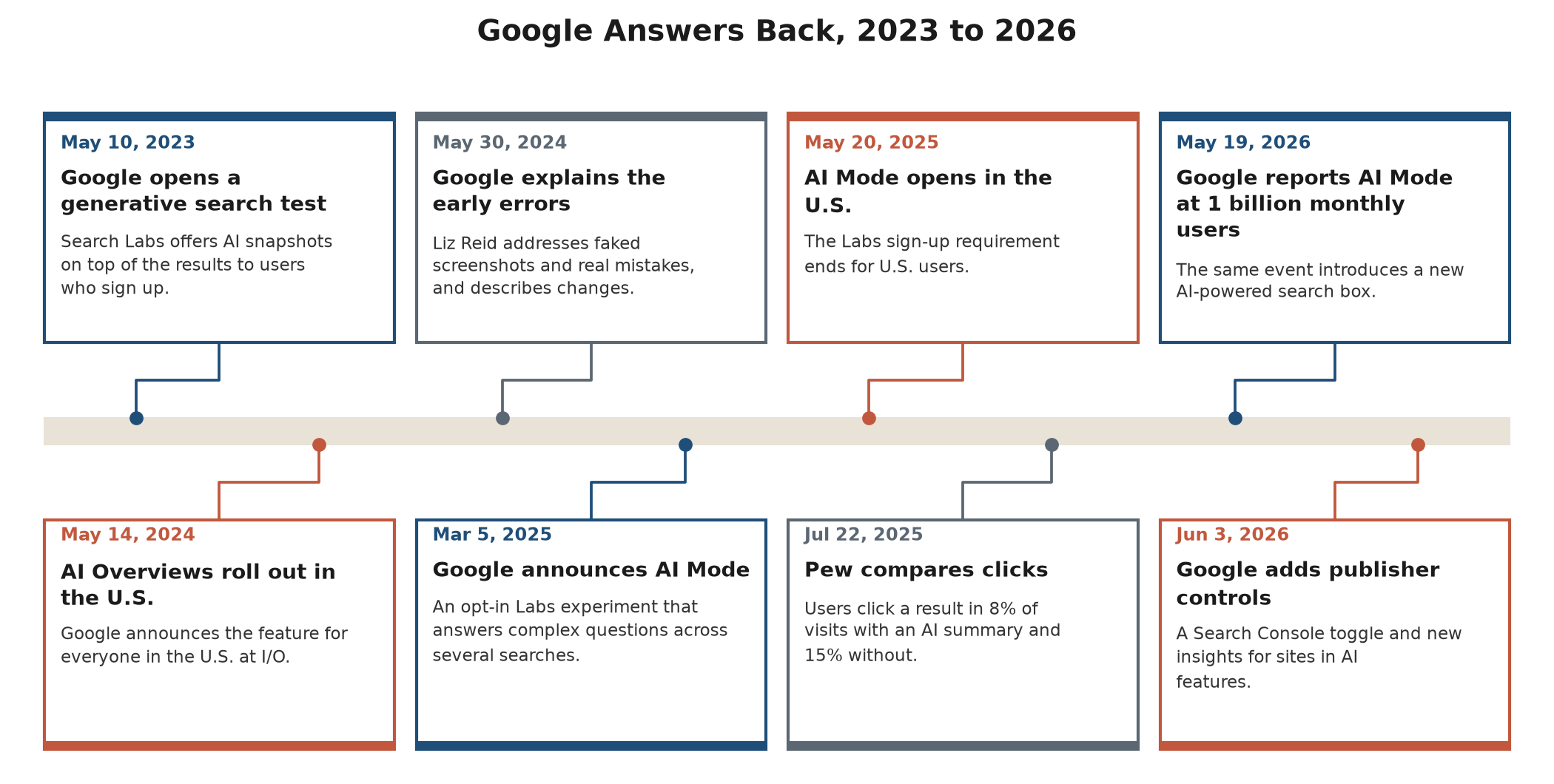
Google's results pages had been adding direct answers for years. Featured snippets, described in Position Zero, lifted a sentence from one page to the top of the results, and the models in Machines That Read had improved how Google matched queries to pages. After the release of ChatGPT and the announcement of Bard, told in The ChatGPT Shock, Google began to put generated text into Search itself. This chapter follows that effort from a Search Labs test in May 2023 to the product changes of October 2026, with attention to what Google said and what outside researchers measured. The industry studies of AI answers from the same years are in The Origins of GEO.
May 2023: Search Generative Experience
On May 10, 2023, Elizabeth Reid, then a vice president and general manager of Search at Google, announced a test of generative AI in Search. The experiment was called SGE, for Search Generative Experience, and it ran in Search Labs for people in the United States who signed up, on Chrome desktop and in the Google app, in English only. Reid illustrated it with a long question, "what's better for a family with kids under 3 and a dog, bryce canyon or arches." Instead of breaking it into several searches, the user would see "an AI-powered snapshot of key information to consider, with links to dig deeper," followed by suggested next steps and the ability to ask follow-up questions in a conversational mode.1
Google Announces Search Generative Experience
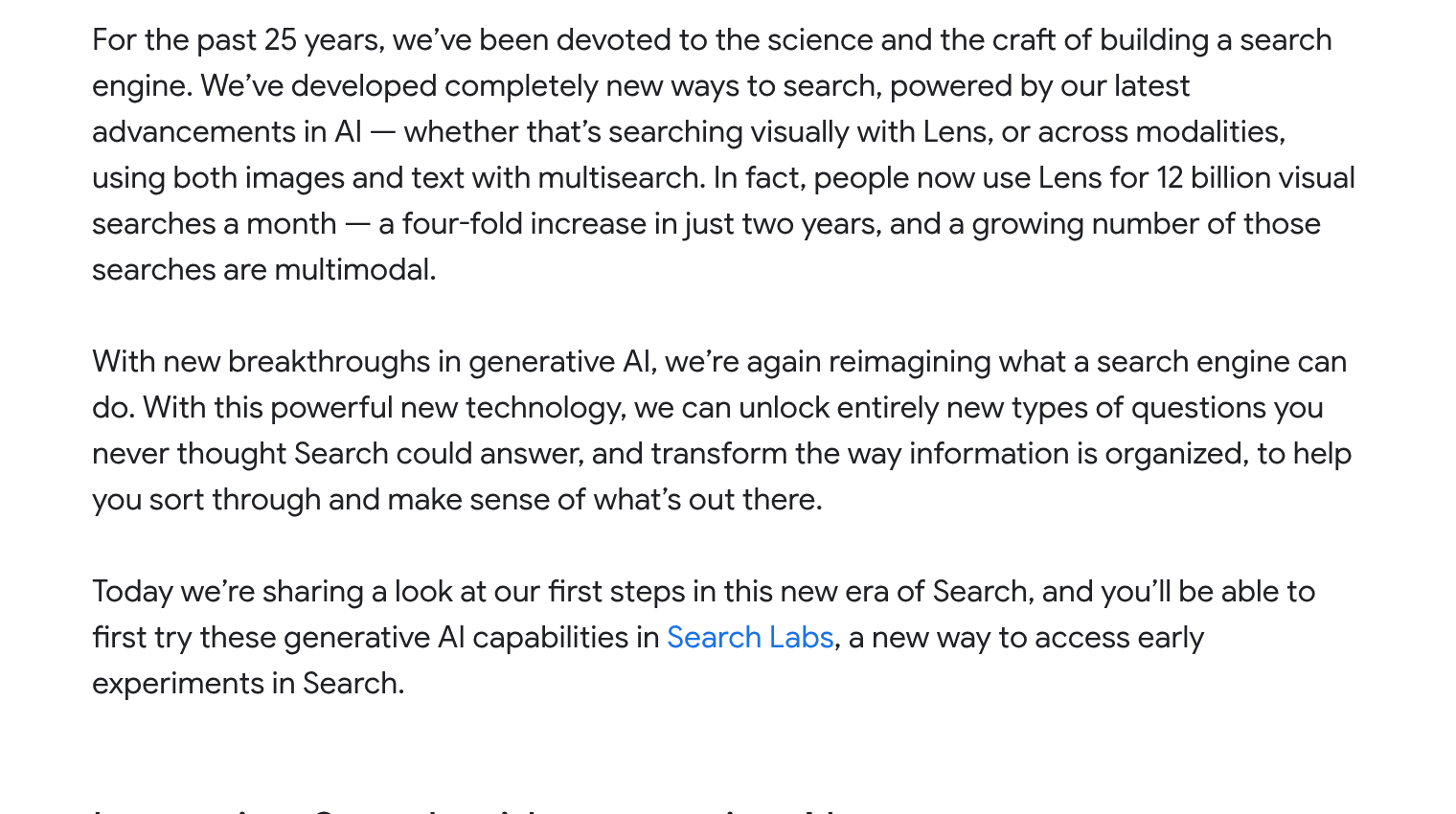
The announcement also addressed the people who relied on Google for traffic and revenue. Google said it designed the new experiences to "highlight and drive attention to content on the web" and that it was "committed to continue sending valuable traffic to sites across the web." Search ads would "continue to appear in dedicated ad slots throughout the page." For shopping, the snapshots drew on Google's Shopping Graph, which Google said had more than 35 billion product listings.1
November 2023: SGE Expands to More Than 120 New Countries
On November 8, 2023, Google said it was bringing Search Labs and SGE in English to more than 120 new countries and territories, in its largest international expansion to date, and adding four languages: Spanish, Portuguese, Korean, and Indonesian. The post said Google had already expanded to India and Japan and that the "vast majority" of feedback in the United States, India, and Japan had been positive. Google also said that with SGE it was "showing more links, and links to a wider range of sources on the results page." New features included a way to ask follow-up questions from the results page, AI-assisted translation that underlines words with more than one meaning, and interactive definitions for topics such as coding and health.2
May 2024: AI Overviews Reach Everyone in the United States
At Google I/O on May 14, 2024, Google announced that AI Overviews would begin rolling out to everyone in the United States, with more countries soon. The feature was powered by what Google called a new Gemini model customized for Search. Google said people had used AI Overviews "billions of times" in Search Labs, and that hundreds of millions of users would have access that week, with over a billion expected by the end of the year. It said that the links included in AI Overviews "get more clicks than if the page had appeared as a traditional web listing for that query," and that ads would continue to appear in dedicated slots with clear labels.3 Industry studies of AI answers from the months before this rollout are in The Origins of GEO.
May 30, 2024: Errors and Google's Response
Within days of the rollout, people on social media shared odd and wrong AI Overviews. Liz Reid, by then a vice president of Search, published "AI Overviews: About last week" on May 30. She said Google had also seen "a very large number of faked screenshots," including some that implied Google had returned dangerous results on topics such as leaving dogs in cars, smoking while pregnant, and depression, which Google said never appeared. Other errors were real. For the query "How many rocks should I eat?" practically no one had asked it before the screenshots spread, and little serious content existed on it, which Reid called a data void. An AI Overview linked to one of the few pages on the subject, which carried satirical content republished on a geological software provider's website. In other cases an AI Overview drew on sarcastic forum posts, and Reid cited advice to use glue to get cheese to stick to pizza.4
"AI Overviews: About Last Week"
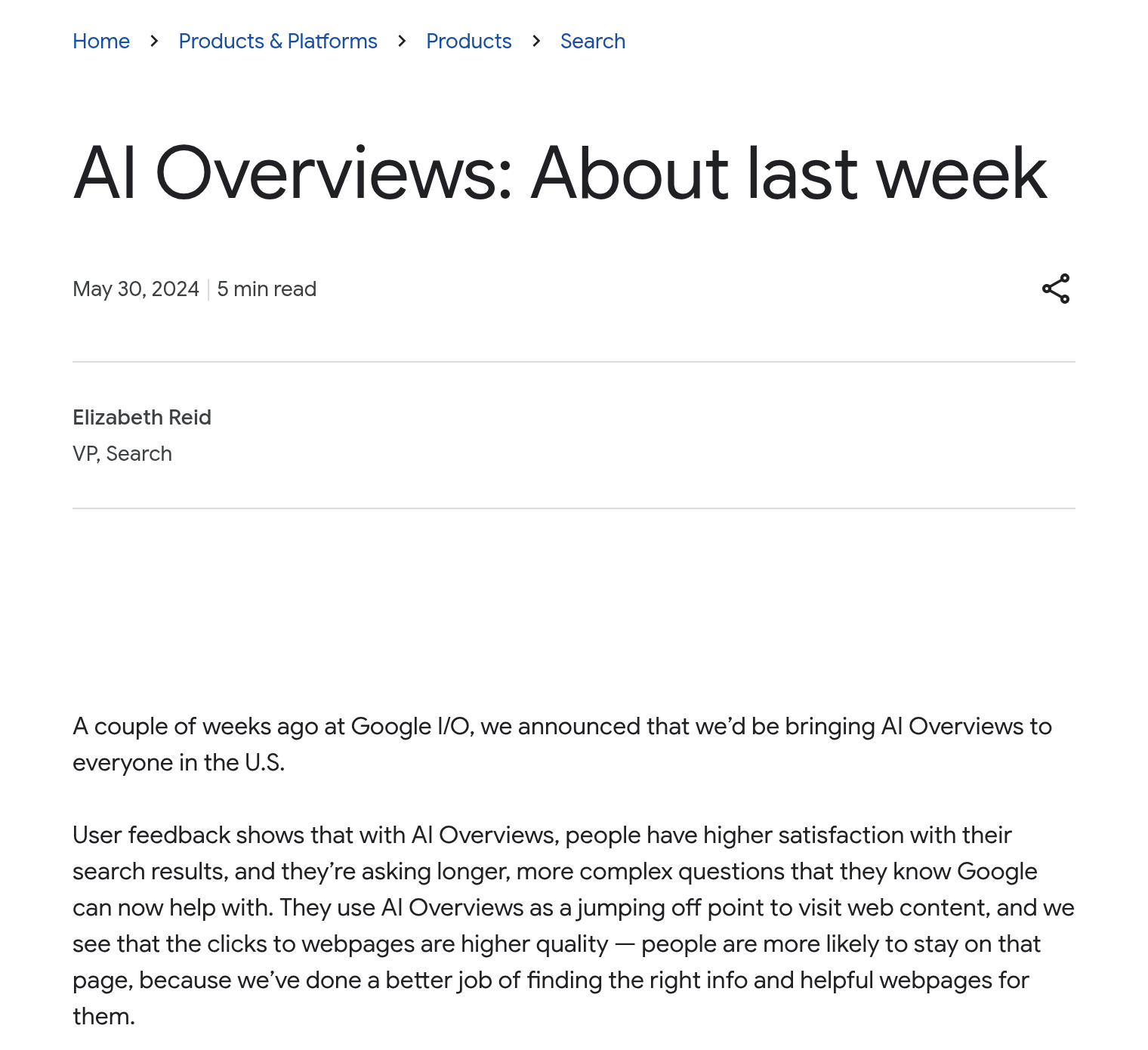
Reid wrote that Google's tests showed an accuracy rate for AI Overviews on par with featured snippets, and that Google had made more than a dozen technical improvements. These included better detection of nonsensical queries, limits on satire and humor content, limits on user-generated content in answers that could mislead, and added restrictions on the kinds of queries that trigger an overview. Google said it aims not to show AI Overviews for hard news topics, and that it found content policy violations on fewer than one in every 7 million unique queries on which AI Overviews appeared. The first paragraphs of the post said people were more satisfied with their results and that "the clicks to webpages are higher quality."4
March 2025: AI Mode
On March 5, 2025, Robby Stein, vice president of product for Google Search, said AI Overviews were used by more than a billion people, that Google had launched Gemini 2.0 for AI Overviews in the United States for harder questions such as coding and advanced math, and that teens could now use them without signing in. The same post introduced AI Mode, an early experiment in Search Labs for power users who wanted AI responses for more of their searches. AI Mode used a custom version of Gemini 2.0 and a technique Google called query fan-out, which issues multiple related searches at once across subtopics and data sources and combines the results. Where Google lacked confidence in an AI response, the post said, it would show a set of web search results instead.5
On May 20, 2025, Reid announced that AI Mode was rolling out in the United States with no Labs sign-up, with a new tab in Search and a custom version of Gemini 2.5 for both AI Mode and AI Overviews. Google said that in its largest markets, the United States and India, AI Overviews was driving a more than 10 percent increase in usage of Google for the kinds of queries that show them. It also described Deep Search, which can issue hundreds of searches and produce a fully cited report, and Search Live, which lets a user talk with Search about what the phone camera sees.6
May 2025: Guidance for Site Owners
On May 21, 2025, John Mueller of Google Search Relations published tips for performing well in AI search. The post said Google saw that "clicks are higher quality, where users are more likely to spend more time on the site" when people click through from a results page with an AI Overview, and it advised site owners to focus on unique, non-commodity content, a good page experience, access for Googlebot, structured data that matches the visible page, and images and video that support the text.7 Google's documentation for AI features states that the best practices for SEO remain relevant for AI Overviews and AI Mode.8
June 2025: AI Mode Appears in Search Console
On June 16, 2025, Search Engine Land reported that AI Mode clicks, impressions, and positions were now included in the totals in the Search Console Performance report. Each component inside AI Mode, such as a link card, image block, or carousel, has its own position, and a follow-up question counts as a new search. The report said Google did not appear to offer a filter for AI Mode alone, so site owners could not separate that traffic from the rest.9
July 2025: Pew Research Center Measures Clicks
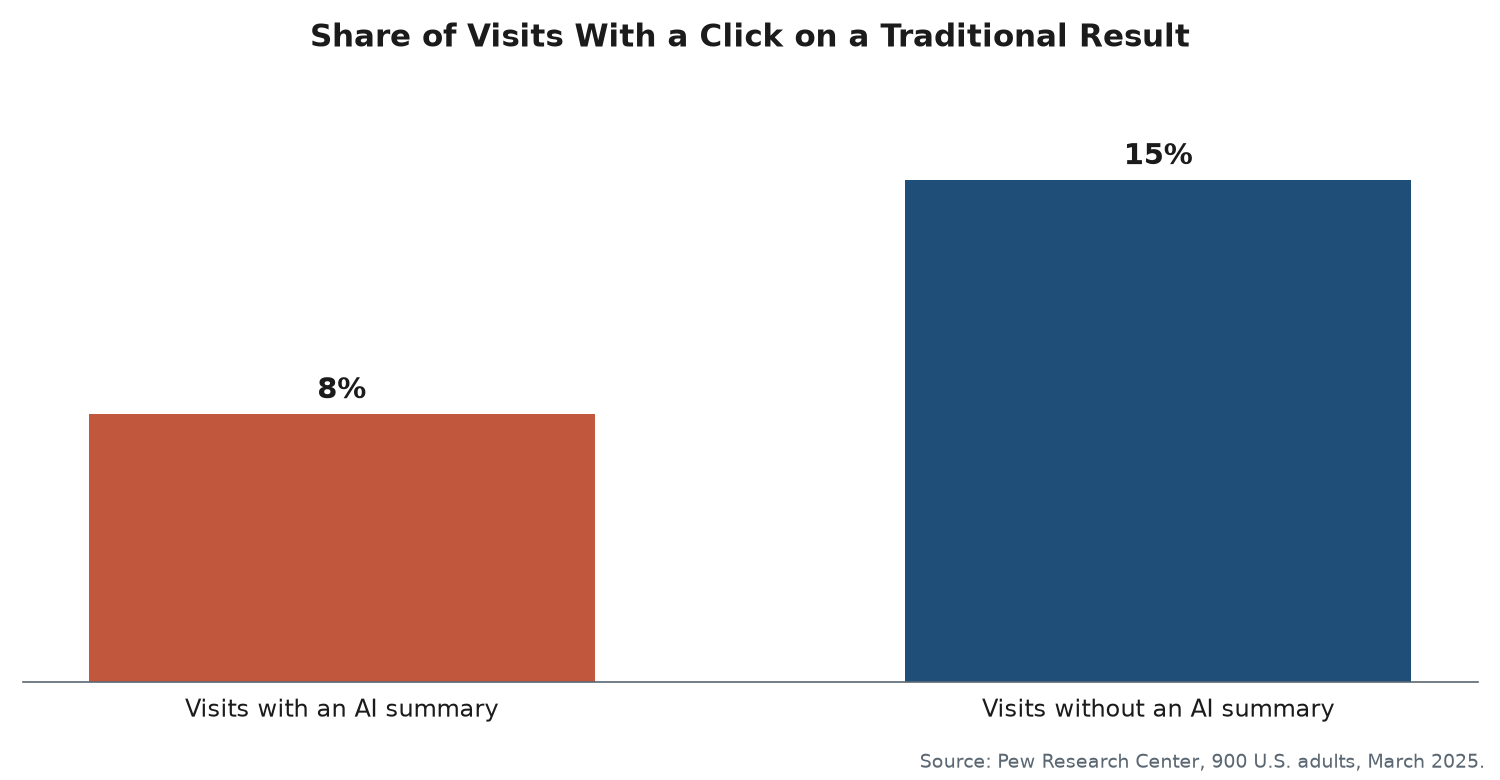
On July 22, 2025, Pew Research Center published an analysis of the browsing of 900 U.S. adults who agreed to share it. In March 2025, 58 percent of the respondents had run at least one Google search that produced an AI summary. Pew reran 68,879 unique Google searches from that browsing to collect the results pages, and 12,593 of them had an AI summary. Pew found that users who met an AI summary clicked a traditional result link in 8 percent of visits, compared with 15 percent for users who did not. Only 1 percent of visits to pages with a summary included a click on a link inside it. Browsing sessions ended after the search page on 26 percent of pages with a summary and 16 percent of pages with only traditional results.10
September 2025: A Publisher Sues Google
On September 14, 2025, TechCrunch reported that Penske Media Corporation, which owns Rolling Stone, Billboard, Variety, and other titles, had sued Google over AI Overviews. The report said the suit was the first to target Google and its parent company, Alphabet, over AI-generated summaries in search. The complaint argued that Penske lets Google crawl its sites in an "exchange of access for traffic," and accused Google of using its monopoly to force Penske to allow its content in AI Overviews. Google's spokesperson said AI Overviews send traffic to a greater diversity of sites and that Google would defend against the claims. TechCrunch also noted that Google was facing an antitrust complaint over AI Overviews in Europe.11
February 2026: Ahrefs Updates Its Click Study
In April 2025 Ahrefs had found that AI Overviews reduced clicks to top-ranking content by 34.5 percent. On February 4, 2026, it published an update using December 2025 data. The study compared 150,000 keywords that triggered an AI Overview with 150,000 informational keywords that did not, using desktop Search Console data. The average clickthrough rate of the top-ranking page for informational keywords without an overview fell from 7.6 percent in December 2023 to 3.9 percent in December 2025, and for keywords with an overview it fell from 7.3 percent to 1.6 percent. Ahrefs used the drop for informational keywords to estimate that the AI Overview keywords would have had a 3.7 percent rate without overviews, and compared that with the actual 1.6 percent. It concluded that an AI Overview was now associated with a 58 percent lower clickthrough rate for position one.12
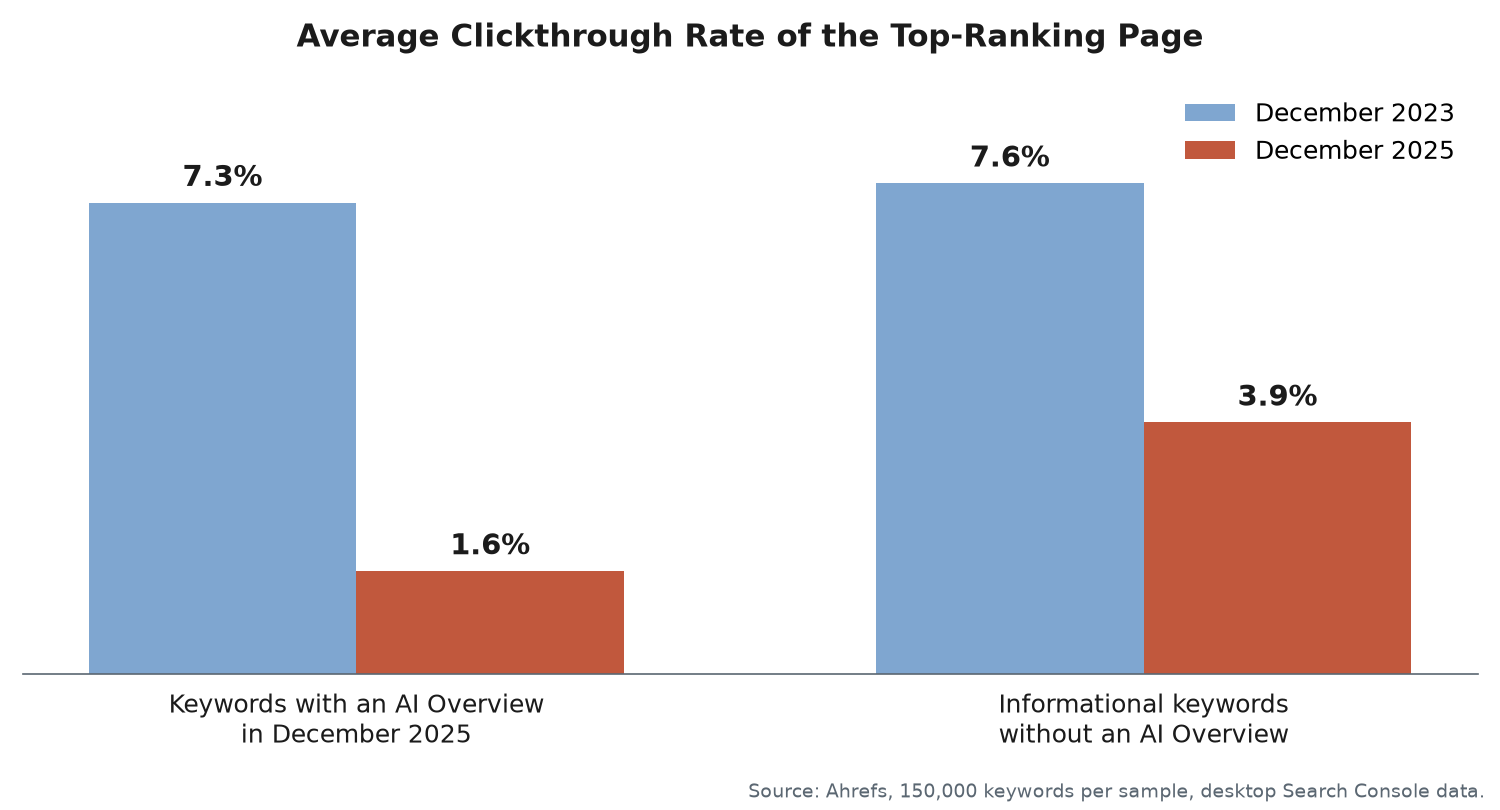
Ahrefs noted that other studies reached similar results, citing Seer Interactive, which found organic clickthrough down 49.4 to 65.2 percent, Kevin Indig, at more than 50 percent, and Authoritas, at 47.5 percent.12 These measure different samples, and Google has said its own data show higher-quality clicks.
May 2026: A New Search Box and One Billion AI Mode Users
At Google I/O on May 19, 2026, Reid said AI Mode had surpassed one billion monthly users one year after its debut, with queries more than doubling every quarter since launch. Google made Gemini 3.5 Flash the default model in AI Mode, introduced what it called the biggest upgrade to its Search box in over 25 years, and added the ability to ask a follow-up from an AI Overview that flows into a conversation in AI Mode. Google also announced Search agents, starting with information agents that monitor the web for changes tied to a user's question, and expanded agentic booking to more tasks.13 Two days later, Digiday reported that the change would turn the traditional search box into more of an AI chat window, and quoted an executive at a major global news organization who said "the page view economy is now all but dead."14
June 2026: Publisher Controls and Insights
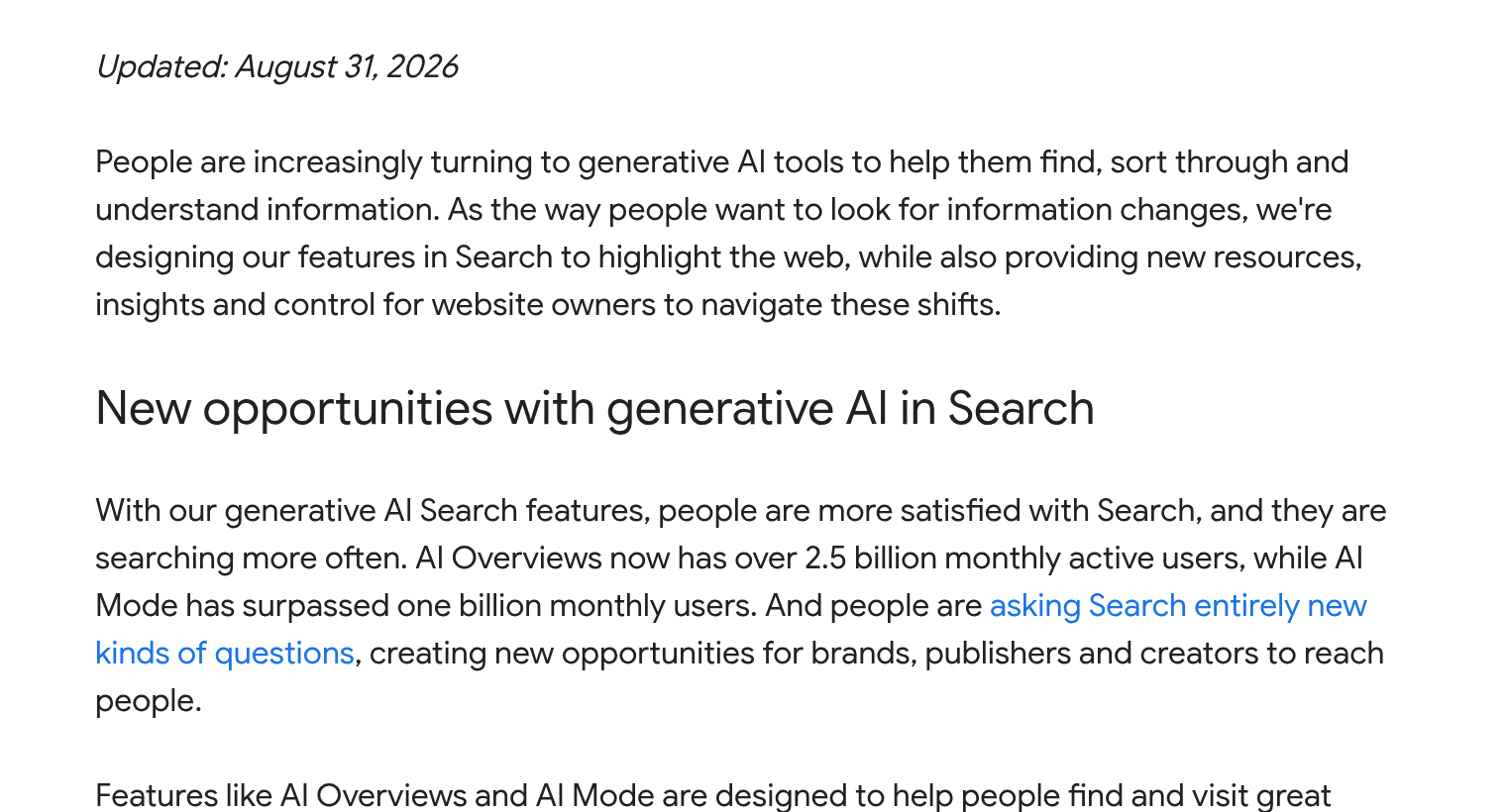
On June 3, 2026, Mrinalini Loew, general manager of Google Search Ecosystem, wrote that AI Overviews had over 2.5 billion monthly active users and AI Mode had passed one billion. Google began testing a toggle in Search Console that lets website owners decide whether their site appears in, and helps ground responses in, generative AI search features such as AI Overviews, AI Mode, and AI Overviews in Discover. Sites that opt out receive no traffic or impressions from those features, and Google said the control would not be used as a ranking signal for results outside them. Google also began rolling out Search Console insights on impressions and on which pages appear in AI responses and in which countries. The features were first offered to a subset of website owners in the United Kingdom, and Google said it was engaging with regulators including the UK Competition and Markets Authority.15 Google's May 2026 guidance on optimizing for generative AI search is covered in The Origins of GEO.
Google Announces Controls for Website Owners
October 2026: More Links Inside AI Answers
On October 15, 2026, Hema Budaraju, a vice president of product management at Google, announced changes to AI Mode and AI Overviews intended to help people reach the web. Google said it had made "continued and substantial increases" to inline links and would show them higher in responses more often. It also began testing a dedicated section at the top of a response that highlights official websites, expanded the carousels of timely articles, made the links at the end of some responses more prominent, and started testing clickable creator and publisher names on video results. Google said the number of people using its Preferred Sources feature had grown by more than 7x since the start of the year.16
Key Organizations
Key Organizations in Google Answers Back, 2023 to 2026
| Organization | Role in this period | Key dates |
|---|---|---|
| Ahrefs | Measured the effect of AI Overviews on clickthrough rates in two studies.12 | Update published February 4, 2026 |
| Launched SGE, AI Overviews, and AI Mode, and added reporting and controls for site owners.1,3,5,15 | SGE May 10, 2023; AI Overviews May 14, 2024; AI Mode March 5, 2025 | |
| Penske Media Corporation | Sued Google over AI Overviews.11 | Reported September 14, 2025 |
| Pew Research Center | Compared clicks on searches with and without AI summaries.10 | Published July 22, 2025 |
| Search Engine Land | Reported on AI Mode in the Search Console Performance report.9 | Reported June 16, 2025 |
Further reading
- Supercharging Search with generative AI: Elizabeth Reid, Google, May 10, 2023.
- AI Overviews: About last week: Liz Reid, Google, May 30, 2024.
- Google users are less likely to click on links when an AI summary appears in the results: Pew Research Center, July 22, 2025.
- New opportunities, control and insights for website owners: Mrinalini Loew, Google, June 3, 2026.
Notes
- Elizabeth Reid, "Supercharging Search with generative AI," Google, May 10, 2023. https://blog.google/products-and-platforms/products/search/generative-ai-search/
- "Generative AI in Search expands to more than 120 new countries and territories," Google, November 8, 2023. https://blog.google/products-and-platforms/products/search/google-search-generative-ai-international-expansion/
- Liz Reid, "Generative AI in Search: Let Google do the searching for you," Google, May 14, 2024. https://blog.google/products/search/generative-ai-google-search-may-2024/
- Liz Reid, "AI Overviews: About last week," Google, May 30, 2024. https://blog.google/products-and-platforms/products/search/ai-overviews-update-may-2024/
- Robby Stein, "Expanding AI Overviews and introducing AI Mode," Google, March 5, 2025. https://blog.google/products/search/ai-mode-search/
- Liz Reid, "AI in Search: Going beyond information to intelligence," Google, May 20, 2025. https://blog.google/products/search/google-search-ai-mode-update/
- John Mueller, "Top ways to ensure your content performs well in Google's AI experiences on Search," Google Search Central Blog, May 21, 2025. https://developers.google.com/search/blog/2025/05/succeeding-in-ai-search
- Google Search Central, "AI features and your website," documentation, read October 30, 2026. https://developers.google.com/search/docs/appearance/ai-features
- "Google AI Mode traffic data comes to Search Console," Search Engine Land, June 16, 2025. https://searchengineland.com/google-ai-mode-traffic-data-search-console-457076
- Pew Research Center, "Google users are less likely to click on links when an AI summary appears in the results," July 22, 2025. https://www.pewresearch.org/short-reads/2025/07/22/google-users-are-less-likely-to-click-on-links-when-an-ai-summary-appears-in-the-results/
- Anthony Ha, "Rolling Stone owner Penske Media sues Google over AI summaries," TechCrunch, September 14, 2025. https://techcrunch.com/2025/09/14/rolling-stone-owner-penske-media-sues-google-over-ai-summaries/
- Ahrefs, "Update: AI Overviews Reduce Clicks by 58%," February 4, 2026. https://ahrefs.com/blog/ai-overviews-reduce-clicks-update/
- Liz Reid, "A new era for AI Search," Google, May 19, 2026. https://blog.google/products-and-platforms/products/search/search-io-2026/
- Sara Guaglione, "Media Briefing: Publishers brace themselves for the zero-click era amid Google's AI search overhaul," Digiday, May 21, 2026. https://digiday.com/media/media-briefing-publishers-brace-themselves-for-the-zero-click-era-amid-googles-ai-search-overhaul/
- Mrinalini Loew, "New opportunities, control and insights for website owners," Google, June 3, 2026, updated August 31, 2026. https://blog.google/products-and-platforms/products/search/new-controls-website-owners/
- Hema Budaraju, "More ways to connect with the web from Search," Google, October 15, 2026. https://blog.google/products-and-platforms/products/search/updates-ai-mode-overviews-explore-web/