Market Research / GEO/AEO History
The Voice Interlude
Chapter 4, 2011 to 2019
How Siri, Google Now, Cortana, Alexa, and Google Assistant put spoken questions and single spoken answers into everyday use between 2011 and 2019, and what marketers learned from the first studies of voice results.
By TGA EditorsOctober 30, 20268 min read
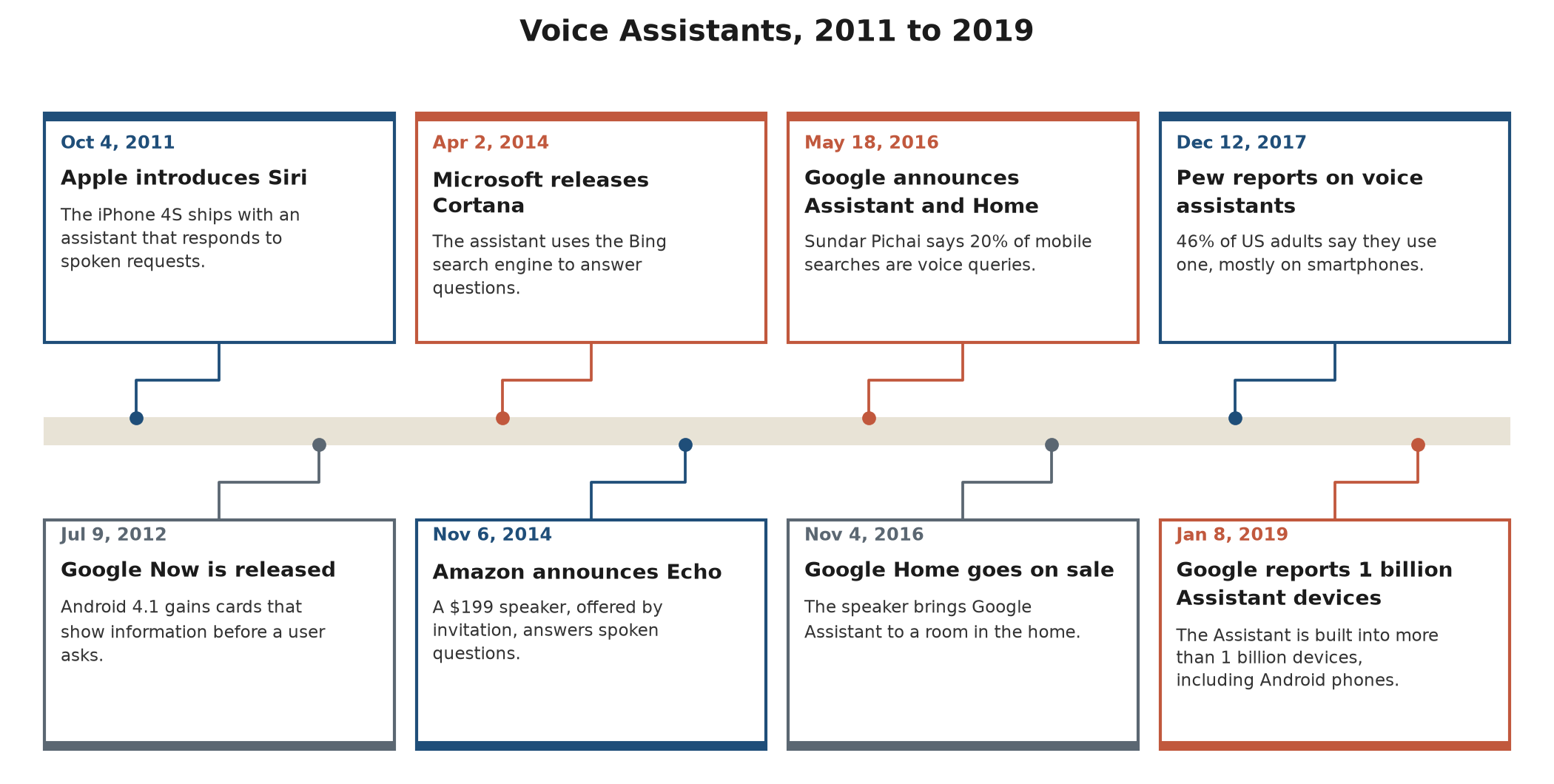
A voice assistant is software that takes a spoken request and either answers it or carries out a task. Between 2011 and 2019, Apple, Google, Microsoft, and Amazon each released one, first on phones and then on speakers for the home. A spoken answer is a single reply with no list of links to scan, and Google noted in 2018 that the traditional "10 blue links" format does not work as well for voice queries.1
These years overlap with the featured snippet period described in Position Zero, and the same short answers that appeared at the top of a results page were the ones a speaker could read aloud. By January 2019, Google reported that its Assistant was built into more than 1 billion devices.2
October 2011: Apple Introduces Siri
Siri began as a spin-off from the Artificial Intelligence Center of SRI International, in a line of work funded by the U.S. Defense Advanced Research Projects Agency (DARPA) under the CALO project. It was co-founded by Dag Kittlaus, Tom Gruber, and Adam Cheyer, and its speech recognition engine was provided by Nuance Communications. Siri was released as an app for iOS in December 2010, and Apple later acquired it.3
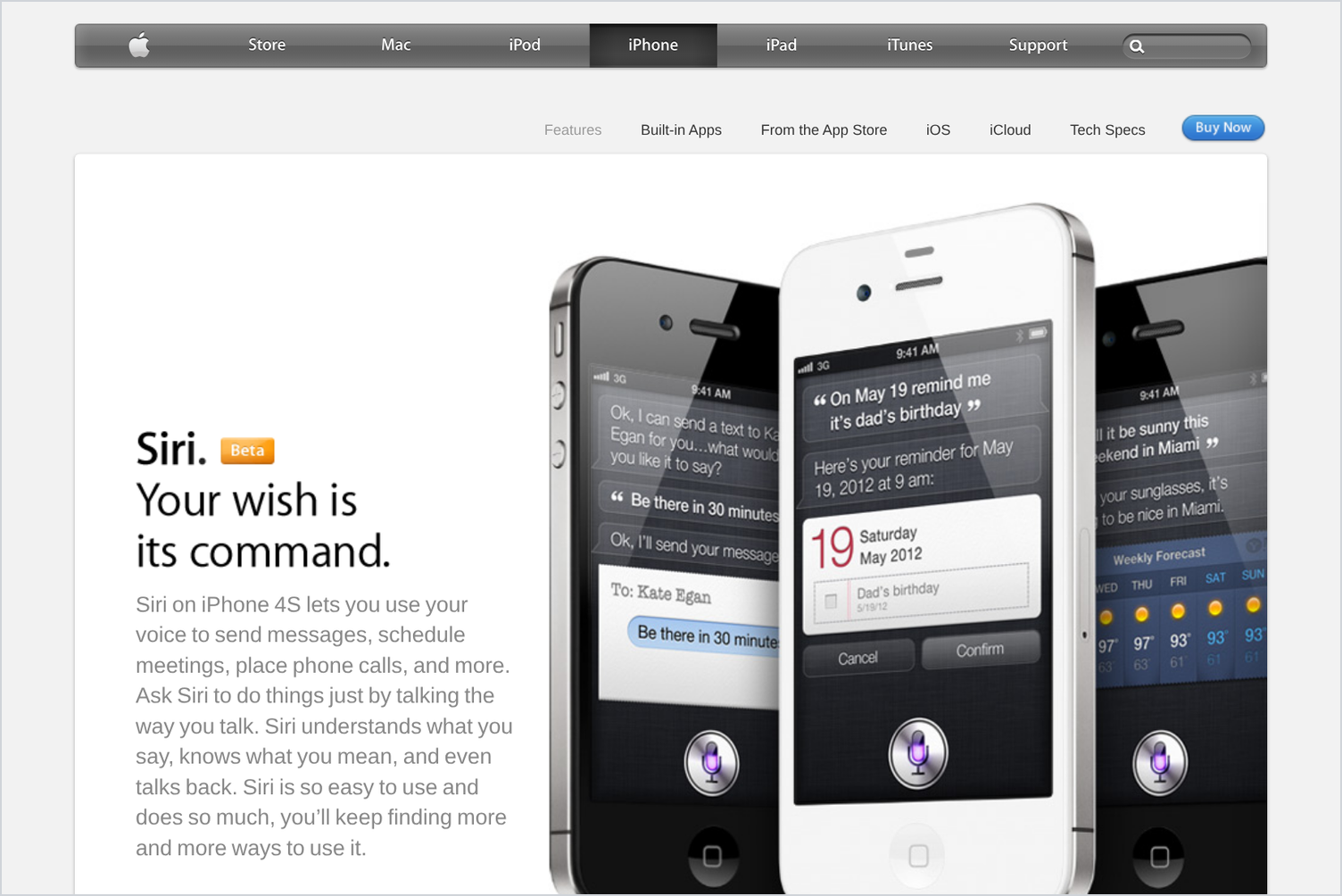
On October 4, 2011, Apple announced the iPhone 4S and described Siri as "an intelligent assistant that helps you get things done just by asking." The press release said that Siri understands context, so a user can speak naturally. If a user asks "Will I need an umbrella this weekend?" Siri understands that the user wants a weather forecast. Siri could also use personal information the user allowed it to access, such as finding "Mom" in the address book when told "Remind me to call Mom when I get home."4
The release listed what Siri could do: make calls, send text messages or email, schedule meetings and reminders, make notes, search the Internet, find local businesses, and get directions. It added that users could also "get answers, find facts and even perform complex calculations just by asking." Siri was available in beta in English, French, and German, and the iPhone 4S went on sale in the United States and six other countries on October 14.4 After the announcement, Apple removed the standalone Siri app from the App Store.3 Reviews in October 2011 praised its voice recognition and its use of personal information, and criticized the stiff commands it required and its lack of flexibility.3
Siri on iPhone 4S, Apple, October 2011
July 2012: Google Now Shows Information Before a Question Is Asked
Google unveiled Google Now on June 27, 2012, at its I/O developer conference, as part of a demonstration of Android 4.1, called Jelly Bean. Android 4.1 launched on July 9, 2012. Google Now was part of Google Search on Android. It recognized repeated actions that a user performed on a device, such as common locations, repeated calendar appointments, and search queries, and it showed information the user was likely to need in the form of cards. The system used the Knowledge Graph.6
Google Now accepted voice commands as well as cards. An October 2012 update added cards drawn from a user's Gmail account, including flight information, package tracking, and reservations. Google Now reached iOS on April 29, 2013, without most of its features.6 Google gradually phased out the Google Now name beginning in 2015, and the Google Assistant, shown in 2016, was a conversational evolution of Google Now.7
April 2014: Microsoft Releases Cortana
Microsoft released Cortana in April 2014 for Windows Phone 8.1. It used the Bing search engine to perform tasks such as setting reminders and answering questions.8 Development had started in 2009 in the Microsoft Speech products team, under general manager Zig Serafin and chief scientist Larry Heck.8 Microsoft began reducing the prominence of Cortana in 2019, and it shut the Cortana mobile app down globally on March 31, 2021.8
November 2014: Amazon Announces Echo
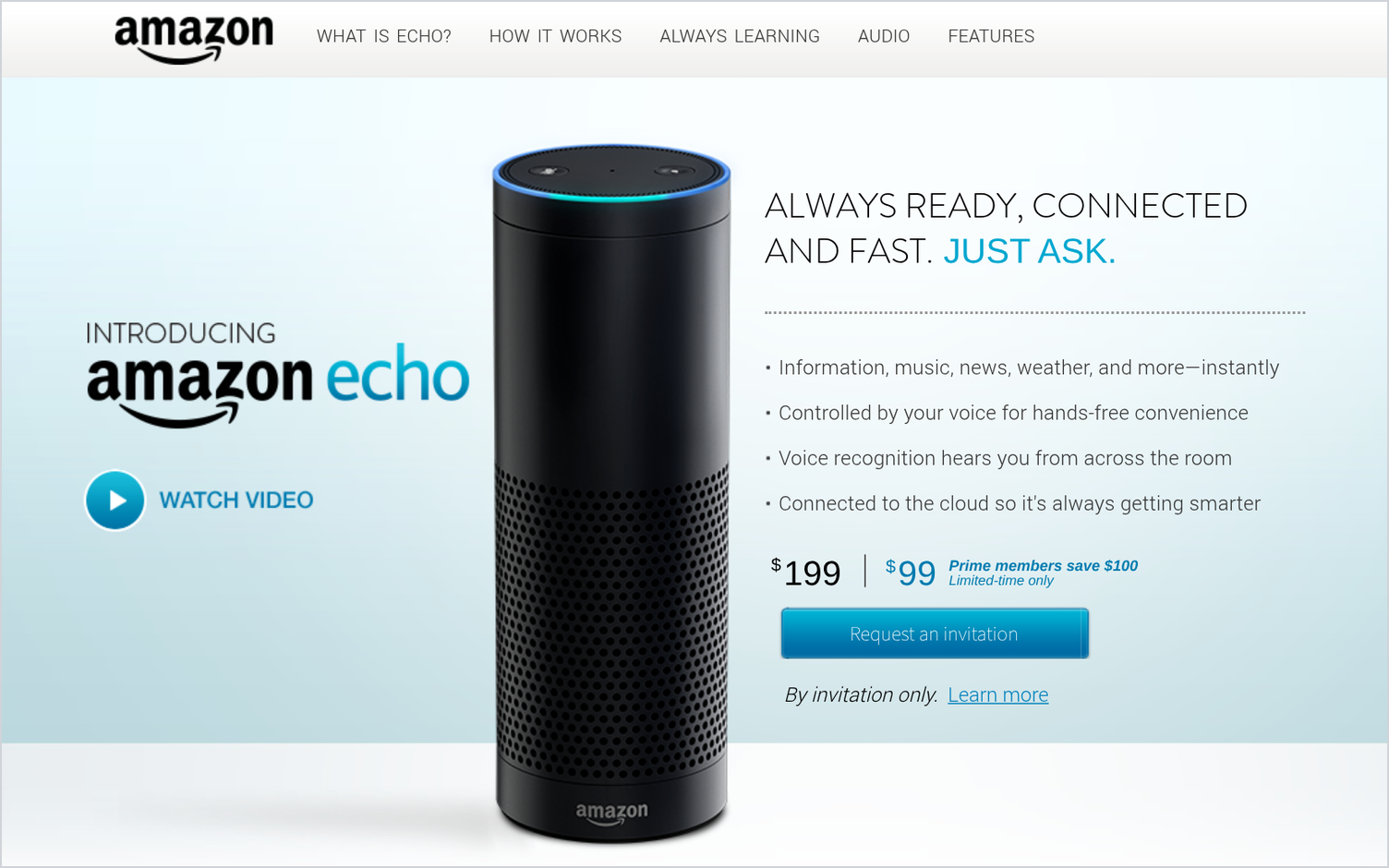
On November 6, 2014, Amazon announced the Echo, a cylindrical speaker for the home that listens for commands and responds with information or by triggering a task. TechCrunch described it as having no real equivalent from another technology company. The Echo had seven microphones, processed voice input on Amazon's servers, and answered queries with basic information from Wikipedia, word definitions, and unit conversions. Its default wake word was "Alexa," and Amazon said the device listens only after hearing it. A companion app let owners set up the service and review alarms, reminders, and shopping lists.9
The Echo cost $199, or $99 for Amazon Prime members for a limited time, and a buyer needed an invitation from Amazon to order one.9 The Verge reported that it would ship "in the coming weeks."10 Alexa was developed largely from the Evi system of William Tunstall-Pedoe, which provided the question-to-answer system, and from the speech synthesizer Ivona. Amazon acquired Evi in 2012 and Ivona in 2013.11
Amazon Echo, Product Page, November 2014
2015 to 2017: Amazon's Choice and Shopping by Voice
Amazon's Choice, a badge Amazon places on a single product for certain search terms, was first introduced for Amazon Echo in 2015, according to a 2019 report in Wired. The idea was to create a shopping experience for voice, where a shopper cannot see all the options laid out. If a person told a speaker to buy new towels, Amazon could use order history to figure out which brand they might have in mind, but a first-time purchase needed a default option to suggest. The badge moved to desktop and mobile in June 2016. Amazon said it goes to "highly rated, well-priced products available to ship immediately," and it has not said how it chooses among them.13
On July 10, 2017, The Verge published a guide to shopping on Amazon with Alexa voice controls. Ordering required an Amazon Prime membership, a U.S. shipping address, and a U.S. payment method, and voice shopping was enabled by default, with an option to set a four-digit PIN. A person could reorder an item from past orders, ask for a new product and receive an "Amazon's Choice" suggestion to confirm, or add a product to the cart. Amazon offered some voice-exclusive deals, and physical goods ordered through Alexa were eligible for free return shipping.14
By 2019, ordering by voice had not produced the revenue Amazon had hoped for, including from partners such as Domino's Pizza and Uber, and Alexa did not play audio ads.11
May 2016: Google Announces Assistant and Home
At Google I/O on May 18, 2016, Sundar Pichai announced the Google Assistant. In a blog post that day, he described it as conversational, an ongoing two-way dialogue between a person and Google that understands the person's world and helps get things done. He wrote that people were increasingly interacting naturally with Google and "expecting Google to help them with their daily tasks" and not only looking for information.15
Pichai also announced Google Home, a voice-activated product that brings the Assistant to any room in the house. The post said a person could use conversational speech to play a song, set a timer, check a flight, or turn on lights, and could "get answers from Google." Home was to be released later in the year.15 CNBC reported that Pichai said 20 percent of mobile searches were voice queries.16 Google Home was released in the United States on November 4, 2016.7
June 2017 to February 2018: Apple Announces HomePod
Apple announced the HomePod, a speaker with Siri, on June 5, 2017, at its Worldwide Developers Conference. Its planned December launch was delayed. Apple began taking orders on January 26, 2018, and released it on February 9, 2018.17 Reviewers, including The Verge, criticized the HomePod's Siri for limited functionality compared with Alexa and Google Assistant, such as an inability to place phone calls from the speaker or set multiple timers at once.17
December 2017: Pew Surveys Americans on Voice Assistants
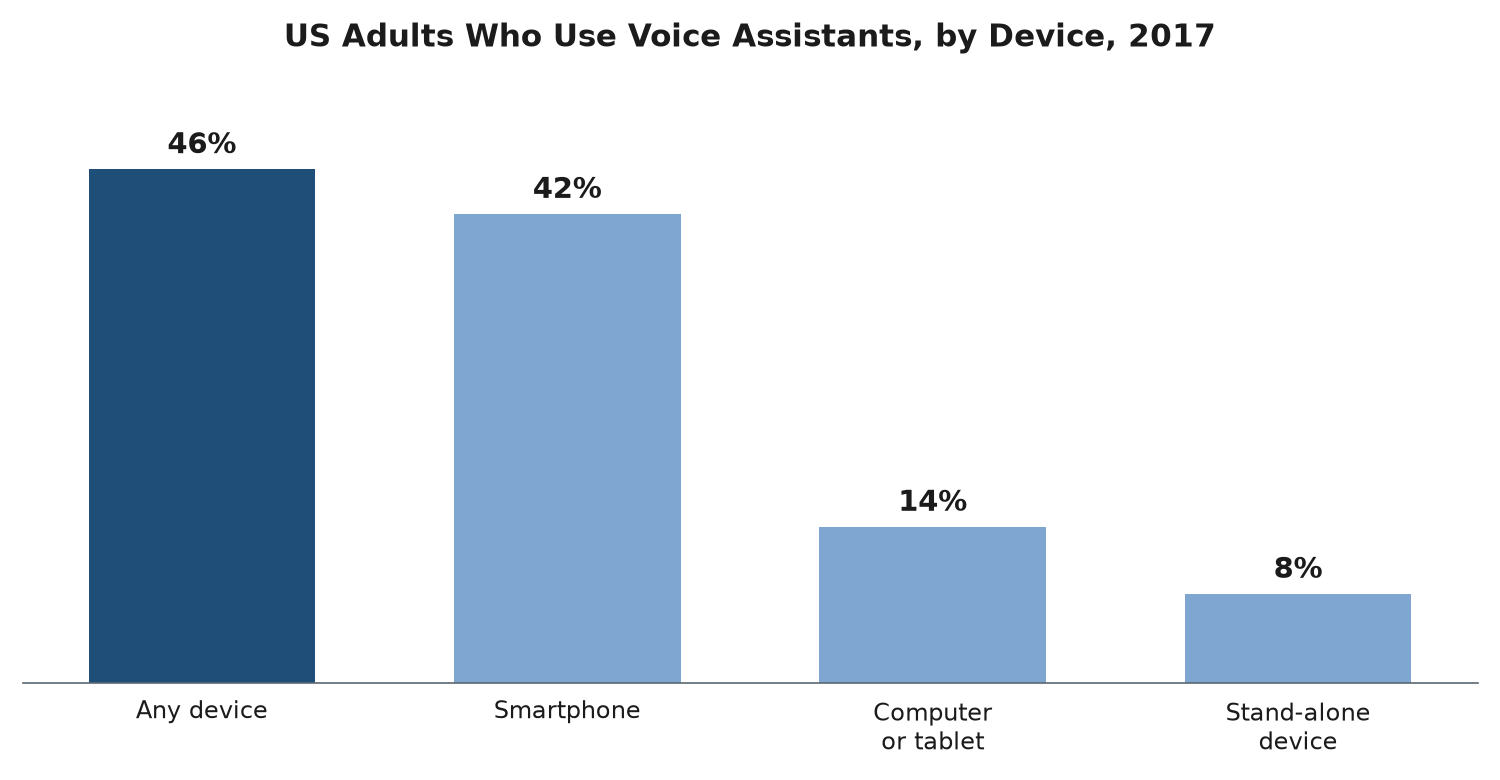
On December 12, 2017, Pew Research Center reported that nearly half of U.S. adults, 46%, said they use voice assistants to interact with smartphones and other devices, according to a survey conducted in the spring of that year. Smartphones were the most common device, at 42% of U.S. adults. Some 14% had used a voice assistant on a computer or tablet, and 8% used one on a stand-alone device such as an Amazon Echo or Google Home.18
Use was higher among younger adults: 55% of Americans ages 18 to 49 said they use voice assistants, compared with 37% of those 50 and older. For 55% of users, a major reason was being able to interact with devices without using their hands. Among users, 39% said the assistants respond accurately to their commands most of the time and 42% said some of the time, while 16% said not very often. Among those who did not use voice assistants, 61% said they were not interested in the tool.18
February 2018: Backlinko Studies 10,000 Google Home Results
On February 28, 2018, Brian Dean of Backlinko published a study titled "We Analyzed 10,000 Google Home Results." It tested 11 potential ranking factors, including page speed, schema markup, and HTTPS, against the web pages that Google Home used to answer spoken questions.19
We Analyzed 10,000 Google Home Results, Backlinko, February 2018
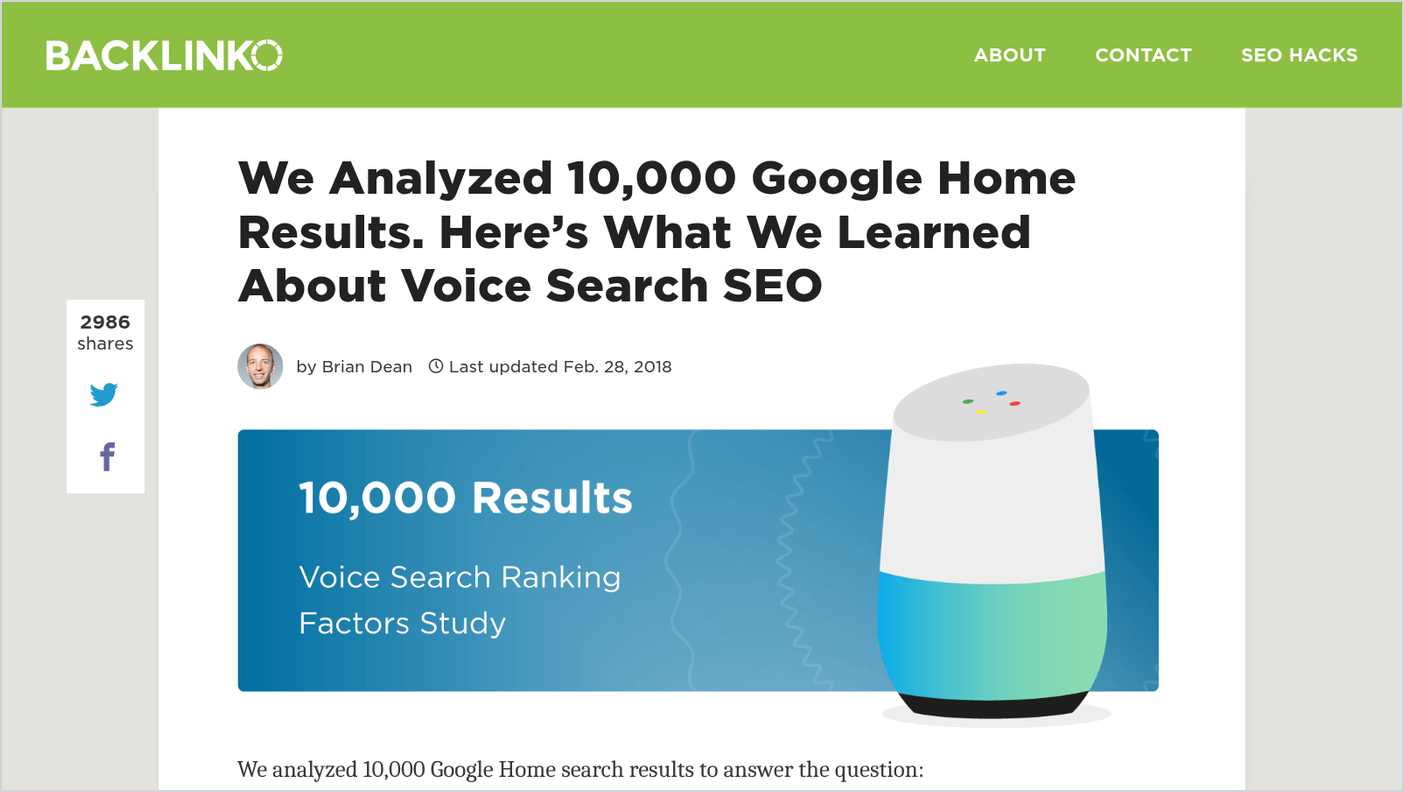
The study found that the typical voice search result was only 29 words long. Of all the voice search answers in the data set, 40.7% came from a featured snippet, and approximately 75% of voice results ranked in the top three for the query. HTTPS pages supplied 70.4% of the results, and the average result page loaded in 4.6 seconds, 52% faster than the worldwide average. Schema markup appeared on 36.4% of voice result pages, only slightly above the worldwide average of 31.3%, so Backlinko concluded that schema may not play a key role in voice search rankings.19
The pages themselves tended to be long. The average voice search result page had 2,312 words, and it was written at a ninth-grade reading level. The mean Ahrefs Domain Rating of a Google Home result was 76.8. Very few results had the exact query in their title tag, which led the study to conclude that creating an individual page for each voice query does not appear to be an effective strategy.19
Google's January 2018 post on featured snippets had described the same behavior from the company's side. For spoken featured snippets, it said, Google cites the source page in the spoken result and provides a link to the page in the Google Home app.1
January 2019: Google Says the Assistant Is on More Than 1 Billion Devices
On January 8, 2019, Manuel Bronstein, Google's Vice President of Product for the Assistant, published a post about the Assistant at the Consumer Electronics Show in Las Vegas. The post described Google Assistant Connect, a platform for device manufacturers, a Lenovo Smart Clock, and Assistant support in Google Maps. It said that the Google Assistant was "built into more than 1 billion devices, including Android phones."2
The same post said the Assistant worked with more than 10,000 home automation devices from over 1,600 brands, and described Interpreter Mode, a feature that helps people hold a conversation in dozens of languages.2
Key Organizations
Key Organizations in the Voice Interlude, 2011 to 2019
| Organization | Role in this period | Key dates |
|---|---|---|
| Amazon | Announced the Echo and Alexa, introduced Amazon's Choice for voice shopping, and offered ordering by voice.9,13,14 | Echo announced November 6, 2014 |
| Apple | Introduced Siri on the iPhone 4S and announced the HomePod.4,17 | Siri announced October 4, 2011 |
| Backlinko | Published a study of 10,000 Google Home results.19 | Study published February 28, 2018 |
| Released Google Now, the Google Assistant, and Google Home.6,15,7 | Google Now July 9, 2012; Home November 4, 2016 | |
| Microsoft | Released Cortana, which used the Bing search engine.8 | Released April 2014 |
| Nuance Communications | Provided the speech recognition engine for Siri.3 | Confirmed publicly in 2013 |
| Pew Research Center | Surveyed U.S. adults on voice assistant use.18 | Report published December 12, 2017 |
| SRI International | Home of the AI Center from which Siri was spun off.3 | Siri app released December 2010 |
Further reading
- Apple Launches iPhone 4S, iOS 5 & iCloud: Apple, October 4, 2011.
- I/O: Building the next evolution of Google: Sundar Pichai, Google, May 18, 2016.
- Nearly half of Americans use digital voice assistants, mostly on their smartphones: Pew Research Center, December 12, 2017.
- We Analyzed 10,000 Google Home Results: Brian Dean, Backlinko, February 28, 2018.
Notes
- Danny Sullivan, Google blog, "A reintroduction to Google's featured snippets," January 30, 2018. https://blog.google/products-and-platforms/products/search/reintroduction-googles-featured-snippets/
- Manuel Bronstein, Google blog, "Hey Google, what's new with the Assistant at CES this year?," January 8, 2019. https://blog.google/products-and-platforms/products/assistant/hey-google-whats-new-assistant-ces-year/
- Wikipedia, "Siri." https://en.wikipedia.org/wiki/Siri
- Apple, "Apple Launches iPhone 4S, iOS 5 & iCloud," October 4, 2011. https://www.apple.com/newsroom/2011/10/04Apple-Launches-iPhone-4S-iOS-5-iCloud/
- Apple, Siri page, Internet Archive Wayback Machine capture of October 31, 2011. https://web.archive.org/web/20111031080134if_/http://www.apple.com/iphone/features/siri.html
- Wikipedia, "Google Now." https://en.wikipedia.org/wiki/Google_Now
- Wikipedia, "Google Nest (smart speakers)." https://en.wikipedia.org/wiki/Google_Nest_(smart_speakers)
- Wikipedia, "Cortana." https://en.wikipedia.org/wiki/Cortana_(virtual_assistant)
- Darrell Etherington, TechCrunch, "Amazon Echo Is A $199 Connected Speaker Packing An Always-On Siri-Style Assistant," November 6, 2014. https://techcrunch.com/2014/11/06/amazon-echo/
- Chris Welch, The Verge, "Amazon just surprised everyone with a crazy speaker that talks to you," November 6, 2014. https://www.theverge.com/2014/11/6/7167793/amazon-echo-speaker-announced
- Wikipedia, "Amazon Alexa." https://en.wikipedia.org/wiki/Amazon_Alexa
- Amazon, Echo page, Internet Archive Wayback Machine capture of November 7, 2014. https://web.archive.org/web/20141107if_/http://www.amazon.com/oc/echo
- Louise Matsakis, Wired, "What Does It Mean When a Product Is 'Amazon's Choice'?," June 4, 2019. https://www.wired.com/story/what-does-amazons-choice-mean/
- Chaim Gartenberg, The Verge, "How to shop on Amazon using Alexa voice controls," July 10, 2017. https://www.theverge.com/2017/7/10/15947672/amazon-alexa-voice-controls-shopping-prime-echo-how-to
- Sundar Pichai, Google blog, "I/O: Building the next evolution of Google," May 18, 2016. https://blog.google/products-and-platforms/products/assistant/io-building-next-evolution-of-google/
- CNBC, "Google Home, Assistant and more: Google's biggest reveals at I/O," May 18, 2016. https://www.cnbc.com/2016/05/18/googles-biggest-reveals-at-io.html
- Wikipedia, "HomePod." https://en.wikipedia.org/wiki/HomePod
- Pew Research Center, "Nearly half of Americans use digital voice assistants, mostly on their smartphones," December 12, 2017. https://www.pewresearch.org/short-reads/2017/12/12/nearly-half-of-americans-use-digital-voice-assistants-mostly-on-their-smartphones/
- Brian Dean, Backlinko, "We Analyzed 10,000 Google Home Results. Here's What We Learned About Voice Search SEO," February 28, 2018. https://backlinko.com/voice-search-seo-study
- Backlinko, voice search study page, Internet Archive Wayback Machine capture of March 7, 2018. https://web.archive.org/web/20180307155423if_/https://backlinko.com/voice-search-seo-study