Marketing Agency AI Adoption Statistics 2026
Published October 24, 2026
Census Bureau data released on October 22, 2026 showed 24.6% of US businesses using AI in the two weeks to October 18, the highest share since the Business Trends and Outlook Survey (BTOS) revised its AI question in November 2025.
Our analysts compiled data on marketing agency AI adoption, tasks and tools, staffing, pricing models, revenue and client demand in October 2026 from two Census Bureau BTOS products, Bureau of Labor Statistics (BLS) payroll employment for advertising and public relations firms, Indeed job posting data and six agency surveys fielded between 2025 and 2026. We coded each survey by population, respondent count, fieldwork date and question wording, built our own comparison tables from those codes and added the disclosed AI investment of three agency holding companies, converted to US dollars.
In the following sections, we measure adoption, compare AI tasks and tools, review staffing, pricing, revenue and client demand, break out AI use by firm size and set out the barriers agencies report to wider AI use.
Key Findings
- US professional services firms (NAICS 54) used AI at a six-period average of 42.5% from July 27 to October 18, 2026, against 23.3% of all US businesses (our calculation, base: six BTOS periods).
- Daily AI use among agency professionals in the Basis survey rose from 9.9% in 2023 (n=101) to 59.2% in 2026 (n=213).
- In April 2026, 6% of US agency leaders in the Forrester and 4As survey treated AI as a line of business (nearly 200 respondents).
- Payroll employment at US advertising and public relations firms was 478.6 thousand in September 2026 (preliminary), 0.6% below September 2025 (our calculation, base: BLS payroll estimates for September 2025 and September 2026).
How Many Marketing Agencies Use AI
This section measures how widely US agencies use AI, first with federal survey data and then with the published agency surveys, coded question by question.
The BTOS surveys about 200,000 businesses in each two-week collection, drawn from a sample of about 1.2 million US employer businesses, and asks whether they used AI in any business function in the previous two weeks. For agencies we used the professional, scientific and technical services sector (NAICS 54), which contains advertising and public relations firms. Table 1 compares that sector with all US businesses.
| BTOS measure | NAICS 54 | All US businesses | Gap (points, our calculation, base: NAICS 54 vs all US businesses in the same periods) |
|---|---|---|---|
| Used AI, first revised period (Nov 17 to Nov 30, 2025) | 34.7% | 17.3% | 17.4 |
| Used AI, six-period average, Nov 17, 2025 to Feb 8, 2026 (our calculation, base: six BTOS periods) | 34.2% | 17.9% | 16.3 |
| Used AI, six-period average, Jul 27 to Oct 18, 2026 (our calculation, base: six BTOS periods) | 42.5% | 23.3% | 19.2 |
| Used AI, latest period (Oct 5 to Oct 18, 2026) | 43.8% | 24.6% | 19.2 |
| Expect to use AI in the next six months (Oct 5 to Oct 18, 2026) | 48.8% | 28.6% | 20.2 |
Source: Top GEO Agencies Marketing Agency AI Adoption Study (Source 1), from Census Bureau BTOS sector and national estimates (Source 2). Shares are of responding businesses in each group. Averages are our calculation from six two-week BTOS periods, and gaps are our calculation from NAICS 54 and all-US estimates for the same periods.
Data: btos_ai_use_trend_nov2025_oct2026.csv
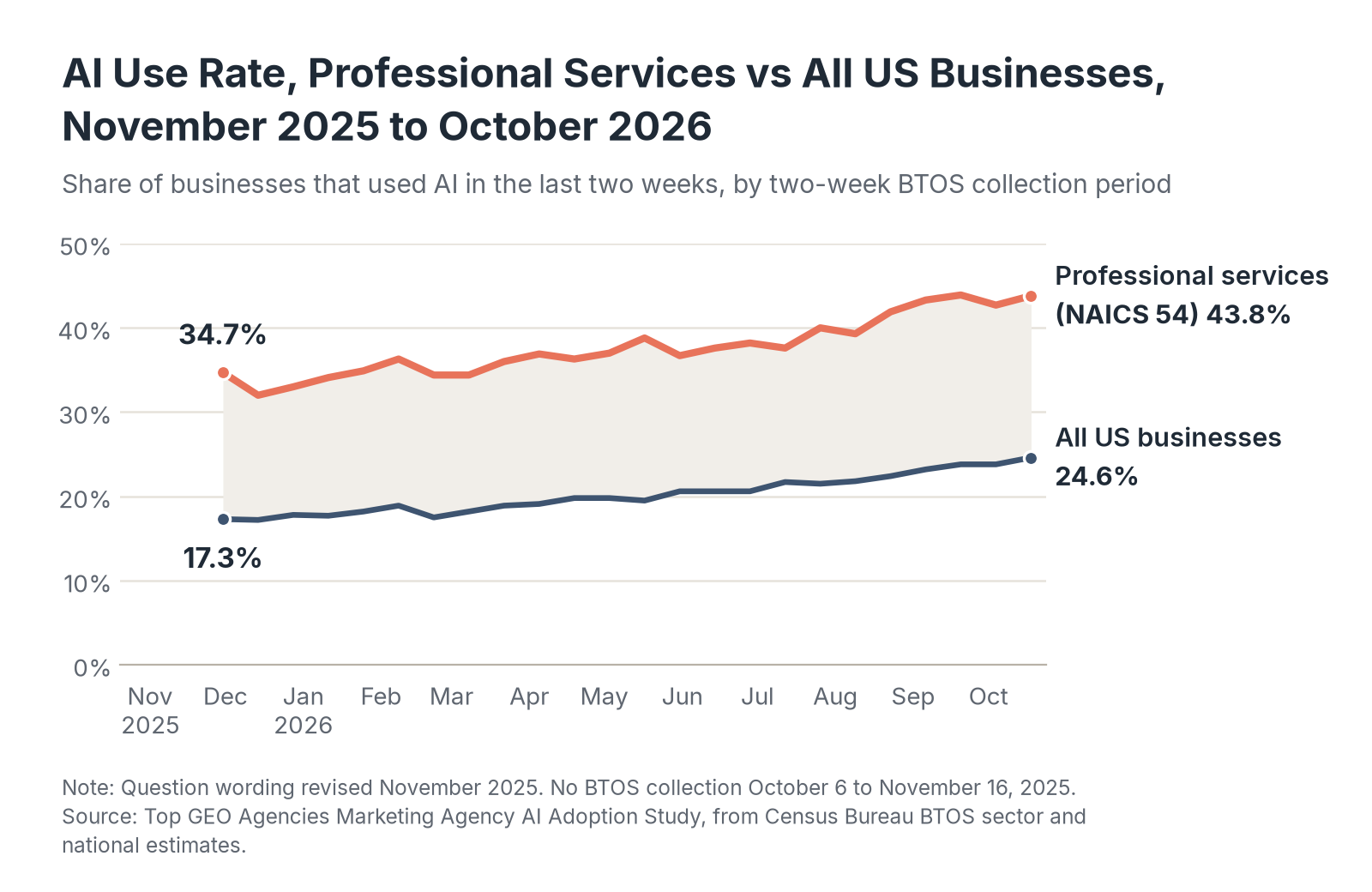
- The NAICS 54 rate rose 8.3 points between the two six-period averages, against 5.4 points for all US businesses (our calculation, base: six BTOS periods in each average, NAICS 54 and all US businesses). The later NAICS 54 average was about 1.8 times the all-business average (our calculation, base: six BTOS periods, NAICS 54 vs all US businesses).
- The NAICS 54 rate has been above 40% for five straight periods, starting with the August 10 to August 23, 2026 collection. The last reading under 40% was 39.3% in the July 27 to August 9, 2026 period.
- The NAICS 54 rate stayed at least 14.8 points above the national rate in all 24 periods since November 2025 (our calculation, base: NAICS 54 vs all US businesses in each two-week period). A national AI rate therefore understates adoption in the part of the economy where agencies are counted.
The Census Bureau also ran a one-time AI supplement alongside the core survey from November 17, 2025 to February 8, 2026, which drew about 18,000 responses from NAICS 54 firms and about 117,000 nationally. In that supplement, 34.2% of NAICS 54 firms had used AI in the prior two weeks, against 17.9% of all firms. Employees used AI for work tasks at 39.4% of NAICS 54 firms (all firms 22.6%) and used generative AI at 34.9% (all firms 20.8%). Looking ahead, 37.5% of NAICS 54 firms in the supplement expected to use AI in the following six months, against 21.6% of all firms.
Agency surveys ask different questions of different people. Table 2 codes six of them, plus the two BTOS measures, on the same fields so each figure can be read against its population and wording.
| Source | Population | Respondents (n) | Fieldwork | Question coded | Share |
|---|---|---|---|---|---|
| Census BTOS core (Source 2) | US employer businesses in NAICS 54 | Sector count not published | Oct 5 to Oct 18, 2026 | Firm used AI in the last two weeks | 43.8% |
| Census BTOS AI supplement (Source 3) | US employer businesses in NAICS 54 | About 18,000 | Nov 2025 to Feb 2026 | Firm used AI in the last two weeks | 34.2% |
| Forrester with the 4As (Sources 4 and 5) | US agency decision-makers, VP or above | Nearly 200 | April 2026 | Agency uses generative AI | 87% |
| Forrester with the 4As (Sources 4 and 5) | US agency decision-makers, VP or above | Nearly 200 | April 2026 | Agency uses agentic AI | 50% |
| Forrester with the 4As (Source 7) | US agencies | Not published | 2025 | Agency uses generative AI | 75% |
| SoDA (Source 8) | Agency leaders, 62% in the US | 251 | Q4 2025 | Adopted at least one of seven AI uses | 99% |
| Basis agency report (Source 9) | Agency professionals | 213 | Published April 2026 | Uses AI at work (our calculation, base n=213) | 99.1% |
| Basis agency report (Source 9) | Agency professionals | 213 | Published April 2026 | Uses AI daily | 59.2% |
| SAGA (Source 10) | Owner-led agencies | 62 | Published May 2026 | Regular or widespread AI use (our calculation, base n=62) | 89% |
| Basis marketing report (Source 11) | Agency and brand professionals | 184 | Published October 2026 | Uses generative or agentic AI | 98.4% |
Source: Top GEO Agencies Marketing Agency AI Adoption Study (Source 1), from the publishers in each row (Sources 2 to 11). The Basis "uses AI at work" figure is 100% minus the 0.9% who answered "not at all." The SAGA figure adds regular use (60%) and widespread use (29%).
Data: agency_survey_adoption_coding.csv
- Half of agencies in the 2026 Forrester and 4As survey use agentic AI (nearly 200 US agency leaders). Generative AI use in that survey is more common than agent use.
- Among Basis respondents, 39.9% use AI at work without using it daily (our calculation, base n=213). Daily use is now the majority answer in that survey.
- A headline agency AI adoption rate depends on whether the survey counts any use or regular use. Cited alone, a near-universal any-use figure says little about how much agency work AI reaches.
The industry surveys differ from the BTOS in method. They ask whether an agency or person uses AI at all, with no two-week window. Most of them poll individual professionals or senior leaders, and their respondents opted in to each survey. The Forrester and 4As series shows the change within one survey program, with generative AI use rising from 61% of agencies in 2024 to 75% in 2025. The Basis agency series shows daily use by agency professionals climbing from 9.9% in 2023 (n=101) to 15.9% in 2024 (n=113), 38.6% in 2025 (n=171) and 59.2% in 2026 (n=213). Over the same four waves, the share of Basis respondents who did not use AI at all fell from 32.7% to 0.9%.
Frequency of use trails breadth of use in the agency surveys. In the 2025 Forrester and 4As survey, nearly 80% of agencies used generative AI on less than half of their work, even as 89% cited employee productivity as a benefit and 69% cited production cost savings, up from 13% in 2024. By April 2026, 81% of US agency leaders in the Forrester and 4As survey said staff productivity is their primary objective for generative AI (nearly 200 respondents).
Which Tasks Agencies Use AI For
This section compares the business functions and tasks where firms apply AI, starting with federal data and then moving to agency surveys.
The BTOS AI supplement asked every firm which functions had used AI in the prior six months, and it asked firms whose employees used generative AI which tasks they used it for. Table 3 shows the function results for NAICS 54 firms (about 18,000 responses) and all US firms (about 117,000 responses).
| Business function | NAICS 54 | All US firms | Gap (points, our calculation, base: NAICS 54 vs all US supplement responses) |
|---|---|---|---|
| Research and development | 24.0% | 11.2% | 12.8 |
| Information technology | 21.9% | 11.4% | 10.5 |
| Strategy and business development | 21.3% | 12.4% | 8.9 |
| Provision of services | 18.2% | 6.4% | 11.8 |
| Sales and marketing | 17.7% | 14.3% | 3.4 |
| Legal and compliance | 13.4% | 7.1% | 6.3 |
| Public relations and communication | 13.1% | 9.3% | 3.8 |
| Management and administration | 12.9% | 8.1% | 4.8 |
| Finance and accounting | 11.7% | 6.6% | 5.1 |
| Customer service | 10.0% | 7.6% | 2.4 |
| Human resources | 5.8% | 4.2% | 1.6 |
Source: Top GEO Agencies Marketing Agency AI Adoption Study (Source 1), from the Census Bureau BTOS AI supplement, collected November 17, 2025 to February 8, 2026 (Source 3). Shares are of all responding firms. Response counts are rounded by the Census Bureau. Gaps are our calculation from NAICS 54 and all-US supplement estimates.
Data: btos_ai_supplement_2026_naics54_vs_all_us.csv
- Research and development is the most common AI function among NAICS 54 firms. Its rate is about 2.1 times the all-firm rate (our calculation, base: about 18,000 NAICS 54 and about 117,000 all-US supplement responses).
- Human resources is the least common AI function in both groups. It also shows the smallest gap between them.
- In professional services firms, AI use centers on research and client delivery work. Back-office functions such as human resources and customer service trail by wide margins.
Provision of services shows the widest ratio in the table, with NAICS 54 firms using AI to deliver client work at 2.8 times the all-firm rate (our calculation, base: about 18,000 NAICS 54 and about 117,000 all-US supplement responses). Sales and marketing, the function where AI use is most common across all US firms, shows one of the smallest gaps. Among NAICS 54 firms planning to use AI in the next six months, research and development (60.3%), strategy (57.6%) and information technology (53.7%) led the planned functions, followed by sales and marketing (51.8%). Across all US firms planning to use AI, sales and marketing led the planned functions at 62.8%.
| Generative AI task | NAICS 54 | All US firms | Gap (points, our calculation, base: NAICS 54 vs all US firms whose employees used generative AI) |
|---|---|---|---|
| Writing or editing documents, emails or communications | 83.8% | 85.4% | -1.6 |
| Searching for information or technical help | 57.3% | 49.9% | 7.4 |
| Interpreting, analyzing, translating or summarizing | 53.6% | 44.6% | 9.0 |
| Developing or researching new projects | 39.1% | 30.0% | 9.1 |
| Information processing | 38.8% | 34.7% | 4.1 |
| Data analysis or visualization | 25.9% | 19.1% | 6.8 |
| Software coding | 23.7% | 12.7% | 11.0 |
| Tutoring or training | 18.1% | 16.1% | 2.0 |
| Customer support | 13.5% | 15.5% | -2.0 |
Source: Top GEO Agencies Marketing Agency AI Adoption Study (Source 1), from the Census Bureau BTOS AI supplement (Source 3). Shares are of firms whose employees used generative AI. Gaps are our calculation from NAICS 54 and all-US supplement estimates.
Data: btos_ai_supplement_2026_naics54_vs_all_us.csv
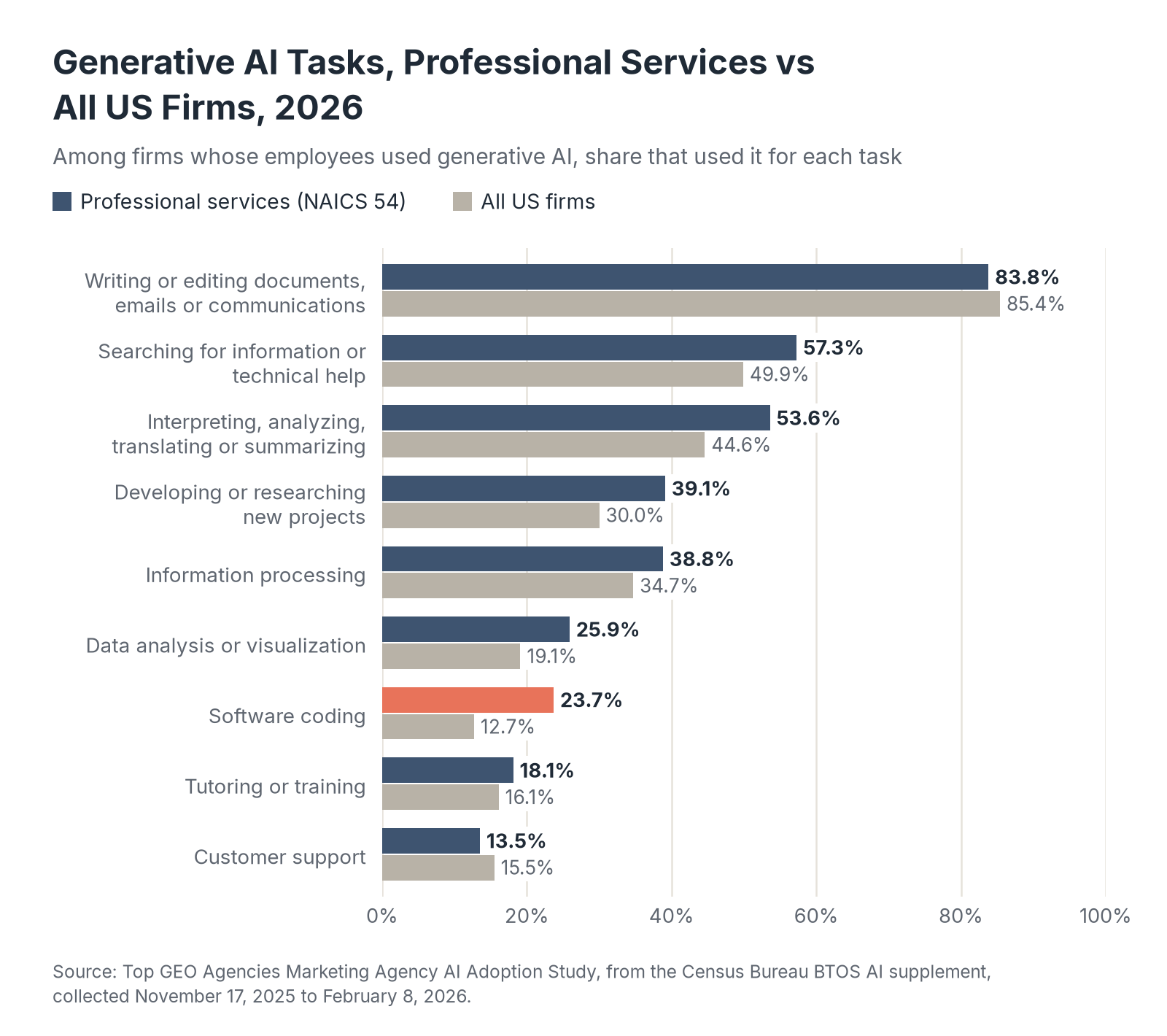
- Writing and editing leads both groups. It is one of two tasks, with customer support, where NAICS 54 users trail all users.
- NAICS 54 generative AI users apply it to software coding at about 1.9 times the all-firm rate (our calculation, base: NAICS 54 vs all US firms whose employees used generative AI). That is the widest gap in the table.
- Generative AI use in the sector extends past writing into search, analysis and project research. More than half of NAICS 54 generative AI users apply it to search and to analysis, so the sector uses it as a research tool as well as a writing aid.
Agency surveys use their own task lists. We grouped matching items into common task groups and kept each survey's base, as shown in Table 5.
| Task group | Basis (n=213 agency professionals) | SAGA (n=62 owner-led agencies) | SoDA (n=251 agency leaders) | Forrester with the 4As (nearly 200 US agency leaders) |
|---|---|---|---|---|
| Research | 84.0% | 89% | Not asked | 70% |
| Ideation or brainstorming | 86.9% | 82% | 81% | Not asked |
| Summarizing documents | Not asked | 82% | Not asked | 74% |
| Drafting copy | 72.3% | 74% | Not asked | Not asked |
| Routine or internal operations | Not asked | 58% | 76% | Not asked |
| Final production assets | Not asked | Not asked | 52% | Not asked |
| Reporting | Not asked | 47% | Not asked | Not asked |
| Image generation | Not asked | 39% | Not asked | Not asked |
| SEO | Not asked | 35% | Not asked | Not asked |
| Code | Not asked | Not asked | 47% | Not asked |
| Media planning | 29.1% | Not asked | Not asked | Not asked |
| Media buying | 22.1% | Not asked | Not asked | Not asked |
Source: Top GEO Agencies Marketing Agency AI Adoption Study (Source 1), from Basis (Source 9), SAGA Agency Growth Advisors (Source 10), SoDA (Source 8) and Forrester with the 4As (Sources 4 and 5). Basis shares are of individual professionals, and the other three are of agencies or their leaders. Task groups are our coding.
Data: agency_ai_tasks_by_survey.csv
- Ideation is the only task group above 80% in all three surveys that asked about it. Basis records the highest share, at 86.9% of agency professionals (n=213).
- SAGA owners use AI for reporting more often than for image generation or SEO (n=62). Fewer than half use it for any of those three tasks.
- Agencies apply AI most to research, ideation and writing work. Media planning and buying are the least common task groups in the table.
Research, ideation, summarizing and first drafts top every survey that asked about them, and media work comes in lower. SAGA also asked owners about proposals (66%), new business prospecting (42%) and media monitoring (24%). SoDA agencies had adopted an average of four of its seven AI uses, and 47% of SoDA leaders use AI to build new service offerings for clients, while 37% develop custom AI models or agents (n=251).
Which AI Tools Agencies Use
This section covers the AI assistants, AI agents and in-house platforms that agencies report using.
Two of the surveys asked which assistants agency staff use, and Basis asked agency professionals whether their agency had built or deployed AI agents and what those agents do. Table 6 brings those items together with their bases.
| Item | Base | Share |
|---|---|---|
| ChatGPT used | SAGA, owner-led agencies (n=62) | 76% |
| Claude used | SAGA, owner-led agencies (n=62) | 76% |
| Gemini used | SAGA, owner-led agencies (n=62) | 56% |
| Microsoft Copilot used | SAGA, owner-led agencies (n=62) | 23% |
| ChatGPT used | Basis, agency and brand professionals (n=184) | 74.5% |
| Claude used | Basis, agency and brand professionals (n=184) | 72.3% |
| AI agents created or in use | Basis, agency professionals (n=213) | 46.0% |
| Agents used for reporting | Basis, agent users (n=98) | 61.2% |
| Agents used for briefs | Basis, agent users (n=98) | 58.2% |
| Agents used for content | Basis, agent users (n=98) | 57.1% |
| Agents used for creative optimization | Basis, agent users (n=98) | 43.9% |
| Agents used for media buying | Basis, agent users (n=98) | 9.2% |
| Agency uses agentic AI | Forrester with the 4As, US agency leaders (nearly 200) | 50% |
Source: Top GEO Agencies Marketing Agency AI Adoption Study (Source 1), from SAGA Agency Growth Advisors (Source 10), Basis (Sources 9 and 11) and Forrester with the 4As (Sources 4 and 5).
Data: ai_tools_and_agents.csv
- Gemini is the third most used assistant among SAGA owners (n=62). It leads Microsoft Copilot by 33 points (our calculation, base n=62).
- Reporting is the most common job for AI agents among Basis agent users (n=98). Media buying is the least common, at fewer than 1 in 10 agent users.
- At least 52% of SAGA's owner-led agencies use both ChatGPT and Claude (our calculation, base n=62). Most owner-led agencies run more than one general assistant, so their AI work spans several vendors' terms and data policies.
Basis recorded Claude use rising from 17.9% to 72.3% of its agency and brand respondents in one year while ChatGPT use fell from 88.6% to 74.5% (n=184 in 2026). Image generation tools (16%) and Jasper (5%) trail the general assistants among SAGA respondents (n=62). In the Forrester and 4As survey, 63% of agency leaders said staff productivity is their primary objective for AI agents (nearly 200 respondents).
Large holding companies run their own platforms on top of these models. WPP reported over 70,000 monthly active users of its WPP Open platform in December 2025, about 90% of its client-facing staff, up from 33,000 users (about 40%) in December 2024. WPP's total technology spend in 2025 was £642 million ($846.9 million, our calculation, base: WPP disclosure at the Federal Reserve 2025 average rate), down from £684 million in 2024.
Tool adoption also shows up in federal data. Among NAICS 54 firms that used AI, 24.3% said AI replaced software or equipment they had used before, against 16.1% of all AI-using firms, and 12.5% bought new computing power or software to support AI, against 8.2% (BTOS AI supplement, about 18,000 NAICS 54 responses).
AI and Agency Staffing
This section sets federal employment counts for advertising and public relations firms beside what AI users and agencies report about jobs.
The BLS Current Employment Statistics program publishes monthly payroll employment for advertising, public relations and related services (NAICS 5418), seasonally adjusted. Table 7 shows four recent monthly points from that series.
| Period | Employees (thousands) |
|---|---|
| September 2025 | 481.3 |
| July 2026 | 477.4 |
| August 2026 (preliminary) | 476.8 |
| September 2026 (preliminary) | 478.6 |
Source: Top GEO Agencies Marketing Agency AI Adoption Study (Source 1), from BLS Current Employment Statistics series CES6054180001 (Source 15). Payroll employment counts, seasonally adjusted.
Data: bls_ces_naics5418_employment_2019_2026.csv
- Employment fell 0.6% between September 2025 and September 2026 (our calculation, base: BLS payroll estimates for September 2025 and September 2026). That is 2,700 fewer jobs, from 481.3 thousand to 478.6 thousand.
- August 2026 was the low point of the four months shown, at 476.8 thousand. September 2026 employment was 1,800 jobs higher (our calculation, base: BLS payroll estimates for August and September 2026).
- The BLS series counts job changes from all causes, so payroll trends alone cannot show AI's effect on agency jobs. The August and September 2026 estimates are preliminary and subject to revision.
Firms that use AI report its direct effect in the BTOS supplement, shown in Table 8 for NAICS 54 and for all US firms.
| Effect reported by AI-using firms | NAICS 54 | All US firms |
|---|---|---|
| AI supplemented tasks done by employees | 60.5% | 43.7% |
| AI performed a task previously done by an employee | 15.5% | 10.1% |
| AI performed a new task | 15.4% | 10.6% |
| Total employment increased because of AI | 3.3% | 2.3% |
| Total employment decreased because of AI | 2.4% | 2.0% |
| No change in total employment | 94.3% | 95.7% |
| Trained current staff to use AI | 23.5% | 15.0% |
| Developed new workflows | 23.0% | 15.4% |
| Hired staff trained in AI | 2.1% | 1.3% |
Source: Top GEO Agencies Marketing Agency AI Adoption Study (Source 1), from the Census Bureau BTOS AI supplement (Source 3). Shares are of firms that used AI in the prior six months.
Data: btos_ai_supplement_2026_naics54_vs_all_us.csv
- AI supplemented employee tasks at most NAICS 54 AI users. That rate is 16.8 points above all AI-using firms (our calculation, base: NAICS 54 vs all US AI-using firms, BTOS AI supplement).
- Net employment effects were close to zero in both groups. Among NAICS 54 AI users, job gains exceeded job losses by 0.9 points (our calculation, base: NAICS 54 AI-using firms, BTOS AI supplement).
- Just over half of NAICS 54 AI users (51.7%) made no organizational changes to adopt AI, and those that did most often trained current staff or developed new workflows. In professional services firms, AI has so far changed how existing staff work more than how many people firms employ.
Among NAICS 54 firms where AI replaced employee tasks, 61.6% said it replaced a small number of tasks, 27.6% a moderate number and 10.8% a large number. Hiring staff trained in AI was rare, at 2.1% of NAICS 54 AI users against 1.3% of all AI-using firms. Among all AI-using US firms, 64.3% made no organizational changes.
Agency surveys asked about staffing in their own terms, and Table 9 codes those items.
| Item | Base | Share |
|---|---|---|
| No staffing impact from AI so far | SAGA, owner-led agencies (n=62) | 68% |
| Avoided a hire because of AI | SAGA, owner-led agencies (n=62) | 13% |
| Reduced headcount because of AI | SAGA, owner-led agencies (n=62) | 8% |
| Agency had layoffs in the last 12 months, any cause | Basis, agency professionals (n=213) | 39.9% |
| AI will change the number and types of roles | SoDA, agency leaders (n=251) | 71% |
| Plan to raise full-time labor spending in 2026 | SoDA, agency leaders (n=251) | 52% |
| Plan to raise freelance spending in 2026 | SoDA, agency leaders (n=251) | 42% |
| US marketing job postings mentioning AI, January 2025 | Indeed postings | 8.4% |
| US marketing job postings mentioning AI, December 2025 | Indeed postings | 14.9% |
Source: Top GEO Agencies Marketing Agency AI Adoption Study (Source 1), from SAGA Agency Growth Advisors (Source 10), Basis (Source 9), SoDA (Source 8) and Indeed Hiring Lab (Source 16). Indeed shares cover marketing occupations across all employers.
Data: agency_staffing_ai_items.csv
- Avoided hires outnumber AI-driven headcount cuts among SAGA's owner-led agencies (n=62). Together they cover 21% of those agencies (our calculation, base n=62).
- SoDA leaders plan to raise full-time labor spending more often than freelance spending in 2026 (n=251). The gap is 10 points (our calculation, base n=251).
- AI shows up in agency staffing through hiring choices and job requirements more than through AI-driven layoffs. The share of US marketing postings mentioning AI rose 6.5 points during 2025 (our calculation, base: Indeed US marketing postings, January and December 2025).
Indeed measured AI mentions in 4.2% of all US job postings in December 2025, and the marketing share was about 3.5 times that rate (our calculation, base: Indeed US marketing vs all US postings, December 2025). SoDA respondents also plan to raise training spending (50%) in 2026. In the Basis survey, 77.7% of senior agency leaders plan to increase AI investment over the next 12 months (n=94), and 73.7% of all respondents work at agencies planning new automation technology (n=213). SAGA found 3% of owner-led agencies had hired for AI roles (n=62).
AI Pricing Models at Agencies
This section tracks how agencies account for AI costs and whether they bill clients for AI work.
Forrester and the 4As have asked US agency leaders in two consecutive years whether AI is a cost of doing business or a line of business, and SAGA and SoDA asked related pricing questions. Table 10 codes those items.
| Item | Source and base | Fieldwork | Share |
|---|---|---|---|
| Agency funds AI as a cost of business | Forrester with the 4As, US agency leaders (n not published) | 2025 | 75% |
| Expects a line-of-business AI model within two years | Forrester with the 4As, US agency leaders (n not published) | 2025 | Under 15% |
| Agency treats AI as a cost of business | Forrester with the 4As, US agency leaders (nearly 200) | April 2026 | 61% |
| Agency treats AI as a line of business | Forrester with the 4As, US agency leaders (nearly 200) | April 2026 | 6% |
| Plans to monetize AI agents within 24 months | Forrester with the 4As, US agency leaders (nearly 200) | April 2026 | 31% |
| Charges clients directly for AI | SAGA, owner-led agencies (n=62) | Published May 2026 | 15% |
| Planning to charge clients directly for AI | SAGA, owner-led agencies (n=62) | Published May 2026 | 13% |
| Discloses AI use in client contracts | SAGA, owner-led agencies (n=62) | Published May 2026 | 13% |
| Pricing or commercial model is an AI transformation challenge | SoDA, agency leaders (n=251) | Q4 2025 | 35% |
| Re-evaluating the core business model | SoDA, agency leaders (n=251) | Q4 2025 | 60% |
Source: Top GEO Agencies Marketing Agency AI Adoption Study (Source 1), from Forrester (Sources 4 and 6), MediaPost (Source 5), the 4As (Source 7), SAGA Agency Growth Advisors (Source 10) and SoDA (Source 8).
Data: agency_ai_pricing_models.csv
- Nearly a third of US agency leaders in the 2026 Forrester and 4As survey plan to monetize AI agents within 24 months (nearly 200 respondents). Only 6% treat AI as a line of business today.
- Among SAGA owners, 28% charge clients directly for AI or plan to (our calculation, base n=62). Fewer disclose AI use in client contracts than charge for it.
- Most agencies treat AI as a cost of business. Agencies that bill clients for AI work are a minority in both surveys that asked.
The cost-of-business share fell 14 points between the 2025 and 2026 Forrester and 4As surveys (our calculation, base: 2025 and 2026 Forrester and 4As respondents, different groups in each year). In 2026, 6% treated AI as a line of business, after fewer than 15% expected a line-of-business model within two years in the 2025 survey. Most SAGA owners (61%) have no plan to charge clients directly for AI. In the SoDA study, 55% of agency leaders called client pricing pressure a growing challenge. Asked where they see room to deliver more value to clients, 49% of SoDA leaders chose exploring new pricing or service models and 70% chose using AI for speed, collaboration and output (n=251).
Agency Revenue and Client Demand
This section brings together what agencies report about client requests and revenue since AI entered their work.
SoDA asked agency leaders which AI-related requests they receive from clients, Basis asked agency professionals how much AI threatens agency revenue, and SoDA, SAGA and Forrester asked about growth and client goals. Table 11 shows the results with their bases.
| Item | Source and base | Share |
|---|---|---|
| Clients ask for help with AI strategy | SoDA, agency leaders (n=251) | 45% |
| Clients ask for faster delivery | SoDA, agency leaders (n=251) | 45% |
| Clients expect lower prices as a result of AI | SoDA, agency leaders (n=251) | 39% |
| Clients ask for AI training | SoDA, agency leaders (n=251) | 30% |
| Clients ask for custom brand models | SoDA, agency leaders (n=251) | 28% |
| Clients expect to take more work in-house | SoDA, agency leaders (n=251) | 26% |
| One or more clients asked for lower fees because of AI | SAGA, owner-led agencies (n=62) | 12% |
| Clients want revenue growth as the main generative AI benefit | Forrester with the 4As, US agency leaders (nearly 200) | 27% |
| AI is at least a slight threat to agency revenue (our calculation, base n=213) | Basis, agency professionals (n=213) | 89.7% |
| AI is a significant threat to agency revenue | Basis, agency professionals (n=213) | 14.6% |
| Clients moved work in-house in the last 12 months | Basis, agency professionals (n=213) | 65.3% |
| Agency revenue grew in 2025, US agencies | SoDA, US agency leaders (n not published) | 69% |
| Agency expects revenue growth in 2026 | SoDA, agency leaders (n=251) | 92% |
| Revenue growing | SAGA, owner-led agencies (n=62) | 48% |
| Revenue declining | SAGA, owner-led agencies (n=62) | 26% |
Source: Top GEO Agencies Marketing Agency AI Adoption Study (Source 1), from SoDA (Source 8), SAGA Agency Growth Advisors (Source 10), Forrester with the 4As (Sources 4 and 5) and Basis (Source 9). The Basis "at least a slight threat" figure adds the significant (14.6%), moderate (42.7%) and slight (32.4%) answers.
Data: agency_revenue_and_client_demand.csv
- Help with AI strategy and faster delivery tie as the most common client requests in the SoDA study (n=251). Expectations of lower prices as a result of AI rank third.
- Most Basis respondents saw clients move work in-house in the past 12 months (n=213). About 1 in 7 rate AI as a significant threat to agency revenue.
- SoDA leaders also field client requests for AI training (30%) and custom brand models (28%, n=251). Agencies selling AI services are asked to widen the scope of their AI work while facing pressure on fees.
The SoDA and SAGA fee items come from different questions asked of different groups. SoDA asked leaders whether clients are expecting lower prices as a result of AI, and SAGA asked owners whether any client had requested lower fees because of AI. In the Forrester and 4As survey, 11% of agency leaders said clients want revenue growth as the main benefit of AI agents. US agencies in the SoDA study reported 2025 revenue growth less often than European agencies, at 69% against 88%.
Agency leaders expect the effects to grow. In the SoDA study, 24% said AI already has a significant impact on their business and 48% expect a significant impact within 12 to 18 months (n=251). Basis asked whether the traditional agency model is broken, and 29.1% said yes, 35.7% said somewhat and 22.5% said it will be within three to five years, leaving 12.7% who said no (n=213).
AI Adoption by Agency Size
This section compares AI use across firm sizes with federal employment size classes, then adds the size and revenue splits that agency surveys publish.
BTOS publishes AI use for NAICS 54 by employment size class. Single two-week estimates for the larger classes move several points from period to period, so Table 12 averages the six periods from July 27 to October 18, 2026.
| Employees | NAICS 54 (six-period average, our calculation, base: six BTOS periods) | All US businesses (six-period average, our calculation, base: six BTOS periods) | Gap (points, our calculation, base: NAICS 54 vs all US six-period averages) |
|---|---|---|---|
| 1 to 4 | 41.3% | 23.3% | 18.0 |
| 5 to 9 | 44.0% | 21.1% | 22.9 |
| 10 to 19 | 45.8% | 22.1% | 23.7 |
| 20 to 49 | 47.4% | 23.8% | 23.6 |
| 50 to 99 | 55.8% | 27.9% | 27.9 |
| 100 to 249 | 58.2% | 33.5% | 24.7 |
| 250 or more | 58.2% | 40.7% | 17.5 |
Source: Top GEO Agencies Marketing Agency AI Adoption Study (Source 1), from Census Bureau BTOS sector by employment size and employment size class estimates (Source 2). Shares are of responding businesses in each class. Averages are our calculation from six two-week BTOS periods, and gaps are our calculation from the unrounded averages.
Data: btos_ai_use_by_employment_size_jul_oct2026.csv
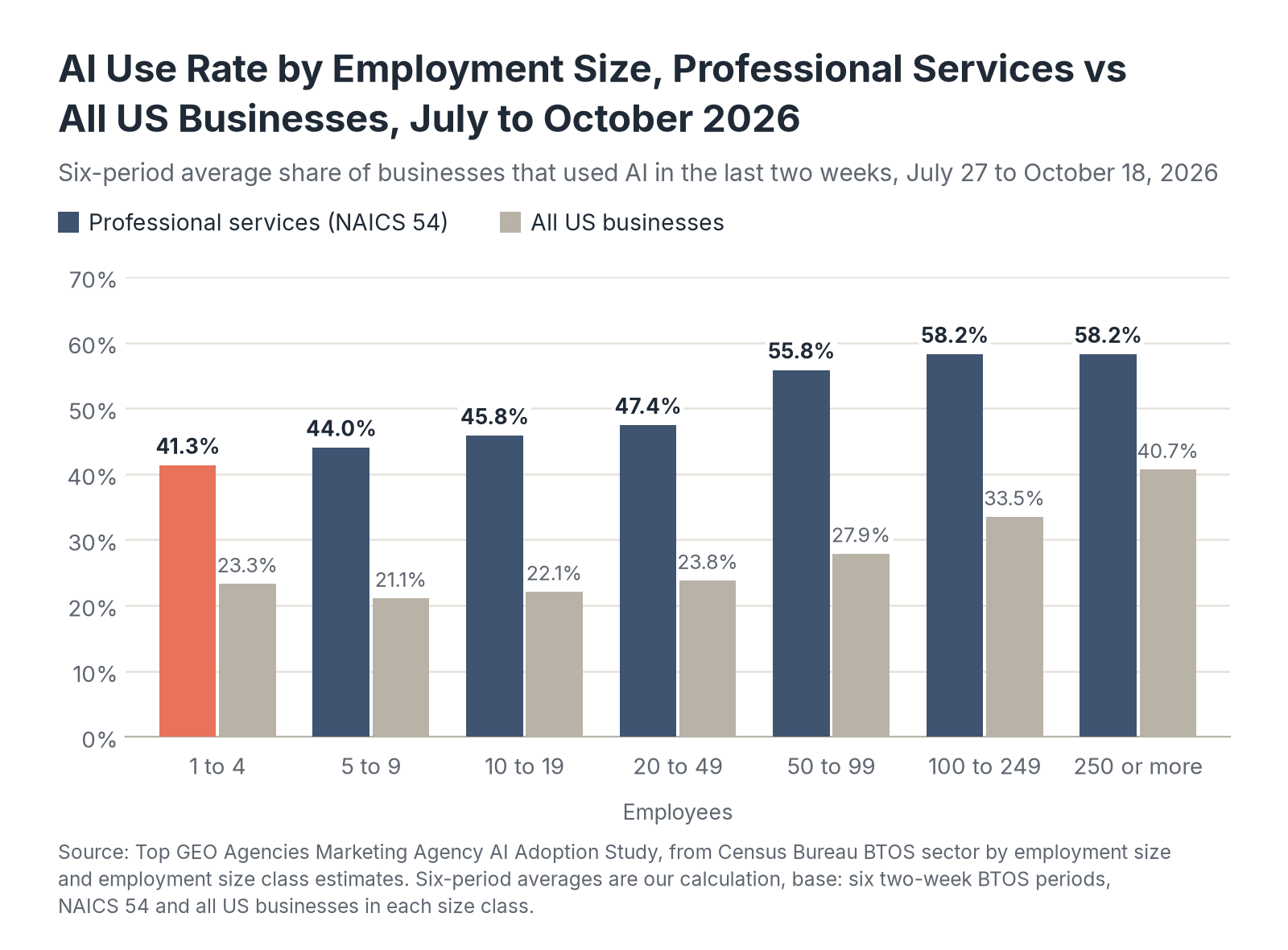
- NAICS 54 firms used AI above the all-business rate in every size class. Firms with 100 or more employees used it 16.9 points more often than firms with one to four employees (our calculation, base: six BTOS periods, NAICS 54 size classes).
- The widest gap with all US businesses is in the 50 to 99 employee class. The narrowest is in the 250 or more class.
- NAICS 54 firms with one to four employees used AI at 41.3%, against 40.7% for all US businesses with 250 or more employees. A professional services firm with a handful of staff uses AI at a slightly higher rate than the largest US businesses.
Agency surveys split by revenue. In the SoDA study, 63% of agencies under $10 million in revenue grew in 2025, against 86% of agencies above $10 million. The SAGA sample is mostly micro agencies, with 64% at five or fewer full-time employees and 71% under $1 million in fees, and 74% of its owners use AI daily (n=62). Half of SAGA respondents (50%) had used AI meaningfully for more than a year, and 88% reported a positive effect on productivity (n=62). The SoDA sample spans a wider size range, with 39% of its 251 agencies under $5 million in revenue.
Data: agency_size_survey_items.csv
The largest agency groups report AI spending directly. Table 13 converts their disclosed commitments to US dollars at one fixed rate per currency.
| Company | Disclosed commitment | Period | USD total (millions, our calculation, base: commitment at the Federal Reserve 2025 rate) | USD per year (millions, our calculation, base: USD total divided by stated years) |
|---|---|---|---|---|
| WPP | £300m invested in AI-driven technology | 2025 | $395.8 | $395.8 |
| Publicis Groupe | €300m for its CoreAI program | 2024 to 2026 | $339.2 | $113.1 |
| Havas | €400m in data, technology and AI | 2024 to 2027 | $452.2 | $113.1 |
Source: Top GEO Agencies Marketing Agency AI Adoption Study (Source 1), from WPP (Source 12), Publicis Groupe (Source 13) and Havas (Source 14), converted at Federal Reserve 2025 annual average rates (Source 17). USD figures are our calculation from each disclosed commitment.
Data: holdco_ai_investment_usd.csv
- WPP's 2025 AI investment exceeds the per-year amounts of the Publicis and Havas commitments combined (our calculation, base: company disclosures at Federal Reserve 2025 rates). WPP's figure covers one year of spending.
- Publicis and Havas each commit about $113.1 million a year (our calculation, base: USD total divided evenly across stated years). Their totals differ because the Havas commitment runs one year longer.
- The three commitments work out to more than $100 million a year at each group (our calculation, base: company disclosures at Federal Reserve 2025 rates, divided evenly across stated years). The commitments differ in scope and period, so the per-year amounts compare stated budgets.
Publicis planned to split the first €100 million of its program, budgeted for 2024, evenly between people and technology.
Barriers to Wider AI Use at Agencies
This section compares the risks and concerns that hold back wider AI use at agencies and at professional services firms with no plans to use AI.
Forrester and the 4As asked US agency leaders which barriers hold back generative AI and AI agents, and SAGA asked owners about their concerns. The BTOS supplement asked firms with no plans to use AI for their reasons. Table 14 shows those items with their bases.
| Barrier or concern | Source and base | Share | All US firms |
|---|---|---|---|
| Accuracy and bias, a barrier to generative AI | Forrester with the 4As, US agency leaders (nearly 200) | 63% | Not measured |
| Legal risk, a barrier to generative AI | Forrester with the 4As, US agency leaders (nearly 200) | 62% | Not measured |
| Privacy and security, a barrier to generative AI | Forrester with the 4As, US agency leaders (nearly 200) | 55% | Not measured |
| Lack of expertise, a barrier to AI agents | Forrester with the 4As, US agency leaders (nearly 200) | 54% | Not measured |
| Concerned about the accuracy of AI output | SAGA, owner-led agencies (n=62) | 82% | Not measured |
| Not applicable to the business | BTOS AI supplement, NAICS 54 firms not planning to use AI | 46.5% | 61.6% |
| Privacy or security concerns | BTOS AI supplement, NAICS 54 firms not planning to use AI | 28.7% | 20.7% |
| Lack of knowledge | BTOS AI supplement, NAICS 54 firms not planning to use AI | 22.7% | 22.0% |
| AI not mature enough | BTOS AI supplement, NAICS 54 firms not planning to use AI | 21.5% | 13.0% |
| Concerns about bias | BTOS AI supplement, NAICS 54 firms not planning to use AI | 13.3% | 8.6% |
| Too expensive | BTOS AI supplement, NAICS 54 firms not planning to use AI | 6.7% | 6.9% |
Source: Top GEO Agencies Marketing Agency AI Adoption Study (Source 1), from Forrester with the 4As (Sources 4 and 5), SAGA Agency Growth Advisors (Source 10) and the Census Bureau BTOS AI supplement (Source 3). BTOS shares are of firms not planning to use AI in the next six months, and the all-US column covers all such US firms. BTOS rows show six of the survey's 11 reasons; the other five are lack of skilled workforce (5.7%, all US 7.1%), lack of required data (5.9%, 5.1%), laws and regulations (5.7%, 2.8%), AI did not meet expectations (6.2%, 3.2%) and other (9.7%, 7.9%).
Data: agency_ai_barriers.csv
- Accuracy leads the concerns in both agency surveys that asked about it. Legal risk follows closely among the US agency leaders in the Forrester and 4As survey (nearly 200 respondents).
- Among NAICS 54 firms with no plans to use AI, privacy or security concerns run 8.0 points above the all-firm rate (our calculation, base: NAICS 54 vs all US firms not planning to use AI). The gap for AI not being mature enough is 8.5 points (our calculation, base: NAICS 54 vs all US firms not planning to use AI).
- The limits on wider AI use center on output quality and data handling more than on price. Among NAICS 54 firms with no plans to use AI, too expensive (6.7%) ranks below privacy or security (28.7%) and AI not being mature enough (21.5%).
Conclusion
Agencies whose clients want help with AI strategy are being asked for work that few agencies treat as a line of business. An agency that starts billing for that work would be pricing it while some clients expect AI to lower what they pay.
For a company hiring a marketing agency, AI work on its account is, at most agencies, a cost of business, and few agencies charge clients for it directly. That work is concentrated in research, ideation and drafting, and few agencies disclose it in their client contracts.
Data Collection and Methodology
Our study combines federal survey and payroll data, job posting data, agency surveys and company disclosures. We used BTOS core estimates for NAICS 54 and for all US businesses for every two-week period from November 17, 2025 to October 18, 2026; the BTOS AI supplement, collected November 17, 2025 to February 8, 2026; BLS Current Employment Statistics payroll employment for NAICS 5418; Indeed Hiring Lab job posting shares; and six agency surveys from Forrester with the 4As (2025 and 2026), SoDA, Basis (two reports) and SAGA Agency Growth Advisors, plus the AI investment disclosures of WPP, Publicis Groupe and Havas.
The Census Bureau does not publish BTOS results for advertising and public relations firms (NAICS 5418) alone, so NAICS 54 stands in for them. That sector also contains legal, accounting, architecture, design, consulting and computer services firms. Each BTOS panel of about 200,000 businesses reports every 12 weeks, and six panels rotate through the two-week collections. The BTOS core question asks whether the business used AI in any business function in the last two weeks. Since the November 17 to November 30, 2025 period, the question reads "Super Intelligence or SI (formerly referred to as Artificial Intelligence or AI)," so our trend starts with that period. The BTOS collected no data from October 6 to November 16, 2025. The Census Bureau does not publish sector response counts for each two-week BTOS period. Six-period averages are simple means of the published two-week estimates. Supplement response counts are as rounded by the Census Bureau, and supplement shares use the base defined for each question, which is all firms, firms that used AI, firms where AI replaced tasks, firms whose employees used generative AI or firms not planning to use AI.
The BLS series is seasonally adjusted payroll employment in thousands. September 2025 and July 2026 values are revised, and August and September 2026 values are preliminary.
For each agency survey we coded the publisher, population, respondent count, fieldwork period, question wording and reported share. Where a publisher gave no exact respondent count, we recorded its own description ("nearly 200") or "not published." SAGA reported 62 responses, and its base varies by question. We kept individual-level and agency-level questions separate in every table. Task groups in Table 5 combine items with matching wording. "Research" combines Basis "research," SAGA "research" and Forrester "research and competitive intelligence"; "routine or internal operations" combines SAGA "internal operations" and SoDA "automate or accelerate routine ops tasks"; "drafting copy" combines Basis "drafting" and SAGA "first drafts." The 2026 Forrester and 4As generative AI share uses the 87% reported by MediaPost from the Forrester report, which the Forrester press release rounds to nine in 10.
Non-US money is converted to US dollars at one fixed rate per currency, the Federal Reserve G.5A 2025 annual average of $1.3192 per British pound and $1.1306 per euro. Per-year figures divide each commitment evenly across its stated years.
Shares are rounded half up to one decimal place where the source publishes one decimal, and survey shares published as whole numbers are kept as whole numbers. Gaps, sums, averages and ratios are computed from unrounded values and rounded half up once. Each one is labeled as our calculation with its base.
Sources
- Top GEO Agencies, Marketing Agency AI Adoption Study: analysis of Census Bureau Business Trends and Outlook Survey core and AI supplement estimates (November 2025 to October 2026), BLS payroll employment for advertising and public relations services (September 2025 to September 2026), Indeed Hiring Lab job posting data, six agency surveys (2025 to 2026) and holding company AI investment disclosures, conducted October 2026
- U.S. Census Bureau, Business Trends and Outlook Survey, https://www.census.gov/data/experimental-data-products/business-trends-and-outlook-survey.html
- U.S. Census Bureau, Business Trends and Outlook Survey data downloads, AI supplement tables, 2026, https://www.census.gov/hfp/btos/data_downloads
- Forrester, Nine In 10 US Marketing Agencies Use AI To Cut Costs At The Expense Of Creativity, June 2026, https://www.forrester.com/press-newsroom/forrester-nine-in-10-us-marketing-agencies-use-ai-to-cut-costs-at-the-expense-of-creativity/
- MediaPost, 4As, Forrester: Agencies Using AI To Boost Margins, Sacrificing Growth, July 2026, https://www.mediapost.com/publications/article/416324/4as-forrester-agencies-using-ai-to-boost-margins.html
- Forrester, Cannes Lions 2025: The AI Challenge For Brands And Agencies, June 2025, https://www.forrester.com/blogs/cannes-lions-2025-the-ai-challenge-for-brands-and-agencies/
- 4As, The State of GenAI Adoption 2025, August 2025, https://www.aaaa.org/blog/the-state-of-genai-adoption-2025/
- SoDA, Agency Outlook Study '26 Research Summary, January 2026, https://www.sodaspeaks.com/s/FINAL_Research-Summary_Agency-Outlook-26.pdf
- Basis, 2026 Advertising Agency Report, April 2026, https://basis.com/wp-content/uploads/2026/04/2026-Advertising-Agency-Report-Basis.pdf
- SAGA Agency Growth Advisors, The State of AI in Owner-Led Agencies, May 2026, https://sagaimpact.com/wp-content/uploads/2026/05/saga-agency-ai-survey-report.pdf
- Basis, AI and the Future of Marketing: 2026 Edition, October 2026, https://basis.com/reports/ai-and-the-future-of-marketing-2026-edition
- WPP, 2025 Preliminary Results and Strategy Update, February 2026, https://cdn.wpp.com/raw/upload/v1778673497/wpp/project/wpp/files/investors/2026/wpp-2025-preliminary-results-and-strategy-update.pdf
- Publicis Groupe, Publicis unveils AI strategy to lead group into its second century, January 2024, https://www.publicisgroupe.com/en/news/press-releases/after-another-record-year-ahead-of-expectations-publicis-unveils-ai-strategy-to-lead-group-into-its-second-century
- Havas, Havas accelerates transformation and pivots to become an AI-driven organization fueled by human ingenuity, June 2025, https://www.havas.com/press_release/havas-accelerates-transformation-and-pivots-to-become-an-ai-driven-organization-fueled-by-human-ingenuity/
- U.S. Bureau of Labor Statistics, Current Employment Statistics, series CES6054180001, https://data.bls.gov/timeseries/CES6054180001
- Indeed Hiring Lab, January 2026 US Labor Market Update: Jobs Mentioning AI Are Growing Amid Broader Hiring Weakness, January 2026, https://hiringlab.indeed.com/2026/01/22/january-labor-market-update-jobs-mentioning-ai-are-growing-amid-broader-hiring-weakness/
- Board of Governors of the Federal Reserve System, Foreign Exchange Rates G.5A, January 2026, https://www.federalreserve.gov/releases/g5a/current/default.htm