The AI Search Location Paper, Explained
Published November 17, 2026
People now ask ChatGPT and Gemini where to find a plumber, which internet provider to choose, and how much it costs to register a car. The AI engine answers with a few paragraphs of text and a handful of cited sources, and the businesses it recommends in that answer are the ones the user sees. Companies that track their visibility in these answers usually send the same list of questions from one office, on one internet connection. In Google search, the user's location has long been one of the biggest reasons two people see different results, but until recently no one had measured whether ChatGPT and Gemini change their answers based on where the user is, or how they learn the user's location in the first place.
Our researchers read Location, Location, Generation: Where You Ask Matters for Generative Engine Optimization, a paper by Mahe Chen and Nick Koudas of the University of Toronto, and wrote this report to explain its findings in simple terms and what they mean for brands. The paper was posted to arXiv on October 16, 2026. The authors asked ChatGPT 300 commercial questions as if the user were in each of 19 cities, and asked ChatGPT and Gemini the same questions from five different internet locations. They sent every request twice, for 31,200 answers in total, so they could separate the effect of location from the ordinary variation between two identical requests.
In the following sections, we explain how the experiment worked, what the authors concluded, how much location changed the sources each engine cited, how the two engines learn where a user is, which businesses the answers recommended in different places, what the results mean for tracking AI visibility, and the limits to keep in mind.
The Main Experiment
The authors wanted to know three things: whether the user's location changes the sources an AI engine cites, how the engine finds out where the user is, and what changes in the answer when the location changes.
The questions and the places
The authors wrote 300 questions across ten commercial topics: home services, health care, finance, insurance, telecom, dining, retail, cars, travel, and public services. They split the questions into three groups of 100. None of the questions mentioned a place, so any local detail in an answer had to come from the engine itself.
| Question group | What it asks for | Example from the paper |
|---|---|---|
| Near me | Something close to the user | “best plumber near me” |
| Place-dependent | An answer that depends on where the user lives, such as prices, laws, providers, or weather | “how much is sales tax on a car” |
| Not local | An answer that should be the same everywhere | “best robot vacuum” |
For the places, the authors chose 15 US cities of different sizes in different regions, plus four cities in other English-speaking countries: London, Toronto, Sydney, and Dublin.
Two ways an engine can learn where a user is
An AI engine can learn a user's location in two ways. The app the user is typing into can tell the engine the user's approximate location, which the authors call a declared location. Or the engine can work out the location from the internet connection the request comes from, which the authors call the network location. The authors ran one experiment for each.
| Experiment | How the location reached the engine | Engines and models | Answers |
|---|---|---|---|
| Declared location | The app passed one of 19 cities to the engine as the user's approximate location, or no location, all from one internet connection | ChatGPT (gpt-5.4-mini with web search) | 24,000 |
| Network location | No location passed; the requests came from six sessions on different internet connections | ChatGPT (gpt-5.4-mini with web search) and Gemini (gemini-3.1-flash-lite with Google Search) | 7,200 |
Key Findings
- In the declared-location experiment, ChatGPT decided by itself whether to search the web. In a second round, every question started with "Search the web:" so that every answer would have sources to compare.
- The six network sessions used the authors' own connection in Canada, VPN connections that exited in New York, Los Angeles, London, and Sydney, and the authors' own connection again three days later, to check whether answers drifted over time.
- Gemini's API also accepts a declared location as map coordinates, but in a trial run those coordinates had no effect on its answers.
- To check that the small ChatGPT model behaved like the full one, the authors repeated part of the test with the full-size gpt-5.4 model on 60 questions in six places.
How the authors measured change
For each question, the authors compared the websites cited in two answers and measured how much the two lists overlapped. Two identical requests from the same place do not always cite the same websites, so the authors used the overlap between those twin answers as the baseline. Their main measure, the localization index, is the overlap between twin answers minus the overlap between answers from two different places. An index of 0 means that moving the user changed nothing beyond the normal variation, and a higher number means that the two places received more different sources.
The authors counted a source as local if its web address contained the user's city or US state, or ended in the country's domain, such as .ca or .uk. To see which businesses each answer recommended, they had an AI model list the businesses, brands, and products in each answer, leaving out directories, review sites, and government bodies. When the authors checked 36 of these lists by hand, 29 were fully correct.
What the Paper Concluded
The authors conclude that ChatGPT and Gemini both change their answers by location, but they learn the location from different places. ChatGPT follows the location the app declares, down to the city. It writes the city into its own web searches, and its search system returns local results even when the search does not mention a place. It ignores the internet connection. Gemini does the opposite. It ignores the declared location and follows the country of the internet connection, and it changes most of its sources between countries even for questions that have nothing to do with place.
When the sources changed, the recommended businesses changed with them. The authors therefore conclude that visibility in AI search is specific to the user's location, and that anyone who monitors or audits these engines needs to control both the declared location and the network location.
How Much Location Changed the Cited Sources
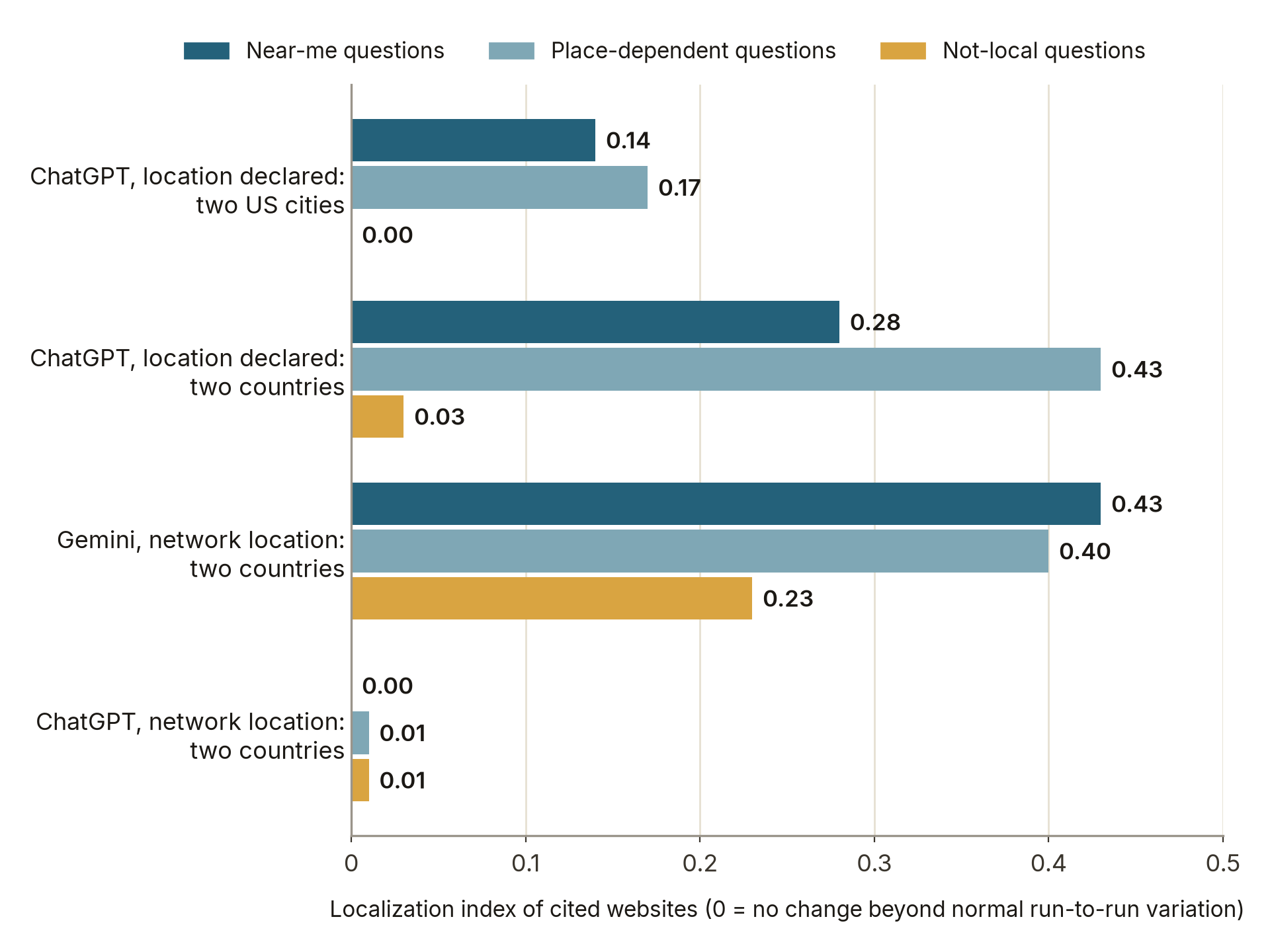
We start with the localization index for each engine and each way of setting the location, broken out by the three groups of questions.
Key Findings
- With a declared location, ChatGPT's sources for near-me questions differed by 0.14 between two US cities and by 0.28 between cities in different countries. For place-dependent questions, the differences were 0.17 and 0.43. For not-local questions they were 0.00 and 0.03, so a declared location did not change ChatGPT's sources for questions like "best robot vacuum."
- Gemini's sources differed by 0.43 between network locations in different countries for near-me questions and by 0.40 for place-dependent ones. They still differed by 0.23 for not-local questions, so a Gemini user in London and a Gemini user in Sydney could see different sources for a question that has the same answer everywhere.
- ChatGPT's index between internet connections in different countries was 0.00, 0.01, and 0.01, all within the normal variation between identical requests.
- A declared location also made ChatGPT more likely to answer with sources at all. Without one, it often asked the user for a ZIP code instead. With one, it cited sources in 64% to 73% of its answers, compared with 46% without.
The effect also varied by topic. Among place-dependent questions, the index between two US cities was highest for public services, at 0.57, because those answers cited the government website of each state. It was lowest for telecom and utilities, at 0.02, because those answers cited national sources such as the Federal Communications Commission, the national carriers, and comparison sites. The authors note that each topic had only ten questions per group, so these topic figures are a rough guide.
How Each Engine Learns Where a User Is
Gemini followed the network, but only at the level of the country. Between New York and Los Angeles, its index was 0.00, and its searches mentioned the country in 56% of near-me answers but never mentioned a city. The authors ruled out drift over time as the cause of the country differences. The same Canadian connection three days apart produced indexes of 0.03, 0.01, and 0.05, while London and Sydney, measured 30 minutes apart, differed as much as any other pair of countries.
ChatGPT, by contrast, followed the declared city, and the clearest way to see the difference is in the web searches each engine wrote for itself before answering.
| Engine, question, and place | Search the engine wrote |
|---|---|
| ChatGPT, “credit unions in my area,” Boise | “credit unions Boise Idaho area branches near Boise Idaho” |
| ChatGPT, “credit unions in my area,” New York | “credit unions near New York NY” |
| ChatGPT, “credit unions in my area,” London | “credit unions near London England United Kingdom” |
| Gemini, “which store has the cheapest groceries,” Canada | “is it cheaper to shop at Walmart vs No Frills vs Superstore Canada” |
| Gemini, “which store has the cheapest groceries,” US | “cheapest grocery stores in US 2026” |
| Gemini, “which store has the cheapest groceries,” UK | “is Aldi or Lidl cheaper UK 2026” |
| Gemini, “which store has the cheapest groceries,” Australia | “how to save money on groceries Australia” |
Key Findings
- ChatGPT wrote the user's place into 100% of its searches for near-me questions and 48% of its searches for place-dependent questions.
- ChatGPT's search system also localized results by itself. When neither of two answers' searches mentioned the location, their sources still differed by 0.17. For a user in Boise asking when to plant tomatoes, for example, ChatGPT cited the Oregon State University extension service. When both searches mentioned the place, the index rose to 0.37.
- ChatGPT's localization did not fade with distance. For near-me questions, the index was 0.13 between US cities less than 1,000 kilometers apart and 0.14 between cities more than 3,000 kilometers apart. The closest pair of cities in the study was 293 kilometers apart. To ChatGPT, every other city counted as a different place. To Gemini, only another country did.
What happens when no location is given
Without a declared location, ChatGPT answered 63% of near-me questions by asking the user for a ZIP code or a city. When it did search, it wrote no state into its searches, and only 11% of its near-me answers mentioned any US place. Its sources looked much more like the sources it cited for the US cities, with an overlap of 0.25, than like those for the other countries, with an overlap of 0.10. In other words, ChatGPT answered as if the user were somewhere in the United States, using national sources. Gemini answered for the country of the internet connection, whatever location the app declared.
What Changed in the Answers: Local Sources and Different Businesses
Next, we looked at how often each engine searched, how often it wrote the place into its searches, and how often its answers cited a source from the user's own area.
| Question group | ChatGPT answers that searched the web | ChatGPT searches with the place in them | ChatGPT answers citing a source from the user's city or state (US) | ChatGPT answers citing a source from the user's country (outside the US) | Gemini searches with the country in them |
|---|---|---|---|---|---|
| Near me | 100% | 100% | 79% | 92% | 56% |
| Place-dependent | 67% | 48% | 22% | 77% | 59% |
| Not local | 49% | 0% | 1% | 10% | 4% |
Key Findings
- With a declared location, 79% of ChatGPT's near-me answers in US cities cited a source with the user's city or state in its web address, and 92% of its near-me answers in the other countries cited a source from that country.
- As a check, the authors counted sources that mentioned one of the other cities in the study instead of the user's own. That share stayed below 0.2%, so the local sources were matched to the right place.
- For not-local questions, ChatGPT almost never cited a local source, and it never wrote the place into its searches.
The businesses in the answers changed along with the sources. A ChatGPT answer to a near-me question recommended 4.3 businesses, brands, or products on average. Two identical requests from the same declared location shared 23% of these recommendations, and two requests from different declared locations shared only 4%. The authors used the same localization index to compare the recommendations.
| Comparison | Near me | Place-dependent | Not local |
|---|---|---|---|
| ChatGPT, declared location: two US cities | 0.18 | 0.14 | 0.01 |
| ChatGPT, declared location: two countries | 0.22 | 0.22 | 0.03 |
| Gemini, network location: two countries | 0.41 | 0.28 | 0.07 |
| ChatGPT, network location: two countries | 0.03 | 0.02 | 0.00 |
Gemini's recommendations differed between countries even for not-local questions, with an index of 0.07, while ChatGPT's recommendations did not change with the internet connection. Two examples from the paper show what these differences look like.
| Engine, question, and place | First three businesses recommended in both repeat answers |
|---|---|
| ChatGPT, “credit unions in my area,” New York | New York University FCU, Neighborhood Trust FCU, and Brooklyn Cooperative FCU |
| ChatGPT, “credit unions in my area,” Boise | Idaho Central CU, CapEd FCU, and Connections CU |
| ChatGPT, “credit unions in my area,” Miami | Educational FCU, University CU, and Miami Postal Service CU |
| ChatGPT, “credit unions in my area,” London | London Mutual CU, London Capital CU, and Your Community Bank |
| Gemini, “which store has the cheapest groceries,” Canada | No Frills, Walmart, and Food Basics |
| Gemini, “which store has the cheapest groceries,” US East | Aldi, Walmart, and Costco |
| Gemini, “which store has the cheapest groceries,” US West | Aldi, Walmart, and WinCo Foods |
| Gemini, “which store has the cheapest groceries,” UK | Aldi, Lidl, and Tesco |
| Gemini, “which store has the cheapest groceries,” Australia | ALDI, Coles, and Woolworths |
Key Findings
- Asked for credit unions in the user's area, ChatGPT recommended a different set of local credit unions in each declared city.
- Asked which store has the cheapest groceries, Gemini recommended different national chains in each country, and mostly the same chains in New York and Los Angeles.
What the Results Mean for Tracking AI Visibility
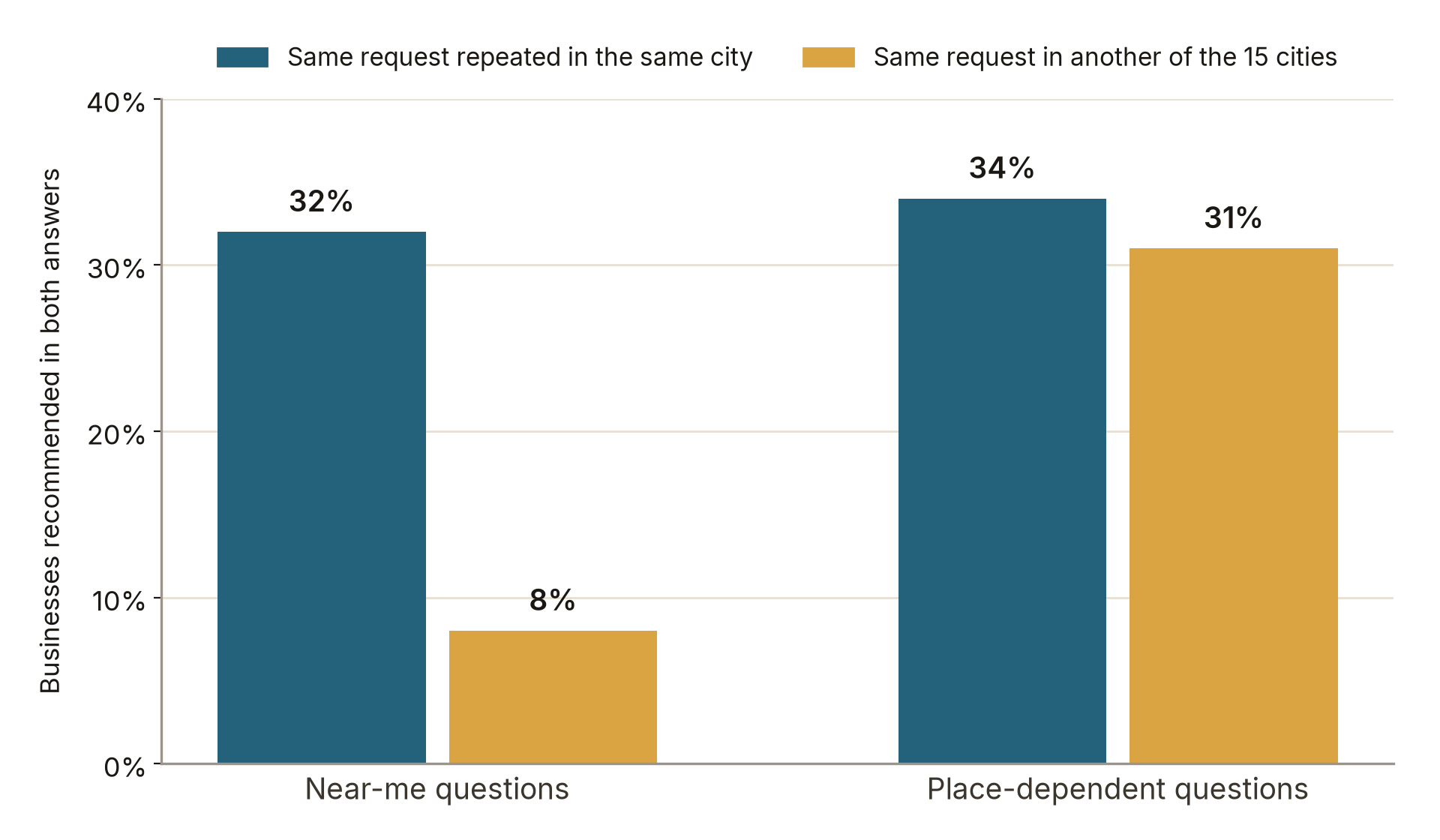
Tools that track which businesses an AI engine recommends usually send their questions from one place. To see how much those tools miss, the authors compared the businesses ChatGPT recommended for the same request in the same city and in different US cities.
Key Findings
- For near-me questions, a request declared in one US city recommended only 8% of the businesses that the same request recommended in another city, compared with 32% when the request was repeated in the same city.
- 96% of the businesses recommended for near-me questions appeared in only one of the 15 cities.
- For place-dependent questions, the gap was much smaller, at 31% compared with 34%.
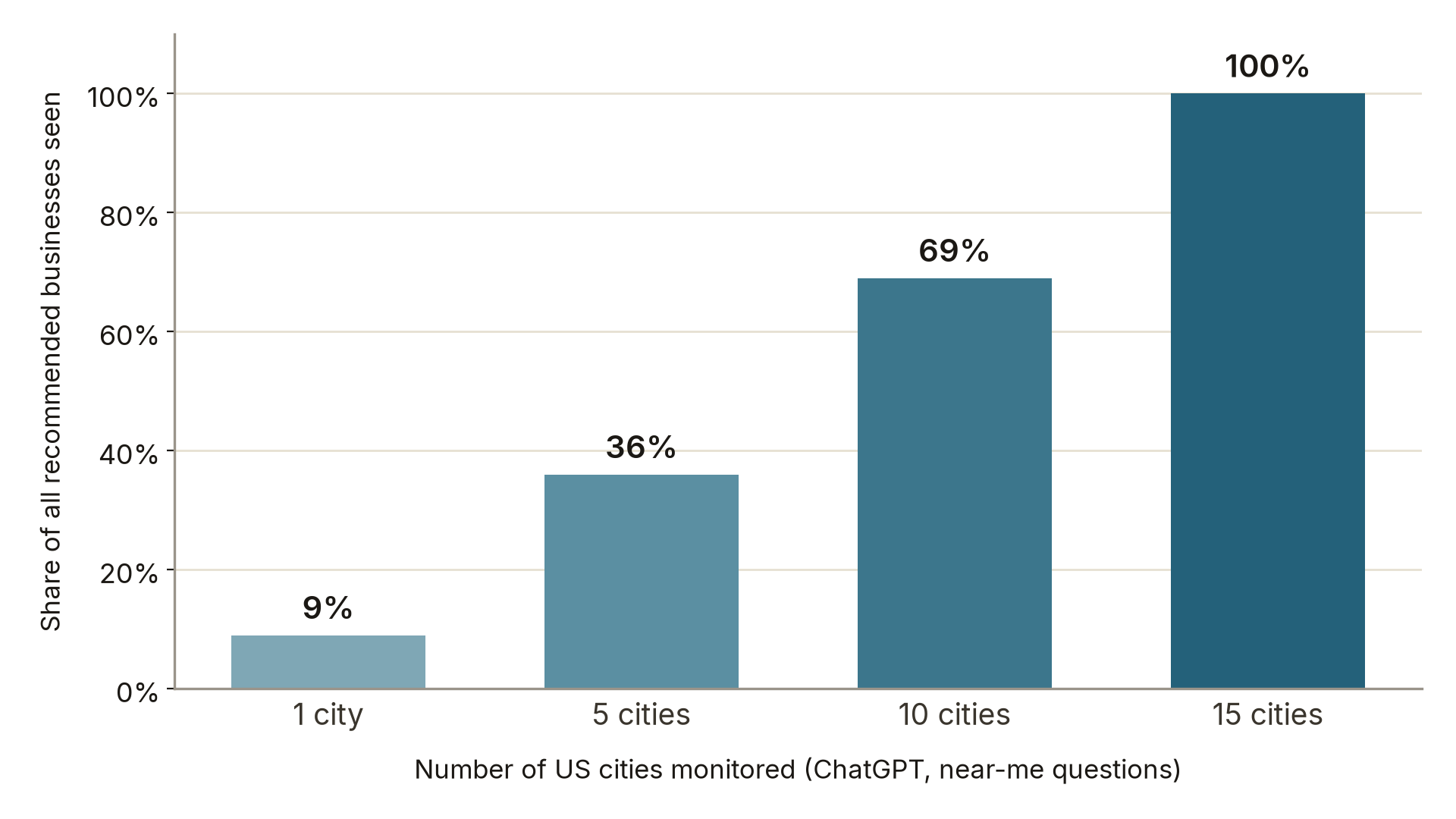
The authors then asked how many cities a tracker would need to monitor to see most of the businesses ChatGPT recommended for near-me questions across all 15 cities.
Key Findings
- Monitoring one city captured 9% of the businesses recommended across the 15 cities, five cities captured 36%, and ten cities captured 69%.
- The curve did not level off, because every city added mostly new businesses.
- For not-local questions, where location had no effect, one city captured 19% and five cities captured 53%. Those gaps came only from the variation between repeated requests, which means tracking needs repeated requests for every question and, for local questions, many locations as well.
The results held up in the authors' checks. In the round where ChatGPT searched for every question, the index across all pairs of places was about the same, at 0.19 for near-me questions, 0.20 for place-dependent questions, and 0.01 for not-local questions. The full-size gpt-5.4 model, tested on 60 questions in six places (720 answers), localized at least as strongly as the small model, with indexes of 0.26, 0.35, and 0.11 against 0.23, 0.31, and 0.07 for the small model on the same questions and places. It also wrote the place into 100% of its near-me searches.
Limits to Keep in Mind
- The authors used the engines' APIs and small models, which may not behave exactly like the ChatGPT and Gemini apps that consumers use. The full-size model check covered ChatGPT only.
- The VPN connections came from data centers and covered only five network locations. Gemini may localize more finely, for example by city, for people on home internet connections.
- The authors wrote all 300 questions themselves, in English, so the results may differ for other languages and other ways of phrasing a question.
- The measurements describe the engines in October 2026, and both engines change often.
What This Means for Brands in 2027 and Beyond
For a local business, the study suggests that visibility in ChatGPT is decided city by city. When someone asks a near-me or place-dependent question, ChatGPT writes the city into its searches and cites sources that mention that city or state, so a local business becomes visible through the pages ChatGPT finds for those local searches, such as local directories, review sites, and the websites of local institutions, rather than through national rankings. For a brand that sells in several countries, Gemini decides which national chains and sources to recommend based on the user's country, so a strong position in one country says little about the next one.
The study also changes how visibility should be measured. A tracking tool that only sets a location parameter measures ChatGPT for that city but Gemini for whatever country the tool runs from, and a tool that sets neither measures ChatGPT for an unspecified US user. Every market a business serves has to be checked on its own, with the location set the way each engine reads it, and each question has to be asked more than once. The same authors' earlier comparison of AI search and Google found that AI engines lean heavily on third-party review and media sites, which fits the finding here that local directories and review sites carry much of a local business's visibility. Brands that want help tracking their AI visibility market by market can compare specialist firms in our directory of GEO and AEO agencies.
So if you track how AI engines recommend your business, check each city or country you sell in separately, set the location the way each engine reads it, and repeat every question before drawing conclusions.
Data Collection and Methodology
We read the arXiv version of the paper (2610.24081v1, posted October 16, 2026) and took every figure in this article from the paper's text, tables, and figures.
The localization indexes for cited websites come from the paper's Figure 1 and the values reported in its results section. The search examples, the search behavior and local-source shares, the localization index of recommended businesses, and the recommendation examples come from the paper's Tables 1 through 4. The overlap of recommended businesses between cities and the share captured by monitoring 1, 5, and 10 cities come from the paper's discussion of monitoring and its Figure 3, where all 15 cities together make up 100% by definition. The paper publishes 95% confidence intervals for most figures, and we left them out of the charts for readability.
Sources
- Top GEO Agencies, The AI Search Location Paper, Explained, November 2026, New York, New York. Download the data (CSV).
- Location, Location, Generation: Where You Ask Matters for Generative Engine Optimization. Mahe Chen and Nick Koudas. University of Toronto. arXiv 2610.24081, October 2026. PDF.