The Competitive GEO Paper, Explained
Published November 10, 2026
When someone asks an AI answer engine such as ChatGPT or Perplexity which product to buy, the engine reads a handful of web pages and cites only a few of them in its answer. A page that the engine retrieves but does not cite gets no visibility, so brands now compete with other pages for a small number of citation slots. Earlier studies of generative engine optimization, starting with the 2024 paper that introduced the term, mostly measured how visible a single page became after a rewrite. They did not test what happens when two similar pages compete for the same citation, and that is the question a team at the customer experience software company Sprinklr set out to answer.
Our researchers read What Gets Cited: Competitive GEO in AI Answer Engines, a paper by Rahul Vishwakarma, Shushant Kumar, and Ratnesh Jamidar of Sprinklr, and wrote this report to explain its findings in simple terms and what they mean for brands. The paper appears in the proceedings of SIGIR 2026, the Association for Computing Machinery's annual conference on information retrieval research, held July 20 to 24, 2026, in Melbourne, Australia, and it was posted to arXiv on May 25, 2026. The authors gave six AI models two versions of the same product review at a time, changed exactly one of 18 content factors between the two versions, and recorded which version the model cited first. They ran 252,000 of these trials.
In the following sections, we explain how the experiment worked, what the authors concluded, which four factors every model agreed on, which seven factors added smaller gains, which changes made little difference, how dates affected citations, how the six models differed, the checklist the authors built for brands, and the limits they point out themselves.
The Main Experiment
The authors wanted to know what makes an AI model cite one page first when two retrieved pages compete for the same citation. To isolate each possible reason, they built a test in which the model sees exactly two sources and nothing else, and the two sources differ in only one way.
Building the test pages
The authors started with 50 consumer product categories, such as consumer technology, home goods, and fitness equipment. For each category they used GPT-4o with web search to gather two representative product review blog posts, 100 in all, with 2026 market prices, technical specifications, and publication dates. AI models can favor well-known brands they saw often during training, so the authors replaced every brand name, product model, and publisher name with an invented alias while keeping the prices, specifications, and dates as they were.
For each of the 18 factors, the authors picked 20 of the review posts at random and wrote four scenarios for each post, which gave 80 scenarios per factor and 1,440 in total. Each scenario has two versions of the same review that differ in one factor and match in every fact, price, and specification, with lengths within 5% of each other. In one of their examples, the confident version says a robot vacuum "delivers exceptional cleaning with 30,000 Pa suction," while the hedged version says it "might possibly deliver cleaning with what could be around 30,000 Pa suction." Each scenario also got three different wordings of the shopper's question. All three authors checked a sample of 300 scenarios and found no leftover brand names and no unintended differences between versions.
| Group | Factor | How the weaker version differs |
|---|---|---|
| Content match | Topic mismatch | Discusses unrelated products instead of the ones the question asks about |
| Content match | Keyword gap | Lacks key terms from the question that the competing source contains |
| Completeness | Price not mentioned | Leaves out the product's price |
| Completeness | Missing specifications | Leaves out technical specifications |
| Completeness | No comparisons | Does not compare the product with alternatives |
| Trustworthiness | Hedged language | Uses heavy qualifiers such as might, possibly, and could |
| Trustworthiness | Claims without evidence | Makes claims with no supporting tests or certifications |
| Trustworthiness | Internal contradictions | Contains statements that conflict with each other |
| Trustworthiness | Overly promotional | Uses an excessively enthusiastic, sales-focused tone |
| Readability | Content structure | Uses dense paragraphs instead of organized sections |
| Readability | Scattered information | Spreads related facts throughout the text |
| Competitive standing | Weaker value proposition | Presents less compelling benefits than the competitor |
| Competitive standing | Less comprehensive | Gives a shallower analysis than the detailed alternative |
| Competitive standing | Weaker social proof | Shows fewer or lower ratings and reviews |
| Competitive standing | Lower list position | Appears second in the search results instead of first |
| Freshness | Recent vs old date | Dated 2019 against a source dated 2026 |
| Freshness | No date vs old date | Dated 2019 against a source with no date |
| Freshness | Recent vs no date | Has no date against a source dated 2026 |
Key Findings
- Seventeen of the factors change something about the text of a page. The eighteenth, lower list position, keeps the text identical and moves the source from first place to second place in the search results the model sees.
- The factors cover things a content team controls directly, from wording and completeness to dates. Brand fame was removed from the test on purpose by replacing every brand with an invented one.
Running the trials
Each trial imitated an ordinary AI search turn. The model received a fixed instruction telling it to search the web and cite the exact URLs it found, then the shopper's question, then a web search call and a search result that listed exactly the two versions, each with a title, a URL, and its full text. The authors supplied the search result themselves and never called a real search engine. For 17 of the factors, they swapped which version came first so that position could not explain the outcome; for list position, the order was the thing being tested. Every combination of scenario, question, and order ran five times.
| Step | Count |
|---|---|
| Consumer product categories | 50 |
| Product review articles (two per category) | 100 |
| Content factors tested | 18 |
| Scenarios (80 per factor) | 1,440 |
| Scenario and question pairs (three wordings each) | 4,320 |
| Repeats of each scenario, question, and order | 5 |
| Trials per model | 42,000 |
| AI models tested | 6 |
| Total trials | 252,000 |
Key Findings
- Each model ran 2,400 trials for each of the 17 text factors and 1,200 for list position, or 42,000 trials per model.
- The six models were Gemini 2.5 Flash, Claude 3.5 Sonnet, Kimi K2 Thinking, GPT-5 Nano, GPT-5 Mini, and GPT-5.2, which brought the study to 252,000 trials in total.
How the authors measured a win
A version won a trial when the first link in the model's answer pointed to it. About 86.4% of answers contained exactly one link, 10.5% contained two or more, and 3.1% contained none. The authors dropped the roughly 3.4% of trials with no link or with a first link that matched neither version. They report each result as an odds ratio. An odds ratio of 5 means the stronger version had about five times the odds of being cited first, and an odds ratio of 1 means the change made no difference. When one version won nearly every trial, the statistic becomes extremely large, so the authors report it as more than 10,000 and read it as a decisive win. They used mixed-effects statistical models that account for repeated runs of the same scenario, and they count a result as significant when its p-value is below 0.05.
What the Paper Concluded
The authors conclude that AI citation choices follow a clear order of importance. Four factors, topic match, price, recency, and list position, decided the first citation in all six models, and failing any one of them could cost a page the citation regardless of its other strengths. Completeness and trust signals added smaller gains once those four were in place, and formatting changes had almost no effect. The authors turned these results into a checklist for content teams and tried it in an early internal pilot at Sprinklr, where teams reported positive feedback on how usable the workflow was.
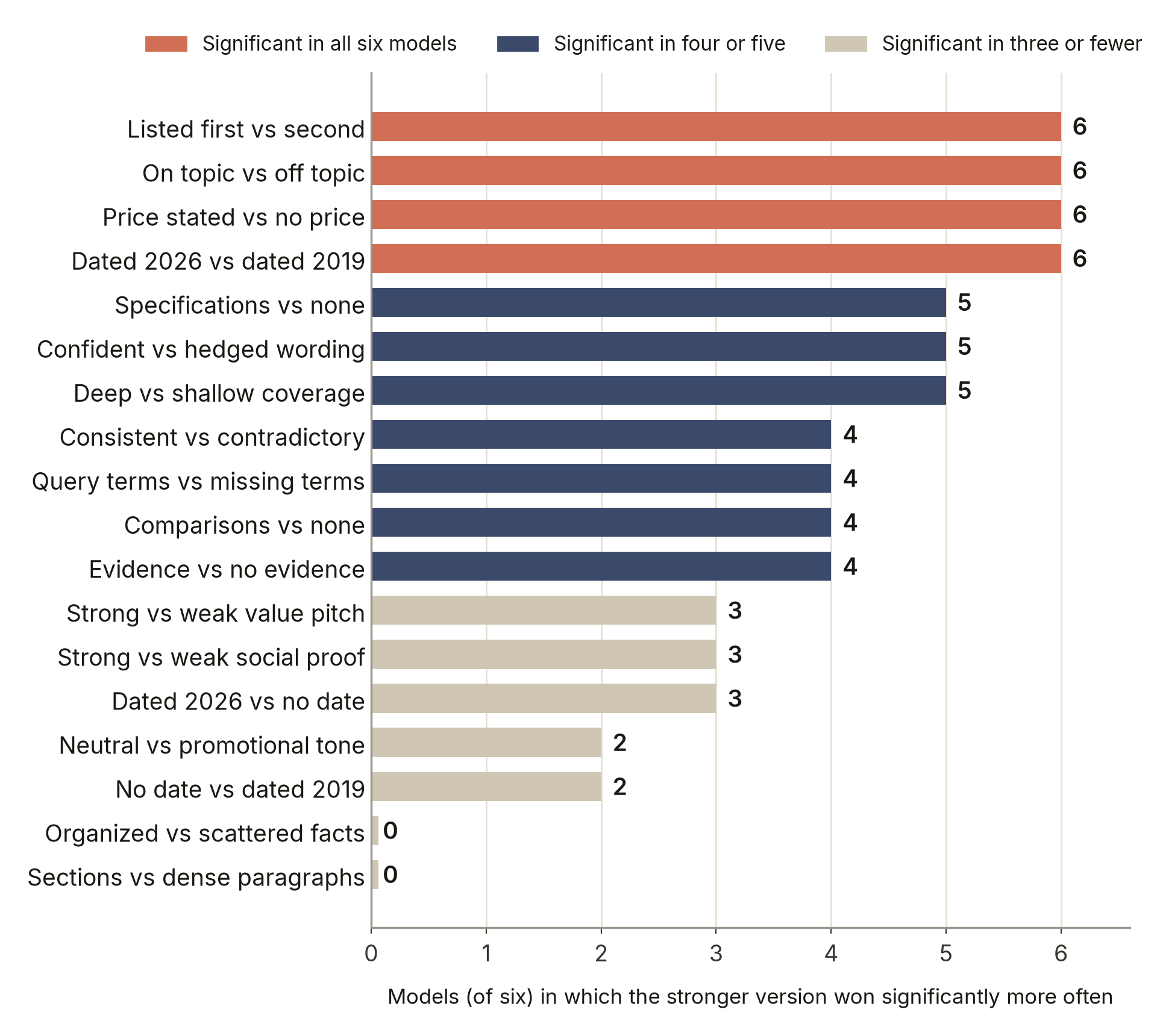
Eleven of the 18 factors, or 61%, were significant in at least four of the six models. The other seven, or 39%, had weak effects or effects that did not hold across models. For each factor, we counted the number of models in which the stronger version was cited first significantly more often.
Key Findings
- Listed first, on topic, price stated, and dated 2026 were the only factors that won in all six models.
- Breaking dense paragraphs into sections and grouping scattered facts did not reach significance in any model.
- For a brand, this ranking gives an order of work: the four factors that every model agreed on come before anything else on the page.
The Four Factors Every Model Agreed On
We start with the four factors the authors call gatekeepers, because a page that fails any one of them tends to lose the citation no matter how good the rest of the page is. We compared the odds ratio for the stronger version in each of the six models.
| Factor (stronger vs weaker) | Gemini 2.5 Flash | Claude 3.5 Sonnet | Kimi K2 Thinking | GPT-5 Nano | GPT-5 Mini | GPT-5.2 |
|---|---|---|---|---|---|---|
| On topic vs off topic | >10,000 | >10,000 | >10,000 | 221 | >10,000 | >10,000 |
| Listed first vs second | >10,000 | >10,000 | >10,000 | 2,002 | 1,795 | >10,000 |
| Price stated vs no price | >10,000 | >10,000 | 36.1 | 7.82 | 6.26 | 30.4 |
| Dated 2026 vs dated 2019 | >10,000 | >10,000 | 68.7 | 14.4 | 1,494 | >10,000 |
Key Findings
- When one version discussed unrelated products, the on-topic version won with odds above 10,000 in five models and odds of 221 in GPT-5 Nano.
- With identical text, the source listed first won with odds above 10,000 in four models, 2,002 in GPT-5 Nano, and 1,795 in GPT-5 Mini.
- A stated price helped in every model, with odds ratios from 6.26 in GPT-5 Mini to more than 10,000 in Gemini 2.5 Flash and Claude 3.5 Sonnet. A 2026 date beat a 2019 date in all six models, from 14.4 in GPT-5 Nano to more than 10,000 in three models.
- Three of the four gatekeepers are edits a team can make on the page itself: answer the question asked, show the price, and keep the date current. The fourth, list position, depends on how the engine's search ranks the page, which the authors assign to SEO work.
The Seven Factors That Add Smaller Gains
Next we looked at the seven factors that were significant in four or five of the six models. The authors call them differentiators, because they separate competing pages once the four gatekeepers are in place. Results marked (ns) were not statistically significant in that model.
| Factor (stronger vs weaker) | Gemini 2.5 Flash | Claude 3.5 Sonnet | Kimi K2 Thinking | GPT-5 Nano | GPT-5 Mini | GPT-5.2 |
|---|---|---|---|---|---|---|
| Specifications vs none | 8.63 (ns) | >10,000 | 238 | 11.5 | 15.4 | 243 |
| Deep vs shallow coverage | 1,480 (ns) | >10,000 | 132 | 5.33 | 19.5 | 3.98 |
| Confident vs hedged wording | 599 | 754 (ns) | 10.6 | 2.67 | 5.44 | 4.75 |
| Query terms vs missing terms | 9.41 (ns) | 17.0 (ns) | 16.4 | 5.99 | 14.4 | 40.0 |
| Evidence vs no evidence | 8.00 (ns) | >10,000 | 46.3 | 2.73 | 5.91 | 2.09 (ns) |
| Comparisons vs none | 7.45 | 4.55 | 4.72 | 2.14 | 1.78 (ns) | 1.61 (ns) |
| Consistent vs contradictory | 2.81 (ns) | 2.81 | 2.72 | 2.19 | 4.09 | 1.74 (ns) |
Key Findings
- Specifications and depth produced the largest effects in this group. Technical specifications won in five models, with odds of 243 in GPT-5.2 and 238 in Kimi K2 Thinking, and deeper coverage won in five, with odds of 132 in Kimi K2 Thinking and 19.5 in GPT-5 Mini.
- Confident wording beat hedged wording in five models, from 2.67 in GPT-5 Nano to 599 in Gemini 2.5 Flash. Using the words from the shopper's question won in four models, with odds as high as 40.0 in GPT-5.2.
- Supporting evidence such as tests or certifications won in four models, from 2.73 in GPT-5 Nano to more than 10,000 in Claude 3.5 Sonnet. Comparisons with other products won in four, with odds between 2.14 and 7.45, and consistent statements won in four, with odds between 2.19 and 4.09.
- The authors put the range for this group at odds ratios of 2.1 to 243. The gains are real but uneven across models, so these fixes come after the gatekeepers.
Changes That Made Little Difference
We also looked at the seven factors that did not hold up across models, because several of them match common advice about writing for AI search.
- Formatting had no measurable effect. Turning dense paragraphs into organized sections and grouping scattered facts together were not significant in any of the six models. The authors suggest the models read the content the same way whatever its visual layout.
- A neutral tone beat a promotional one in only two models, GPT-5 Mini (1.81) and GPT-5.2 (2.08). Claude 3.5 Sonnet's estimate of 362 was not statistically significant.
- A stronger value proposition and stronger social proof, such as more or better ratings, were each significant in three models: Kimi K2 Thinking, GPT-5 Nano, and GPT-5 Mini.
- Reformatting a page was the lowest-return change in this study, and the authors recommend leaving it for last.
How Dates Affected Citations
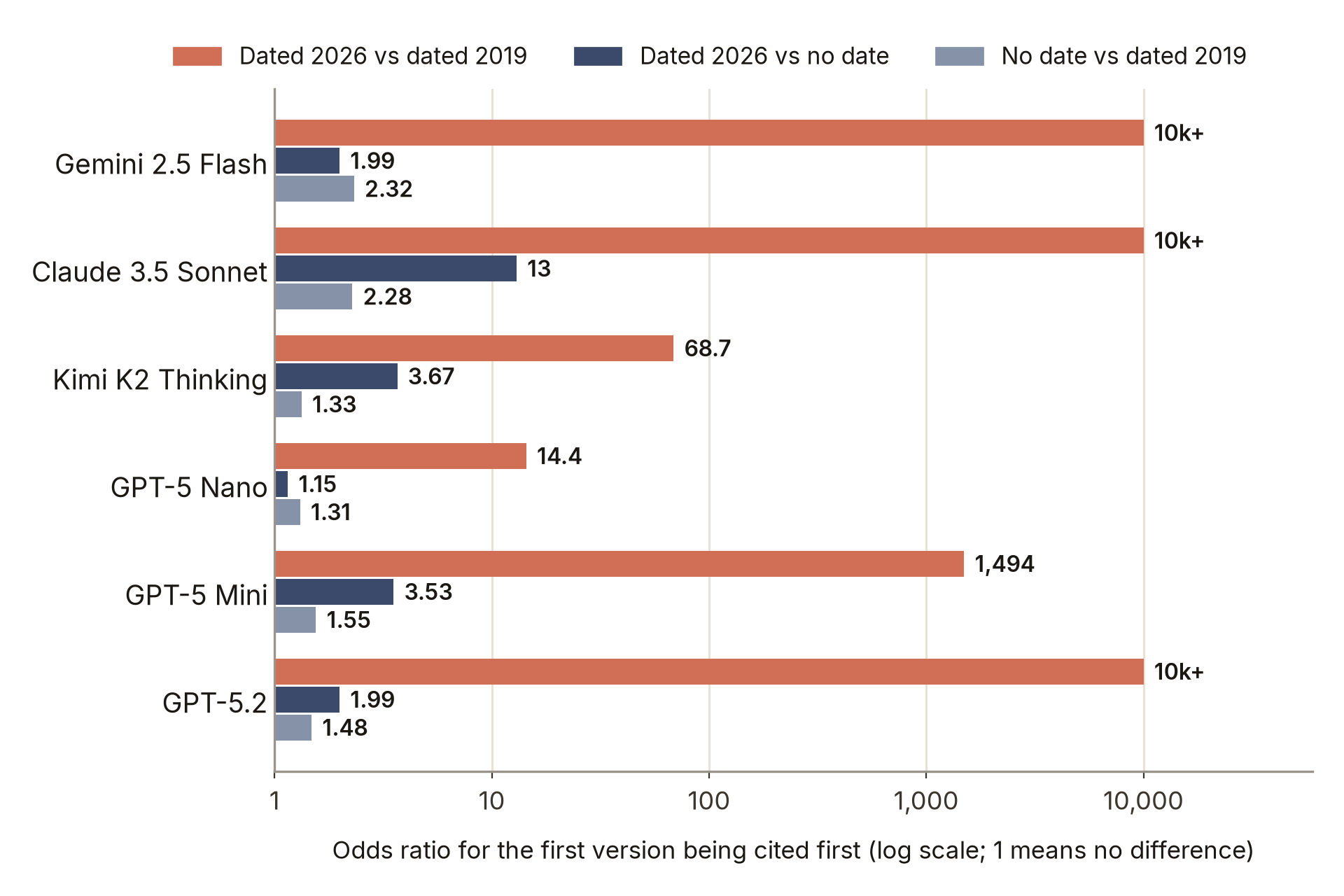
The study tested freshness three separate ways, and we compared how much each kind of date mattered to each model.
Key Findings
- A 2026 date against a 2019 date was decisive, with odds above 10,000 in Gemini 2.5 Flash, Claude 3.5 Sonnet, and GPT-5.2, and 1,494 in GPT-5 Mini.
- A 2026 date against no date at all helped much less. It was significant in three models, with odds of 3.67 in Kimi K2 Thinking, 3.53 in GPT-5 Mini, and 1.99 in GPT-5.2.
- A page with no date beat a page dated 2019 in only two models, Kimi K2 Thinking (1.33) and GPT-5.2 (1.48).
- The large penalty in these tests came from a visibly old date competing with a current one. Updating dates is one of the quick fixes the authors recommend.
How the Six Models Differed
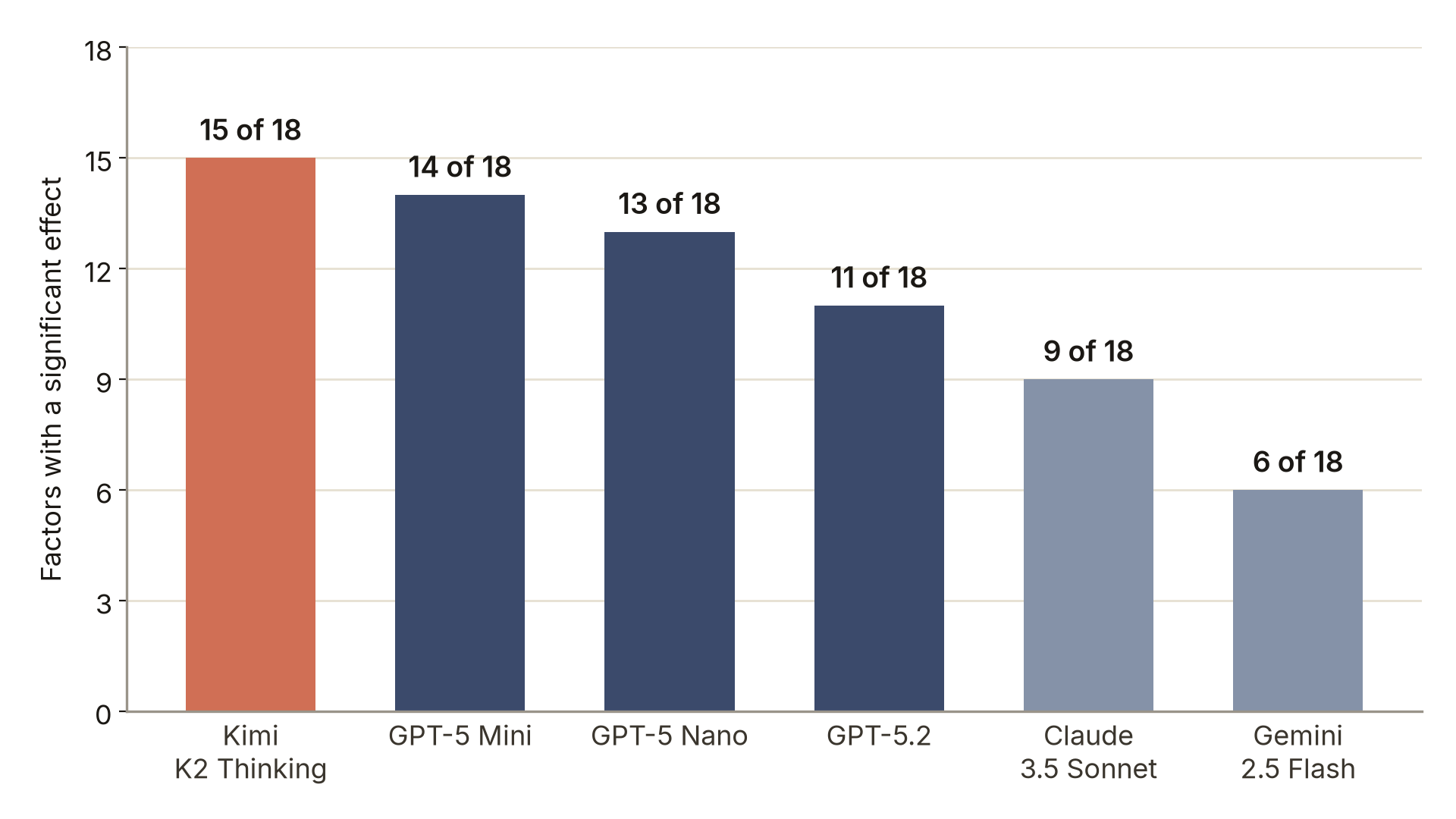
The six models did not react to content changes equally, so we counted how many of the 18 factors reached significance in each one.
Key Findings
- Kimi K2 Thinking was the most sensitive, with 15 of 18 factors significant (83%). Claude 3.5 Sonnet had 9 (50%), and Gemini 2.5 Flash had 6 (33%).
- Gemini and Claude tended to react in an all-or-nothing way: 67% to 78% of their significant factors produced odds ratios above 10,000, which the authors read as something close to a yes-or-no decision rule.
- The three GPT models, from GPT-5 Nano to GPT-5.2, behaved consistently with each other, which the authors take as a sign that model size does not change citation habits much within a model family.
- Despite these differences, all six models agreed on the four gatekeepers, so a brand can fix those without knowing which engine a buyer uses.
The Authors' Checklist for Brands
The paper ends by turning its results into a workflow that a marketing team can run on a real AI answer. The workflow sorts a brand's situation into three cases, and each case points to a different fix and a different team.
| What the team sees in the AI answer | What the authors conclude | What to do |
|---|---|---|
| The brand is the top recommendation | The page is already winning | Recheck when visibility drops, before product launches, and during regular content refreshes |
| The brand's page is cited, but another product is recommended first | The problem is content quality | Content and product teams score the page against the 11 factors that held up in four or more models and fix the weakest first |
| The brand's page is not cited at all | The problem is retrieval | SEO teams work on the page's search ranking |
Key Findings
- For a brand's own pages, the authors advise putting core topic terms early, adding an explicit price and key specifications, including comparisons, keeping dates current, and replacing hedged claims with claims backed by evidence.
- For third-party pages such as independent reviews, they suggest giving reviewers missing data, making independent testing possible, and supporting side-by-side comparison articles, with PR and partnerships teams owning that outreach.
- Their example of a weak page describes a fitness tracker's battery life and offline maps and then says "Contact us for pricing details." The workflow flags a missing price, missing specifications, and a weaker value proposition.
- The quickest fixes are usually editorial: add concrete pricing, update dates, and close keyword gaps. Specification tables and fuller comparisons come next, and formatting changes come last.
Limits the Authors Note
- Each trial gave the model exactly two sources. Production AI search often retrieves five to ten or more pages, so the results describe which of two pages wins, and a larger set of competing pages could change the picture.
- All brands and publishers were replaced with invented names. Real answer engines may still favor trusted websites and well-known brands, and the authors propose a follow-up that swaps in matched real brands to measure that effect.
- GPT-4o gathered the seed articles, replaced the brand names, and wrote the paired versions. The authors reviewed a sample by hand to check that each pair differed in only one factor.
- All 100 seed articles were consumer product reviews. The authors plan to extend the work to larger sets of candidate pages, answers with several citation slots, and full search and recommendation systems.
What This Means for Brands in 2027 and Beyond
For a brand that wants AI answer engines to cite its pages, this study gives a clear order of work. In every model tested, a page that strayed from the shopper's question, left out its price, or carried an old date lost to a competing page almost every time. Search position carried straight into the answer as well, since the same text lost to itself when it was listed second.
Beyond those basics, specifications, depth, confident and consistent claims, comparisons, and evidence each added smaller gains, while reorganizing a page into sections made no measurable difference in any model. The test used two sources and invented brand names, so an engine weighing many pages and familiar brands may behave differently. Our report on the AI citations drivers paper found a related pattern in live ChatGPT, Gemini, and Perplexity answers, where pages whose titles and paragraphs matched the questions people ask were cited more, and FAQ blocks and schema markup showed no effect once the website was held fixed. Brands that want help applying this kind of research can compare specialist firms in our directory of GEO and AEO agencies.
So if you publish product content for AI search, answer the exact question, state the price and specifications, keep the date current, and back your claims with evidence before you spend time on layout.
Data Collection and Methodology
We read the arXiv version of the paper (2605.25517v1, posted May 25, 2026), which carries the SIGIR 2026 proceedings reference, and took every figure in this article from the paper's text and tables.
Odds ratios come from the paper's table of effect sizes across the six models, and (ns) marks results the paper does not show as significant at p < 0.05. The number of models in which each factor was significant, and the number of factors significant in each model, are counts of the results the paper marks as significant. They match the paper's own totals of 11 factors significant in four or more models and 83%, 50%, and 33% of factors significant for Kimi K2 Thinking, Claude 3.5 Sonnet, and Gemini 2.5 Flash.
Sources
- Top GEO Agencies, The Competitive GEO Paper, Explained, November 2026, New York, New York. Download the data (CSV).
- What Gets Cited: Competitive GEO in AI Answer Engines. Rahul Vishwakarma, Shushant Kumar, and Ratnesh Jamidar. Sprinklr. Proceedings of the 49th International ACM SIGIR Conference on Research and Development in Information Retrieval (SIGIR '26), Melbourne, Australia, July 2026. arXiv 2605.25517. DOI 10.1145/3805712.3808445. PDF.